In sectors where national security, community safety, and public trust are paramount, the hiring process has traditionally been a delicate balancing act. Defense contractors requiring highly vetted analysts and public safety agencies grappling with understaffing face a stark reality: a slow hire isn’t merely an administrative hiccup; it’s a tangible risk. Unfilled critical positions strain existing personnel, jeopardize operational readiness, and in the most severe cases, can directly impact the safety and security of communities. For years, organizations within military, defense, and public safety have implicitly accepted a trade-off, prioritizing rigorous vetting and comprehensive standards over speed. However, this long-held paradigm is being reshaped by technological advancements, particularly in the realm of artificial intelligence, offering a path to accelerate the hiring pipeline without compromising the essential integrity of the selection process.
The inherent tension between the need for speed and the imperative for accuracy is not new. Historically, the cost of a misjudgment in these high-stakes environments far outweighed the inconvenience of protracted hiring timelines. This led to an overreliance on manual, often time-consuming, assessment methods. But this perceived dichotomy between swiftness and thoroughness is increasingly being challenged by innovative tools. Artificial intelligence (AI) interviewing is emerging as a transformative force, enabling defense-adjacent employers and public safety agencies to significantly expedite candidate progression through initial hiring stages. Crucially, this acceleration does not come at the expense of the structured, consistent, and meticulously documented processes these sensitive roles demand. Speed and stringent standards, once viewed as opposing forces, are now finding a unified solution through AI-powered platforms.
The convergence of these challenges across military, defense, and public safety sectors is striking, despite their surface-level differences. Both domains demand an exceptionally high caliber of candidate. For instance, a civilian analyst supporting a defense program must possess immediate expertise, just as a paramedic responding to an emergency requires instant critical thinking and skill. There is little room for on-the-job learning in these roles; the necessary competencies and sound judgment must be present from day one.
Compounding these demands is a pervasive shortage of qualified candidates. Defense and security firms are locked in a fierce competition with the private sector for talent possessing specialized skills and security clearances. Simultaneously, public safety agencies are openly acknowledging a deep-seated recruiting crisis, characterized by shrinking applicant pools and escalating competition for available personnel. In this environment, each day a position remains unfilled represents a potential loss of a highly desirable candidate to a more agile employer.

Furthermore, the hiring processes within these sectors are subject to intense scrutiny. Inconsistent interview practices, a lack of standardized decision-making documentation, and variability in how evaluators assess candidates are not merely poor HR practices; they constitute significant liabilities. Whether facing an audit, a union grievance, or a public records request, the hiring process must be demonstrably defensible and transparent, not just expedient in the moment. It is precisely within this shared landscape of high standards and acute need that AI interviewing demonstrates its significant value, offering a means to compress hiring timelines without sacrificing essential rigor.
The Dual Demands of Defense and Civilian Support Roles
Within the defense sector, civilian roles encompassing analysts, program support specialists, logistics personnel, and positions requiring security clearances operate at a particularly critical intersection. The imperative to fill these roles swiftly is driven by the need to maintain program continuity and ensure mission success. Concurrently, the hiring process must adhere to stringent compliance and audit requirements. Inconsistency in candidate evaluation can easily become a finding in an audit, highlighting procedural weaknesses.
AI interviewing fundamentally alters this dynamic. By employing a structured, role-relevant set of questions for every candidate, and scoring them against a uniform rubric, it eradicates evaluator-dependent variations. This ensures that a candidate’s progression or rejection is based on objective criteria, not the subjective biases of individual recruiters. Crucially, the process eliminates documentation gaps that can arise from manual interview loops.
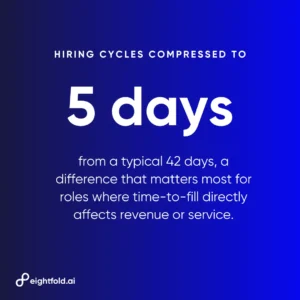
Moreover, AI interviewing liberates the initial screening from the constraints of scheduling availability. Candidates can engage in the interview process shortly after applying, rather than waiting for a recruiter’s calendar to align. This dramatically accelerates the initial assessment, providing hiring teams with structured summaries and scores within hours, rather than weeks.
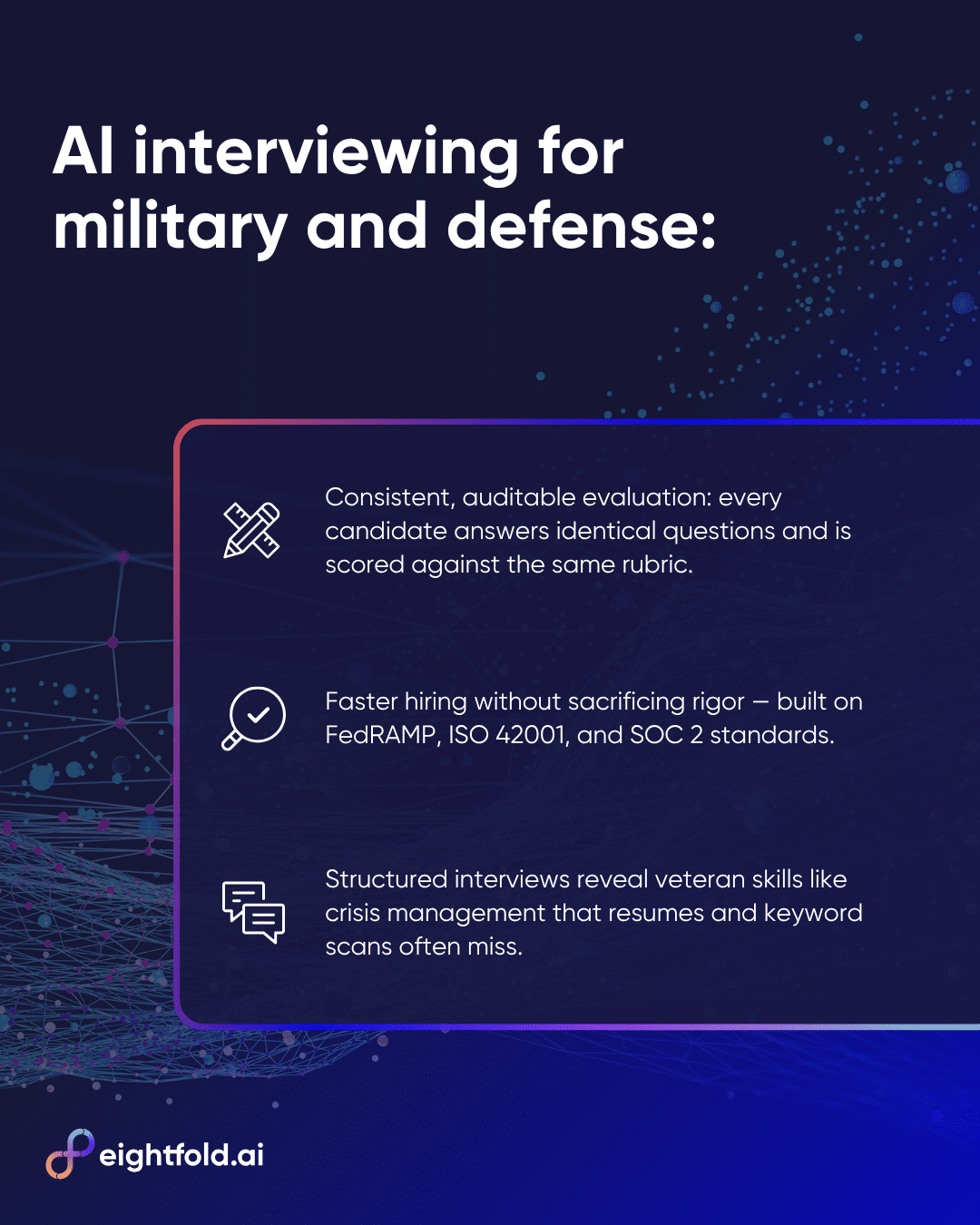
The impact of this technology is already evident. Constellis, a global leader in defense and security services, faced the challenge of filling a high volume of security roles while maintaining the industry-standard compliance rigor and audit trails. They successfully leveraged Eightfold AI’s Interviewer to meet these demands. The platform’s robust infrastructure, which includes FedRAMP Moderate and ISO 42001 compliance alongside SOC 2 certification, is particularly relevant for organizations accountable for candidate data handling and hiring decision transparency. This adherence to stringent security and compliance standards is a critical differentiator for entities operating within regulated environments.

Notably, Eightfold’s Talent Intelligence Platform is already a trusted solution for organizations like the U.S. Department of Defense, underscoring its suitability for mission-critical, high-compliance hiring. This is not a general-purpose tool adapted for defense needs; it is a platform engineered from its inception with the exacting requirements of such sectors in mind.
An additional significant benefit of AI interviewing in the defense context lies in its capacity to effectively translate military experience into civilian job requirements. Skills such as crisis management, structured decision-making under pressure, and team leadership, which may be understated or overlooked in traditional résumés formatted with military job titles, can be effectively surfaced through a well-designed AI interview. By focusing on behavioral competencies and situational judgment rather than mere keyword matching, AI interviewing can transform transitioning service members and veterans into more visible and competitive candidates.
Addressing the Public Safety Recruiting Crisis
Public safety agencies, including police, fire departments, and emergency medical services (EMS), are confronting a hiring crisis that has been steadily escalating for years. Many departments operate with staffing levels insufficient to meet community needs, compounded by the physically and emotionally demanding nature of the work, which inherently narrows the pool of potential applicants. Every week an emergency service role remains vacant translates into increased strain on existing personnel.
In this demanding environment, speed is not merely an advantage; it is a competitive necessity. Public safety agencies increasingly find themselves vying for talent with private sector employers, and a candidate who faces weeks of delay before a first-round interview is highly likely to accept an offer elsewhere.
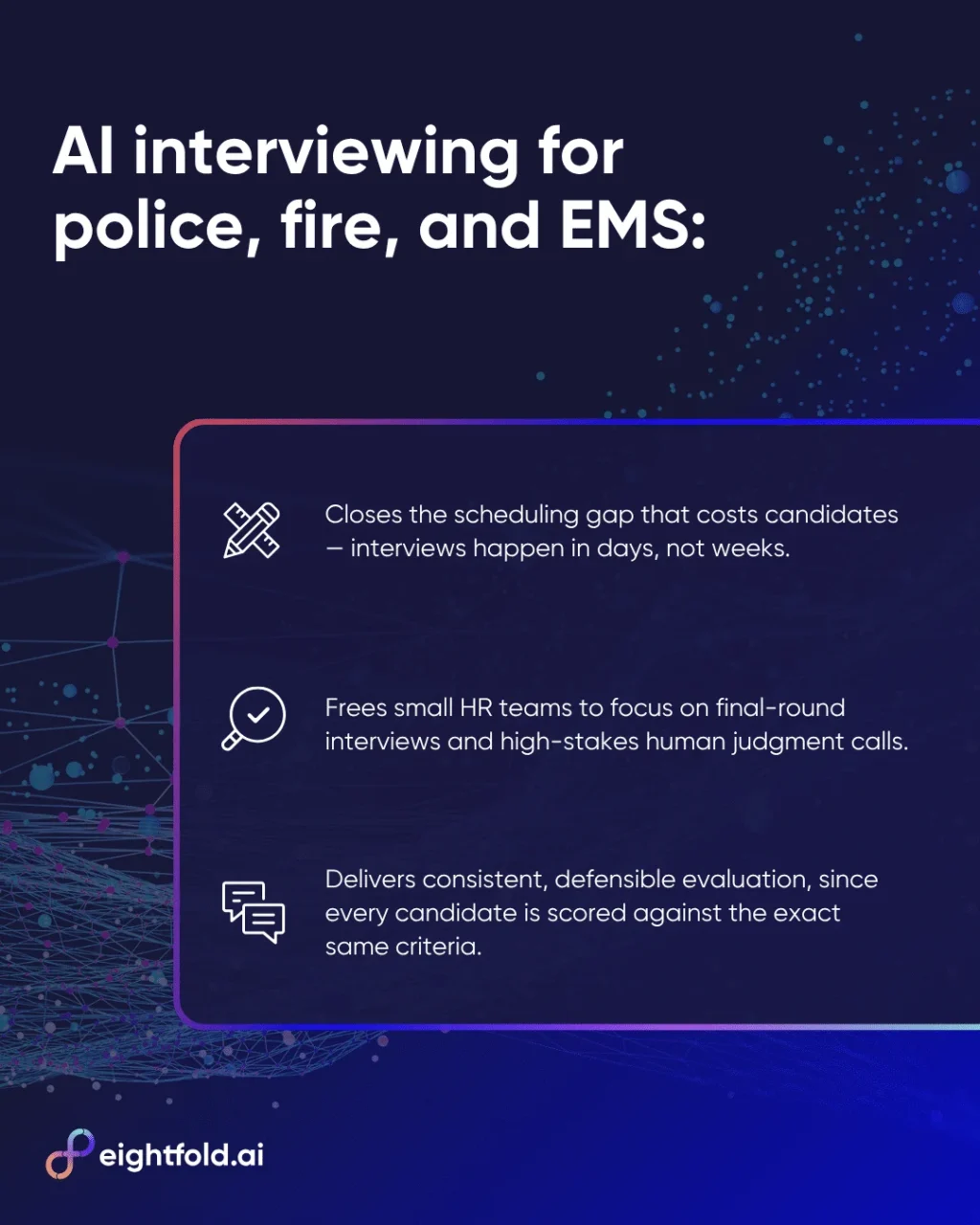
AI interviewing directly addresses this bottleneck by streamlining early-stage candidate screening. Instead of waiting for recruiter availability, candidates can complete a structured interview within days of applying. This allows hiring teams to identify and advance qualified candidates with unprecedented alacrity.
The importance of consistency cannot be overstated in public safety hiring. In roles where a hiring error can have profound consequences for public trust and physical safety, every candidate must be assessed against the same objective criteria. AI interviewing provides a standardized, defensible foundation for hiring decisions. This frees up limited HR and recruiting resources to focus on the final stages of the process, where human judgment and interpersonal assessment are indispensable and cannot be automated.
The Evolving Landscape of High-Stakes Hiring
The traditional hiring paradigms in military, defense, and public safety sectors have long been governed by a critical constraint: these organizations cannot afford to sacrifice either speed or accuracy. For an extended period, this meant accepting slow, manual processes as an unavoidable cost of maintaining rigorous standards. However, this trade-off is no longer a fixed reality.
AI interviewing presents a paradigm shift, empowering these sectors to screen candidates more rapidly, with greater consistency, and enhanced transparency than manual methods could ever achieve. The perceived choice between speed and stringent standards is dissolving. Organizations that recognize and embrace this evolution will be positioned to fill vital roles efficiently, gaining a significant advantage over their more traditional counterparts who remain mired in protracted, manual recruitment processes.
For agencies and organizations considering the integration of AI interviewing into their hiring strategies, a comprehensive evaluation of its potential benefits is essential. By offering a robust solution for mission-critical, high-compliance hiring, AI interviewing promises to redefine efficiency and effectiveness in sectors where the stakes are exceptionally high.