In an increasingly competitive global talent market, the phenomenon of candidate reneging—where an accepted job offer is subsequently withdrawn by the candidate—has become a significant challenge for organizations across all sectors. This disruptive trend, which often leaves companies scrambling to fill critical roles, highlights a fundamental flaw in traditional post-offer talent acquisition processes. Historically, many recruitment programs have operated without a structured mechanism to monitor candidate engagement during the crucial pre-start period, often discovering a renege only after the decision has been irrevocably made. By the time a candidate falls silent or communication ceases, their intent to withdraw has frequently solidified, leaving employers in a reactive, disadvantageous position.
The prevailing solution emerging from leading talent acquisition strategists advocates for a paradigm shift: treating engagement signals not as incidental observations, but as critical leading indicators of a candidate’s commitment and satisfaction. This proactive approach aims to identify and address potential issues before they escalate into an offer withdrawal, thereby safeguarding talent pipelines and minimizing operational disruptions.
The Escalating Challenge of Candidate Reneging
The modern talent landscape is characterized by several factors that exacerbate the problem of offer reneging. A persistently tight labor market, particularly for specialized skills in technology, healthcare, and engineering, means that top-tier candidates often receive multiple competing offers. The proliferation of remote work opportunities has further broadened candidates’ choices, allowing them to consider roles irrespective of geographical location. This environment empowers candidates to be highly selective, and a lack of sustained engagement from an employer can easily be interpreted as a lack of interest or a disorganised onboarding process, pushing them towards more attentive competitors.
The financial implications of candidate reneging are substantial. Industry reports suggest that the average cost of a reneged offer can range from $10,000 to $30,000 for mid-level positions, a figure that can skyrocket for senior or highly specialized roles. These costs encompass not only the direct expenses of re-recruiting (advertising, recruiter time, background checks, drug screenings) but also the indirect costs associated with lost productivity, delayed project timelines, increased workload for existing team members, and the potential damage to team morale. Furthermore, a high renege rate can subtly erode an organization’s employer brand, making it harder to attract top talent in the future. The reputation of being an employer where candidates frequently withdraw offers can circulate through professional networks, impacting recruitment efforts long-term.
The Shift from Reactive to Proactive Engagement
For decades, the standard practice in talent acquisition often ended with an offer letter. Once accepted, candidates were typically left to their own devices until their official start date, with only sporadic, generic communications. This "set it and forget it" mentality was a major vulnerability, creating an engagement vacuum that competing offers or personal uncertainties could easily exploit.
The recognition of this vulnerability has spurred an evolution in talent management strategies. Progressive organizations are now focusing intensely on the "pre-start period"—the critical weeks or months between offer acceptance and the first day of employment. This period is no longer seen as a passive waiting game but as a crucial window for nurturing the candidate relationship, reinforcing their decision, and integrating them into the company culture even before they formally begin. The advent of sophisticated HR technology and data analytics platforms has made this proactive approach not just desirable, but entirely feasible. These platforms enable organizations to track candidate interactions, analyze engagement patterns, and intervene strategically.
Understanding the Engagement Health Scorecard
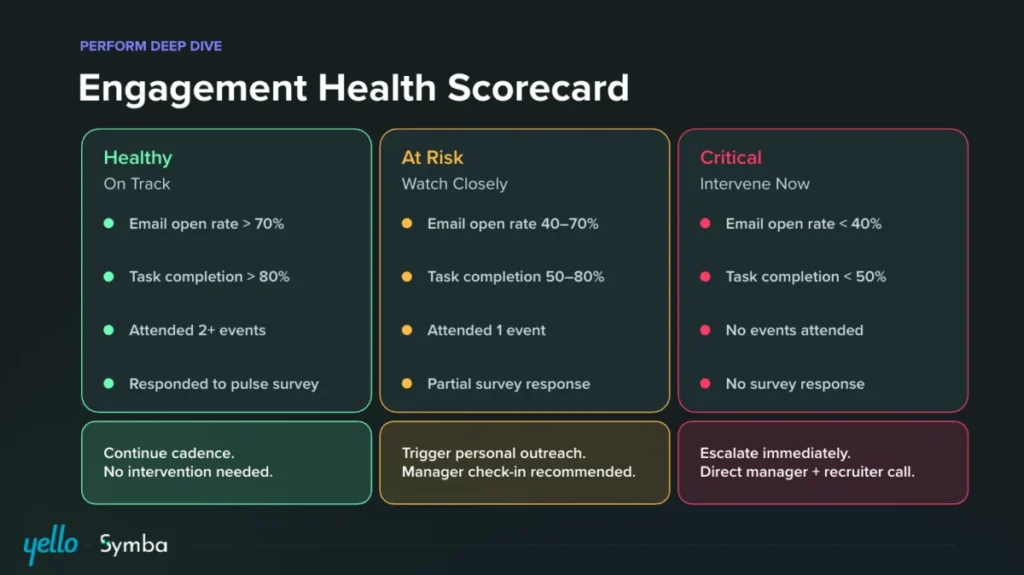
At the core of this proactive strategy is the implementation of an Engagement Health Scorecard, a systematic framework designed to continuously monitor and categorize candidates based on their pre-start behavior. This scorecard leverages various data points to assign candidates to one of three distinct tiers, each signaling a different level of engagement and requiring a specific intervention strategy.
1. Healthy Candidates:
These candidates exhibit robust and consistent engagement signals, indicating a strong commitment to their new role and the organization. Key indicators include:
- Email Open Rates: Consistently above 70%, demonstrating active consumption of pre-onboarding communications.
- Task Completion: Prompt and thorough completion of all assigned pre-start tasks (e.g., submitting paperwork, accessing portals).
- Event Attendance: Active participation in multiple virtual or in-person pre-onboarding events (e.g., meet-and-greets, webinars, informational sessions).
- Survey Responses: Timely and comprehensive responses to any pre-start surveys or feedback requests.
For healthy candidates, the recommended action is to "continue the cadence and stay the course." This involves maintaining the established communication schedule, reinforcing positive messaging, and ensuring a seamless, positive experience leading up to their start date. The goal is to sustain their enthusiasm and commitment, validating their decision to join.
2. At-Risk Candidates:
Candidates in this category display early warning signs of declining engagement, suggesting a potential wavering in their commitment. These signals, while not yet critical, warrant immediate attention. Indicators often include:
- Email Open Rates: A noticeable decline, typically between 40% and 70%, suggesting less attention to communications.
- Limited Event Attendance: Sporadic or no attendance at optional pre-onboarding events.
- Incomplete Survey Responses: Partial or delayed responses to surveys, or a complete lack of engagement with feedback mechanisms.
- Reduced Activity: Less frequent logins to candidate portals or slower completion of administrative tasks.
When a candidate falls into the "At-Risk" tier, personal outreach within 48 hours is critical. This intervention should be tailored and feel individual rather than mass-distributed. Effective actions include:
- Direct Message from the Program Manager: A personalized email or message from the hiring manager or future team lead, expressing excitement for their arrival and offering to answer any questions.
- Personalized Event Invitation: An invitation to an upcoming event that is specifically extended to them, highlighting its relevance to their interests or role.
- Hiring Manager Check-in: A brief, informal call from the hiring manager to simply touch base, reiterate excitement, and open a channel for conversation. These personalized touches can often quickly re-engage candidates and address nascent concerns.
3. Critical Candidates:
This tier represents the most urgent situation, where candidates show almost no engagement, indicating a high probability of reneging. These are often candidates who have already made up their minds or are on the verge of doing so. Signals include:
- Email Open Rates: Consistently below 40%, or no opens at all, signifying disengagement from official communications.
- No Events Attended: Complete absence from all pre-onboarding events.
- No Survey Responses: A total lack of participation in any feedback or informational surveys.
- No Activity: Zero engagement with candidate portals, or a complete cessation of activity for three or more weeks.
For critical candidates, immediate escalation and direct, high-level intervention are required. This is a salvage operation, often the last chance to prevent a renege. Recommended actions include:
- Direct Call from the Hiring Manager: A personal, empathetic phone call from the hiring manager, not to demand answers, but to genuinely inquire about their well-being and any potential concerns.
- Personal Touchpoint from the Recruiter: A senior recruiter should also reach out, offering support and a confidential channel to discuss any issues.
- Real Conversation: The aim is to uncover the root cause of their disengagement. Often, the issue might be a competing offer, a personal circumstance (e.g., family relocation, health concern), or simple uncertainty about the role or company culture. Catching these issues in time allows the organization to potentially address them, whether through negotiating terms, offering flexibility, or providing additional information and reassurance.
The Data-Driven Advantage: Leading Indicators in Talent Acquisition
The fundamental difference between organizations that successfully retain accepted candidates and those that are constantly scrambling to backfill roles lies in their approach to data. The first group continuously monitors engagement data, recognizing that metrics like email open rates, task completion, and event attendance are powerful leading indicators. They don’t wait for a renege email—which is a lagging indicator, signifying a problem that has already occurred—but instead use real-time data to predict and prevent.
This data-driven methodology aligns with broader trends in predictive analytics within human resources. By identifying patterns in candidate behavior, organizations can refine their pre-onboarding strategies, making them more effective and personalized. For instance, an analysis might reveal that candidates in certain roles or demographics are more prone to becoming "At-Risk" if they don’t receive a personalized call within two weeks of offer acceptance. Such insights allow for continuous improvement of the engagement process. Studies indicate that organizations that implement sophisticated, data-driven candidate engagement models can significantly reduce their renege rate, with some reports suggesting reductions of 25-40%, leading to substantial cost savings and operational stability.
Industry Perspectives and Expert Commentary
"The shift towards proactive engagement isn’t merely about preventing a candidate from walking away; it’s about fundamentally reshaping the candidate experience and reinforcing the employer’s value proposition," states Dr. Evelyn Reed, a leading HR technology analyst. "Companies that master this will not only secure their talent but also build a more resilient and attractive employer brand in the long run. It’s moving from a transactional offer-acceptance model to a relational pre-onboarding journey."
A spokesperson for Yello, a prominent talent acquisition platform provider, commented on the significance of structured engagement: "Our KEEP Playbook is designed to empower organizations to move beyond guesswork. It provides a structured framework to nurture candidates from offer acceptance through to their first day, ensuring they feel connected, valued, and fully prepared. Before implementing a structured engagement strategy, many of our clients felt blindsided by reneges. Now, they have clear signals and actionable steps, transforming their pre-onboarding into a strategic competitive advantage."
Ms. Anya Sharma, VP of Talent Acquisition at a major tech firm, shared her experience: "Prior to adopting a proactive engagement scorecard, our renege rate was a constant source of frustration and budget drain. We were always reacting. Implementing a system like the Engagement Health Scorecard provided us with foresight. We can now identify and intervene with ‘At-Risk’ candidates, often salvaging what would have been a lost hire. It has not only reduced our backfill costs but also significantly improved our new hire retention rates, as candidates arrive feeling more integrated and supported."
Broader Implications and Strategic Imperatives
The implications of adopting a proactive candidate engagement strategy extend far beyond simply preventing reneges. This approach fundamentally transforms several aspects of talent management:
- Enhanced Candidate Experience: A meticulously managed pre-start period signals a highly organized, caring, and professional employer. This positive experience, regardless of the ultimate outcome, contributes positively to the company’s reputation.
- Strengthened Employer Brand: Organizations known for their robust and personalized pre-onboarding processes become magnets for top talent. Word-of-mouth and online reviews from candidates who felt valued and engaged can significantly boost recruitment efforts.
- Improved Onboarding Success and Time-to-Productivity: Candidates who arrive on day one feeling informed, connected, and supported are more likely to be productive faster. They have a clearer understanding of their role, team, and company culture, leading to higher job satisfaction and lower early attrition.
- Cost Efficiency and Resource Optimization: Preventing a renege is demonstrably more cost-effective than initiating an entirely new recruitment cycle. Resources that would have been spent on re-advertising, re-interviewing, and re-screening can be reallocated to other strategic HR initiatives.
- Competitive Advantage: In a fiercely competitive market, a superior candidate engagement strategy serves as a critical differentiator. It allows organizations to not only attract but also secure the talent necessary for innovation and growth.
- Future of Talent Management: This model is rapidly becoming standard practice, pushing talent acquisition beyond mere hiring to encompass comprehensive talent nurturing and relationship building. It underscores a strategic shift where human capital is recognized as the most vital asset, warranting continuous investment and care from the moment of initial contact through long-term employment.
Resources such as "The KEEP Playbook," mentioned in the original content, provide comprehensive guidance for organizations looking to implement such a system. It typically includes the full engagement health scorecard with specific thresholds, a step-by-step intervention playbook for each tier, and a post-cycle review template to facilitate continuous improvement with every recruitment program. By embracing these proactive strategies, organizations can transform the challenge of candidate reneging into an opportunity to build stronger relationships, secure top talent, and establish a resilient workforce for the future.