The Evolution of Instructional Design: A Historical Context
The discipline of instructional design has its roots in the mid-20th century, specifically during World War II when the United States military required a systematic method for training thousands of personnel quickly and effectively. This era saw the birth of instructional systems design (ISD), which applied psychological principles of learning to military training modules. By the 1950s and 60s, educational psychologists like B.F. Skinner and Robert Gagné further refined these concepts, introducing programmed instruction and the "Nine Events of Instruction."
The 1970s brought the development of the ADDIE model (Analysis, Design, Development, Implementation, and Evaluation), which remains the foundational framework for the industry today. However, the true paradigm shift occurred with the advent of the internet in the 1990s and early 2000s, which gave rise to e-learning. The recent global pandemic acted as a further catalyst, forcing a wholesale migration of traditional education and corporate training to digital platforms. This historical trajectory explains why today’s certificate programs emphasize agility, digital literacy, and user experience (UX) design over purely academic theory.
Distinguishing Between Certificates and Certifications
In the professional landscape, the terms "certificate" and "certification" are frequently used interchangeably, yet they represent distinct milestones. An Instructional Design certificate is an educational program designed to teach new skills. It is a process of learning where the participant completes a curriculum to gain specific knowledge in areas such as adult learning theory, storyboarding, and authoring tools.
In contrast, a certification is a professional designation awarded to those who have already demonstrated a specific level of expertise, often through standardized testing or a rigorous review of work experience. For example, the Association for Talent Development (ATD) offers the Certified Professional in Talent Development (CPTD) as a certification for seasoned professionals. For those entering the field or seeking to modernize their toolkit, a certificate program is often the more appropriate path, as it focuses on building the portfolio and practical skills necessary to perform the job.
Market Trends and Supporting Data
The growth of the instructional design sector is reflected in global economic data. According to market research, the global e-learning market is projected to surpass $460 billion by 2026. This growth is driven by the corporate sector’s need for continuous upskilling. A 2023 report from the LinkedIn Learning "State of L&D" indicated that 89% of L&D professionals agree that proactively building employee skills will help navigate the evolving future of work.
Furthermore, the U.S. Bureau of Labor Statistics projects that the employment of training and development specialists—a category that includes instructional designers—will grow by 6% to 10% through 2032, faster than the average for all occupations. This demand is particularly high in the technology, healthcare, and finance sectors, where regulatory changes and rapid innovation require constant personnel training.
Core Curricula: What Modern Programs Offer
Modern instructional design certificate programs have moved beyond the basics of lesson planning. They now offer a comprehensive blend of learning science and technical proficiency.
1. Learning Needs Analysis (LNA):
Instructional design begins with identifying a performance gap. Programs teach students how to conduct stakeholder interviews and analyze data to determine if a problem can be solved by training or if it requires a different organizational intervention.
2. Adult Learning Theory (Andragogy):
Understanding how adults learn is fundamental. Programs delve into Malcolm Knowles’ principles of andragogy, emphasizing that adult learners are self-directed, bring prior experience to the table, and are motivated by internal factors and immediate relevancy.
3. Advanced Instructional Models:
While ADDIE remains a staple, contemporary programs introduce the Successive Approximation Model (SAM) and Agile methodologies. These iterative processes allow designers to create prototypes quickly, gather feedback, and make adjustments in real-time, which is essential in fast-paced corporate environments.

4. Emerging Technologies and Generative AI:
A significant addition to 2024-2025 curricula is the integration of AI-powered learning tools. Designers are now learning to use generative AI for rapid content creation, automated storyboarding, and personalizing learning paths at scale. This technical enrichment ensures that designers can maintain high standards while increasing efficiency.
Sector-Specific Applications: Who Benefits Most?
The versatility of an instructional design certificate makes it an attractive credential across various professional backgrounds.
Transitioning Educators:
K-12 and higher education teachers often find their skills highly transferable to the corporate sector. However, the transition requires a shift from "teaching for knowledge" to "designing for performance." A certificate program helps these professionals bridge that gap by teaching them corporate-standard tools like Articulate Storyline or Adobe Captivate.
HR and Talent Development Leaders:
For those already in human resources, an ID certificate provides the strategic framework to align employee development with the company’s bottom line. It allows HR leaders to speak the language of "learning ROI" and data-driven performance.
Corporate Trainers:
Traditional trainers who are accustomed to "sage on the stage" delivery use these programs to transition into "guide on the side" digital facilitators. They learn to design asynchronous modules that can reach a global workforce without the need for travel or synchronous sessions.
Evaluating Program Quality: A Newsroom Perspective
With the proliferation of online "boot camps" and university offerings, quality control is a primary concern for prospective students. Industry analysts suggest that a high-value program should be evaluated based on three pillars:
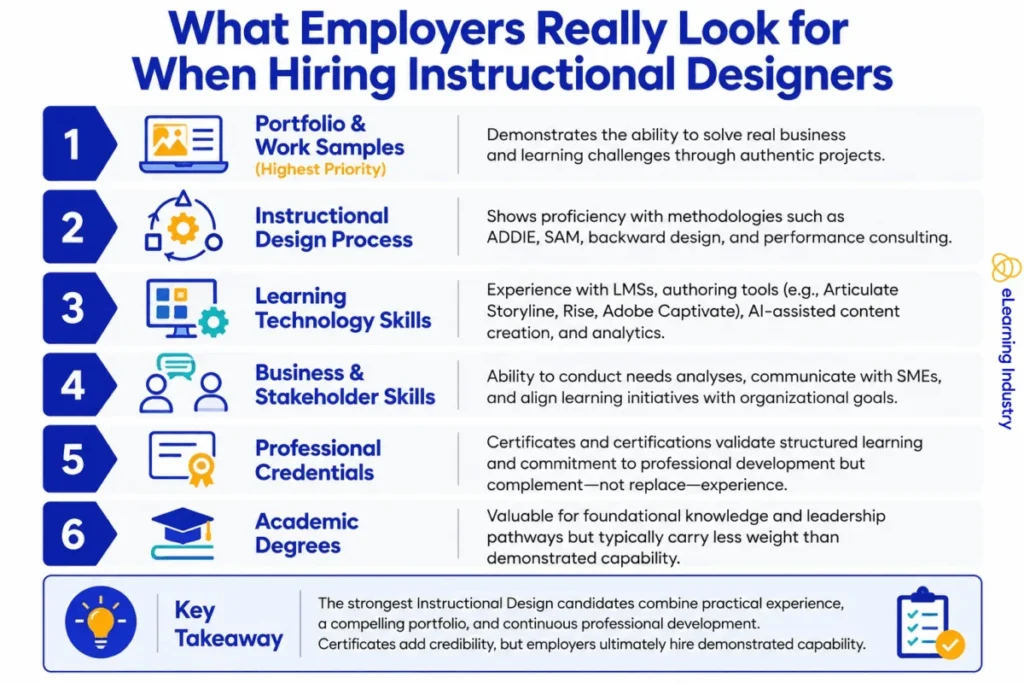
- Portfolio Development: Does the program require the completion of a "capstone project" or a professional portfolio? In the current job market, a portfolio of work is often more influential than a degree.
- Industry Recognition: Is the program backed by a reputable university or a recognized professional body like ATD or the International Society for Performance Improvement (ISPI)?
- Technological Access: Does the program provide hands-on experience with industry-standard authoring tools and Learning Management Systems (LMS)?
Official Responses and Industry Sentiment
Industry leaders emphasize that the value of the certificate lies in its ability to produce "job-ready" candidates. In a recent industry panel, L&D executives noted that they are increasingly looking for "T-shaped professionals"—those with deep expertise in instructional design (the vertical bar) and a broad understanding of business operations and technology (the horizontal bar).
"The credential is the signal, but the skill is the substance," noted one Chief Learning Officer during a 2024 talent summit. This sentiment reflects a broader shift in the corporate world toward skills-based hiring, where demonstrated ability often takes precedence over traditional academic pedigree.
Broader Impact and Future Implications
The rise of instructional design certificates has broader implications for the democratization of education. As high-quality training becomes more accessible through these programs, the barrier to entry for high-paying corporate roles is lowered for individuals from diverse backgrounds.
Furthermore, as AI continues to automate the more routine aspects of content creation, the role of the instructional designer is evolving into that of a "learning architect" or "experience designer." Future certificate programs are likely to focus even more heavily on data analytics, behavioral psychology, and the ethical implementation of AI in training.
In conclusion, an instructional design certificate is no longer just an optional add-on for the curious educator. It has become a vital credential for anyone serious about the future of workplace performance. By combining the rigor of learning science with the agility of modern technology, these programs prepare professionals to meet the challenges of a world where the only constant is change. Organizations that employ certified designers benefit from more engaged employees, more efficient onboarding, and a more resilient workforce, ultimately driving long-term success in an increasingly competitive global market.