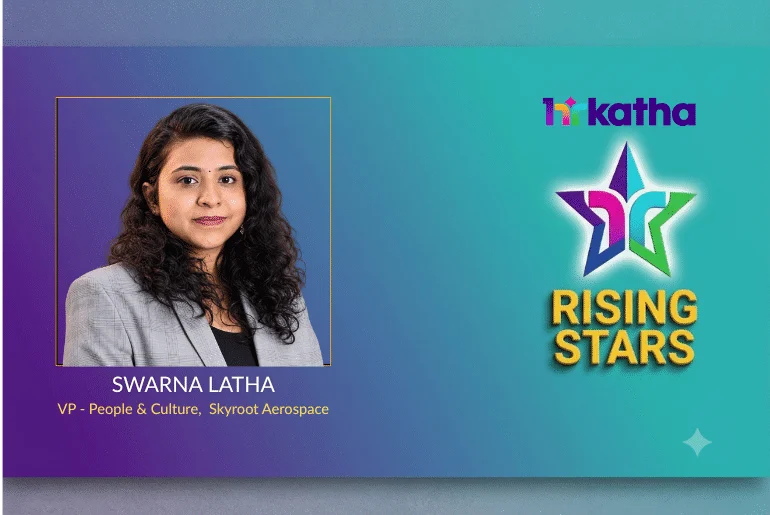
Swarna Latha Buravalli, a prominent figure in human resources, has carved a unique trajectory, culminating in her pivotal role as an HR leader at Skyroot Aerospace. Her early aspirations of a scientific career were rerouted by the responsibilities of early marriage and motherhood, guiding her professional path into the dynamic field of human resources. Today, her journey reveals an unexpected symmetry, as she collaborates closely with the engineers and scientists at Skyroot Aerospace, an organization at the forefront of India’s burgeoning private space ambitions. In this high-stakes environment, Buravalli is not merely managing people; she is meticulously shaping the organizational ecosystem that empowers these innovators to push the boundaries of space technology.
The Crucible of Aerospace: Redefining HR Rigour
Buravalli’s experience within Skyroot Aerospace has profoundly influenced her perspective on the very essence of human resources. The highly iterative and exacting nature of aerospace engineering, where components are refined repeatedly until they meet stringent standards, has become a powerful metaphor for her approach to people systems. "This changes how you think about people systems," she observes, reflecting on the pervasive culture of precision that permeates the company.
This engineering discipline, she explains, is not about mechanizing human interactions but about instilling a foundational rigour in HR frameworks. She has meticulously applied this principle to critical areas such as role design, competency models, and levelling architecture. Her motivation stems from a fundamental belief that just as ambiguity in rocket components can lead to catastrophic failures, imprecision in people systems can result in significant, costly inefficiencies down the line. For Buravalli, rigour is not an impediment to speed; rather, when executed thoughtfully, it is the very mechanism that enables an organization to move with agility, minimizing the need for constant, costly rectifications that could have been avoided with earlier, more thorough consideration. This philosophy resonates deeply within the aerospace sector, where the margin for error is often exceptionally small, and the consequences of oversight can be profound.
Influence Without Authority: The Credibility Imperative for HR Leaders
A cornerstone of Buravalli’s HR philosophy is her concise definition of HR leadership: "influence without authority." This concept underscores a critical reality for HR professionals, particularly in agile, high-growth environments like Skyroot. Many strategic decisions that HR aims to shape—such as leadership styles, resource allocation, and shifting organizational priorities—ultimately rest with business leaders, not HR. Consequently, formal authority provides an HR leader with only limited leverage. True impact, Buravalli argues, is built entirely on credibility.
To cultivate this essential credibility, Buravalli strongly advocates for younger HR professionals to immerse themselves deeply in the core business operations. This involves understanding the company’s revenue model, dissecting its product roadmap, recognizing operational constraints, and grasping the most pressing challenges occupying the attention of its leadership. Only by acquiring such comprehensive business acumen, she contends, can HR recommendations transcend mere ancillary suggestions and become integral components of strategic business conversations. The objective extends beyond simply mastering the industry’s jargon; it is about developing a sufficiently profound understanding of organizational problems to contribute meaningfully to their resolution, thereby establishing HR as a strategic partner rather than a purely administrative function.
The Indian Space Sector: A Backdrop of Rapid Expansion
Skyroot Aerospace operates within an exhilarating and rapidly expanding landscape: India’s private space sector. For decades, the Indian Space Research Organisation (ISRO) held a monopoly over space activities. However, recent policy reforms, notably the establishment of IN-SPACe (Indian National Space Promotion and Authorisation Centre) in 2020, have opened the doors for private participation, ushering in a new era of innovation and investment. This deregulation has led to a proliferation of startups like Skyroot, which made history in November 2022 by launching India’s first privately developed rocket, Vikram-S, marking a pivotal moment for the nation’s space capabilities.
This burgeoning sector is characterized by intense competition, rapid technological advancements, and a constant drive for innovation. Companies like Skyroot are not just building rockets; they are building entire ecosystems, attracting top talent, and pioneering new operational models. The workforce in this sector is typically young, highly skilled, and deeply passionate, often operating under immense pressure and with ambitious timelines. In this context, effective human resources management becomes not just a support function but a strategic enabler, crucial for attracting, retaining, and developing the talent necessary to achieve audacious goals. Buravalli’s work at Skyroot is therefore not merely an internal HR success story but a blueprint for managing human capital in a frontier industry poised for exponential growth. Industry analysts frequently highlight the pivotal role of robust human resources frameworks in high-growth technology sectors, particularly in mission-critical fields like aerospace, where specialized talent is scarce and retention is paramount.
The AI Revolution: Reshaping HR Expertise
Buravalli recognizes that Artificial Intelligence (AI) is poised to fundamentally transform HR, extending far beyond merely accelerating existing processes. She points to a dramatic shift in productivity: a year ago, her team would dedicate considerable time to drafting initial versions of job descriptions, competency frameworks, or policy documents. Today, generative AI tools can compress much of this foundational work into mere minutes. This rapid automation, she argues, fundamentally redefines where true value and expertise reside within HR.
With AI handling the preliminary drafts, the premium now shifts to the human capabilities that surround this initial output: the ability to formulate the precise questions, discern critical missing information, comprehend nuanced contextual factors, and exercise astute judgment over the AI-generated content. These skills – critical thinking, contextual understanding, and ethical oversight – become paramount.
Buravalli posits that certain capabilities traditionally associated with a strong HR generalist, such as efficient process execution, meticulous documentation, and consistent application of frameworks, are increasingly being augmented or even taken over by technology. This evolution, she believes, places a significantly greater emphasis on higher-order cognitive functions within the HR profession: critical thinking, nuanced contextual judgment, and the adeptness to navigate ambiguity. "We’re actively rethinking what we hire for, what we develop, and how we describe value-add within the HR function itself," she states, highlighting a proactive re-evaluation of the HR talent model.
Crucially, Buravalli’s team operates under a principle of "AI literacy" rather than mere "AI adoption." This distinction is deliberate and profound. Adoption, she explains, simply asks whether individuals are utilizing a tool. Literacy, however, delves deeper, querying whether users genuinely comprehend the tool’s capabilities, can critically evaluate its outputs, understand when to place trust in its recommendations, and, equally important, when to challenge or override them. This discerning approach ensures that AI serves as a powerful assistant rather than an unchallenged authority.
Skyroot’s HR team is actively experimenting with a range of AI-assisted applications, including job design, structured interview frameworks, and early-stage skills mapping. However, Buravalli draws a firm and clear boundary around the realm of human judgment. While AI excels at surfacing patterns and accelerating data analysis, decisions concerning people, she insists, unequivocally demand human accountability. This boundary, she firmly believes, is most critical precisely when technological advancements make it most tempting to blur. Her insights into AI literacy align with broader industry trends, where a 2023 report by Gartner indicated that only 29% of HR leaders felt their teams were adequately prepared for the impact of AI, underscoring the foresight of Skyroot’s approach.
Scaling with Standards: Preserving Agility in Growth
One of Buravalli’s most significant achievements at Skyroot Aerospace is her instrumental role in scaling the organization from approximately 300 employees to over 1,000, all while striving to preserve the intrinsic speed, ownership culture, and high standards that characterized the smaller, earlier-stage company. This expansion, particularly within a span of just a few years, presents immense organizational challenges for any high-growth startup.
The sheer numbers carry profound implications. With an average employee age around 28, Skyroot commands a predominantly young workforce engaged in developing cutting-edge aerospace technology—a field where the final margin for error is exceptionally small. This unique organizational reality necessitated that the supporting people systems be custom-built, reflecting Skyroot’s specific operational context rather than merely replicating generic practices borrowed from more mature or slower-moving industries. Consequently, the company’s onboarding processes, manager capability development programs, and ownership structures all had to undergo significant evolution and adaptation as the company surged in size.
This experience powerfully reinforced Buravalli’s conviction in what she terms a "first-time-right" mindset. This is not the unrealistic expectation that failures will never occur; rather, it represents the rigorous discipline of undertaking all necessary intellectual groundwork, thorough preparation, and meticulous checking before any consequential action is initiated. In this sense, she argues, thoroughness should never be conflated with bureaucracy. Instead, it is an integral component of how organizational speed becomes truly sustainable, especially in an industry where mission success hinges on absolute precision. Data from the Indian startup ecosystem shows that companies scaling rapidly often face significant challenges in maintaining culture and operational efficiency, making Skyroot’s achievement a notable benchmark.
The Art of Sequencing: When Timing Outweighs Design
Despite her unwavering commitment to rigour, Buravalli learned a crucial lesson about the limitations of even the most well-designed HR initiatives: rigour alone does not guarantee adoption. This insight crystallized during the introduction of a structured assessment framework, an initiative she firmly believed was genuinely necessary for the organization’s maturity. While the framework itself was meticulously conceived and thoughtfully designed, its adoption proved slower than anticipated.
The reasons for this became clearer when she stepped back to consider the broader organizational context. Skyroot was experiencing extraordinary growth, with teams operating at full capacity, and managerial attention already heavily consumed by the demands of execution. In such an environment, a new assessment framework, however intrinsically valuable, was competing for a finite resource—managerial bandwidth—that the organization simply did not possess at that moment. The problem, she concluded, was not necessarily with the design of the framework; the timing was the critical misjudgment.
For Buravalli, this experience became an invaluable lesson in the strategic sequencing of HR interventions. HR professionals can accurately identify an organization’s needs but still miscalculate the optimal moment for the organization to absorb and implement new initiatives. Every new people initiative, she emphasizes, incurs an opportunity cost in terms of managerial attention and organizational energy. Therefore, HR must earn its place within the established rhythm of the business rather than assume that a good idea automatically merits immediate adoption. Sometimes, the more disciplined and strategic decision is to patiently wait for the opportune moment, a sentiment echoed by organizational development experts who stress the importance of change readiness.
Quick Takes: Insights from a Rising Star
Buravalli’s leadership is characterized by a set of distinct principles and preferences:
- A Surprising Skill: Her ability to ask probing questions like a journalist and embrace the discomfort of not knowing until the genuine answer emerges.
- Conflict Style: Her default approach is to mediate first, seeking common ground and resolution.
- Engagement Driver: She firmly believes recognition is a more potent driver of engagement than rewards, as recognition fosters a personal connection to contribution, while rewards primarily reinforce outcomes.
- Feedback Preference: Instant feedback, given its utility diminishes significantly when decoupled from the moment that prompted it.
- Team Energy Booster: Brainstorming sessions, which she sees as the fuel for collective ideas, contrasting with coffee as merely individual fuel.
A Rising Star Shaping the Future of HR
Swarna Latha Buravalli stands out as a "Rising Star" in the HR profession, as recognized by HRKatha’s editorial series. Her distinctive strength lies in her ability to judiciously borrow the rigour and precision inherent in the aerospace engineering environment around her, without succumbing to the fallacy that human beings can be engineered like machines. Her comprehensive experience in scaling Skyroot Aerospace from a lean team of approximately 300 to a thriving workforce exceeding 1,000 employees has instilled in her a profound understanding of both sides of this critical equation: the imperative for precision in systems and the vital necessity of respecting the organic rhythms and capacity of an organization, even for the most thoughtfully designed interventions. This nuanced judgment is further reflected in her astute distinction between mere AI adoption and true AI literacy, advocating for informed and critical engagement with emerging technologies. Buravalli’s work exemplifies a forward-thinking approach to HR, positioning her as a key architect in shaping the future of human capital management in India’s dynamic and high-stakes technology landscape. Her leadership offers invaluable lessons for organizations navigating rapid growth, technological disruption, and the complex art of fostering innovation through people.