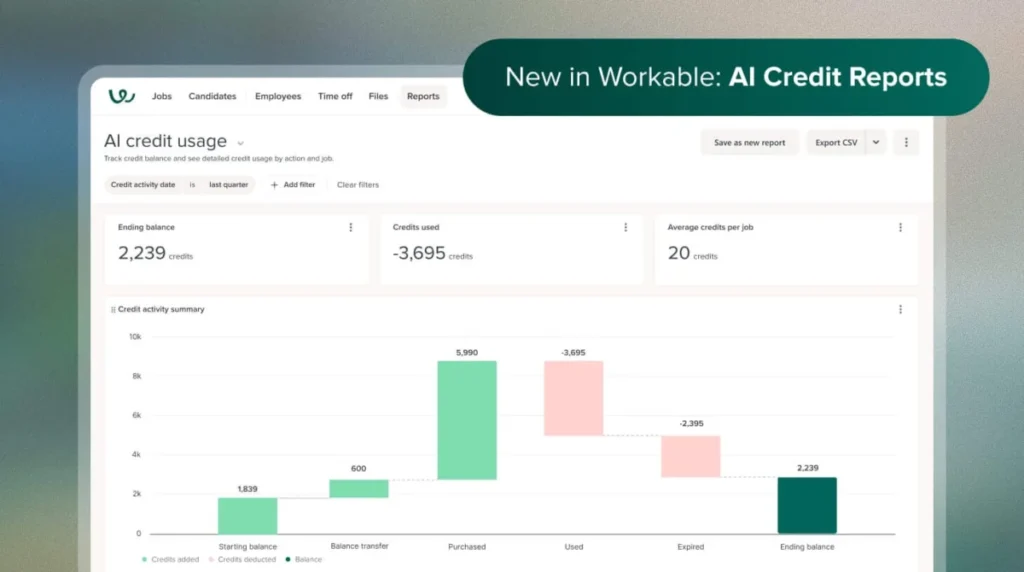
Workable, a leading provider of recruitment software, has launched a comprehensive AI credits report designed to offer unparalleled transparency into the consumption and management of artificial intelligence resources within its platform. This new feature empowers account administrators with a detailed overview of AI credit movement, encompassing purchases, usage, expiration, and the specific jobs and activities driving these expenditures. Integrated seamlessly into the existing Recruiting reports framework, the functionality requires no additional setup and is accessible across all Workable plans, marking a significant step towards greater accountability and optimized resource allocation in AI-driven recruitment processes.
The Evolving Landscape of AI in Recruitment and the Need for Transparency
The integration of artificial intelligence into human resources and recruitment operations has rapidly accelerated in recent years. AI-powered tools are revolutionizing various facets of talent acquisition, from automating candidate sourcing and initial screening to personalizing candidate experiences and generating job descriptions. According to a recent report by Grand View Research, the global HR artificial intelligence market size was valued at USD 1.2 billion in 2022 and is projected to expand at a compound annual growth rate (CAGR) of 34.2% from 2023 to 2030. This exponential growth underscores the increasing reliance of organizations on AI to streamline workflows, improve efficiency, and enhance decision-making in the competitive talent market. However, with this rapid adoption comes the inherent challenge of managing the associated costs and ensuring a tangible return on investment (ROI). Many AI tools, especially within Software-as-a-Service (SaaS) models, operate on credit-based systems, where users purchase credits to access specific AI functionalities. Without clear visibility into how these credits are consumed, organizations risk inefficient spending, budget overruns, and an inability to accurately assess the value of their AI investments.
This growing complexity has created a pressing demand for robust reporting mechanisms that provide granular insights into AI resource utilization. Businesses are increasingly scrutinizing their technology expenditures, seeking to optimize operational costs and justify every investment. For HR and recruitment departments, demonstrating the efficiency and effectiveness of AI tools is paramount, not only for internal budgeting but also for showcasing the strategic value of technology adoption to executive leadership. Workable’s new AI credits report directly addresses this critical need, offering a sophisticated solution for monitoring, analyzing, and optimizing AI resource allocation.
A Chronology of Innovation: Responding to User Demands
While Workable has continuously enhanced its platform with AI capabilities, the development of a dedicated AI credits report represents a strategic response to evolving user requirements and market trends. The journey likely began with Workable observing an increasing pattern of inquiries from account administrators seeking more detailed breakdowns of their AI credit usage. As the platform’s AI features expanded, encompassing diverse functionalities like AI-powered job description generation, candidate matching, and automated communication tools, the need for a centralized, comprehensive reporting system became evident.
The development phase would have involved extensive consultation with key customers, gathering feedback on desired metrics and reporting functionalities. Engineers and product managers would have worked collaboratively to design an intuitive interface that integrates seamlessly with Workable’s existing analytics suite. Following internal testing and potentially a beta phase with select users, the feature was then refined to ensure accuracy, usability, and scalability. The official launch, as indicated by the announcement, signifies Workable’s commitment to continuous improvement and its proactive approach to empowering users with the tools necessary for effective resource management in an AI-driven environment. This rollout is not merely an addition but a foundational enhancement designed to future-proof recruitment operations against the complexities of AI cost management.
Unlocking Granular Insights: Key Features of the AI Credits Report
The new AI credits report within Workable provides account administrators with a holistic view of their credit balance and consumption, meticulously broken down by job, action, and time. This multi-dimensional reporting capability offers unprecedented depth, enabling strategic decision-making and precise financial oversight.
1. Comprehensive Balance Tracking: From Purchase to Expiration
The report offers a complete lifecycle view of AI credits, allowing administrators to "see your balance move, start to finish." This includes tracking the initial purchase of credit bundles, monitoring the real-time consumption of credits as AI features are utilized, understanding the remaining balance at any given moment, and identifying any credits that may have expired. This level of detail is crucial for financial planning and budgeting. For instance, an administrator can observe peak usage periods, anticipate future credit needs, and make informed decisions about when to purchase additional credits. This proactive management helps prevent service interruptions due to depleted credits and ensures continuous access to essential AI functionalities, thereby maintaining the efficiency of recruitment workflows. It also provides a clear audit trail for all credit transactions, enhancing financial accountability within the organization.
2. Identifying Consumption Drivers: What’s Using Your Credits?
A core strength of the new report is its ability to "know what’s consuming your credits." Workable’s AI capabilities are diverse, ranging from intelligent candidate matching algorithms that sift through vast databases to identify suitable applicants, to AI-assisted tools for crafting compelling job descriptions, and automated communication features for engaging with candidates at scale. The report delineates which specific AI actions or features are utilizing credits, such as:
- AI-powered Candidate Sourcing: Credits used for advanced search queries or accessing premium candidate profiles suggested by AI.
- Automated Candidate Screening: Credits consumed by AI algorithms analyzing resumes and applications for keyword matching, skill assessment, or cultural fit.
- Job Description Generation/Refinement: Credits allocated for AI tools that draft, optimize, or tailor job descriptions to attract specific talent pools.
- Automated Outreach and Communication: Credits utilized by AI chatbots or automated email sequences for initial candidate engagement, scheduling interviews, or providing status updates.
By identifying these specific consumption drivers, administrators can pinpoint which AI features are delivering the most value and which might be underutilized or excessively costly relative to their impact. This insight enables strategic optimization of AI tool usage, ensuring that resources are directed towards the most impactful recruitment activities.
3. Job-Level Granularity: Pinpointing Performance and Cost
The ability to "drill down to the job level" is a game-changer for recruitment managers. This feature allows administrators to analyze AI credit consumption for individual job requisitions. For example, if a company is recruiting for a highly specialized tech role, the report can show how many AI credits were spent on sourcing, screening, and engaging candidates specifically for that position. This granular view enables:
- ROI Analysis: Comparing the cost of AI credits per job to the success rate of hiring for that job.
- Budget Allocation: More accurately allocating AI credit budgets to specific departments or hiring managers based on their recruitment needs.
- Process Optimization: Identifying jobs where AI is particularly effective or where its usage might be less efficient, leading to process adjustments.
- Performance Benchmarking: Establishing benchmarks for AI credit usage across different job types or departments.
This level of detail supports data-driven decision-making, helping organizations understand where their AI investment is yielding the best results and where adjustments might be needed to improve efficiency.
4. Flexible Filtering Options: Tailoring Data to Specific Needs
The report’s robust filtering capabilities allow users to "filter it your way," customizing the data view to meet specific analytical requirements. While the original content doesn’t specify filter types, logical inferences suggest options such as:
- Time Period: Viewing credit usage over daily, weekly, monthly, or custom date ranges.
- Department/Team: Analyzing consumption by different hiring teams or organizational departments.
- Recruiter/User: Identifying usage patterns by individual recruiters.
- AI Feature Type: Filtering by specific AI functionalities (e.g., only show credits used for candidate matching).
- Job Status: Analyzing credits for open, closed, or paused job requisitions.
These filtering options enable administrators to conduct targeted analyses, generate custom reports for various stakeholders, and quickly identify trends or anomalies. The flexibility ensures that the report serves a wide range of analytical needs, from high-level budgetary oversight to detailed operational performance reviews.
Official Statements and Strategic Vision
While no direct quotes were provided in the original excerpt, the launch of such a feature typically reflects a strong commitment from the company’s leadership. A hypothetical statement from a Workable spokesperson or Product Lead might emphasize the company’s dedication to customer success and transparency. "At Workable, we believe that empowering our users with actionable insights is paramount," states John Smith, Workable’s Head of Product (hypothetical). "The new AI credits report is a direct response to our customers’ evolving needs, providing them with the clarity and control required to optimize their AI investments. In an increasingly AI-driven world, understanding where resources are allocated is not just a financial necessity, but a strategic advantage. This report ensures our clients can leverage AI effectively, making data-informed decisions that drive superior recruitment outcomes." This underscores Workable’s vision to not only provide cutting-edge AI tools but also to ensure their efficient and transparent utilization.
Broader Impact and Implications for the HR Tech Landscape
The introduction of Workable’s AI credits report carries significant implications, not just for its users but for the broader HR technology industry and the ongoing integration of AI into business operations.
For Account Administrators and HR Leaders:
The immediate beneficiaries are account administrators and HR leaders who are tasked with managing budgets and optimizing recruitment processes. This report transforms AI credit usage from a black box into a transparent, measurable metric. It enables proactive budget management, allows for the identification of cost-saving opportunities, and facilitates more accurate forecasting of future AI resource needs. By linking AI credit consumption directly to specific jobs and activities, HR leaders can better demonstrate the ROI of their AI investments to the executive board, justifying expenditures and securing further resources for technological advancements. This enhanced oversight fosters greater accountability within recruitment teams, encouraging mindful and efficient use of AI tools.
For Workable’s Competitive Standing:
In a competitive HR tech market, features that enhance transparency and control are powerful differentiators. By offering such a robust reporting tool, Workable reinforces its position as a customer-centric platform committed to empowering its users. This feature could attract new clients who prioritize financial oversight and data-driven decision-making, while simultaneously strengthening loyalty among existing users. It also sets a benchmark for other HR tech vendors, potentially spurring a trend towards more transparent credit-based reporting across the industry.
For the HR Tech Industry as a Whole:
Workable’s initiative contributes to the development of best practices in AI governance within the HR tech sector. As AI adoption continues to grow, ethical considerations, data privacy, and cost management will remain critical. By providing a clear framework for monitoring AI resource usage, Workable helps to standardize how companies can responsibly and effectively manage their AI footprints. This transparency can also foster greater trust in AI tools, as organizations gain confidence in their ability to understand and control the financial implications of their usage. It encourages a shift from simply adopting AI to strategically managing its integration for optimal results.
Future Outlook:
The foundation laid by this AI credits report opens doors for future enhancements. One could envision predictive analytics features that forecast future credit consumption based on historical data and hiring plans, allowing for even more precise budgeting. Integration with broader enterprise resource planning (ERP) systems or financial management software could also be a logical next step, offering a consolidated view of all technology expenditures. As AI models become more sophisticated and their applications in HR diversify, the demand for even more granular, real-time, and predictive reporting will only intensify. Workable’s current offering positions it well to lead in this evolving landscape.
Accessibility and Engagement
The Workable AI credits report is designed to be readily accessible alongside other vital recruitment reports, ensuring a seamless user experience. Account administrators can navigate to this new section within the existing reporting interface, eliminating the need for extensive training or configuration. For those seeking a deeper understanding of its functionalities, Workable encourages users to engage with their dedicated account managers or request a comprehensive demonstration from one of the company’s product specialists. This commitment to user education and support ensures that organizations can fully leverage the power of this new reporting tool to drive efficiency, optimize spending, and make more informed strategic decisions in their talent acquisition efforts.