Most compliance checklists treat the burgeoning field of AI hiring laws with a one-size-fits-all approach, offering a single bullet point for each regulation with a uniform tone and an implied, undifferentiated urgency. This simplistic view is not only inaccurate but has been so for at least six months, if not longer. The reality on the ground for employers operating across state lines is far more intricate: these are not monolithic blocks of regulation but four distinct obligations, each on its own temporal track, with unique definitions of what constitutes "compliant." Misinterpreting a single deadline or requirement can lead to more than just an awkward correction; it can result in misrepresenting the existence or applicability of a control to a candidate or a regulatory body, creating significant legal and reputational risks.
The increasing adoption of Artificial Intelligence (AI) in recruitment and hiring processes has necessitated new legal frameworks to address potential biases and ensure fairness. However, the rapid evolution of AI technology and the varied approaches taken by different legislative bodies have created a complex compliance puzzle for businesses. Unlike traditional employment laws, which have had decades to mature and be interpreted, AI regulations are in their infancy, marked by shifting deadlines, court challenges, and evolving regulatory guidance.
New York City Local Law 144: A Pioneer in AI Hiring Audits
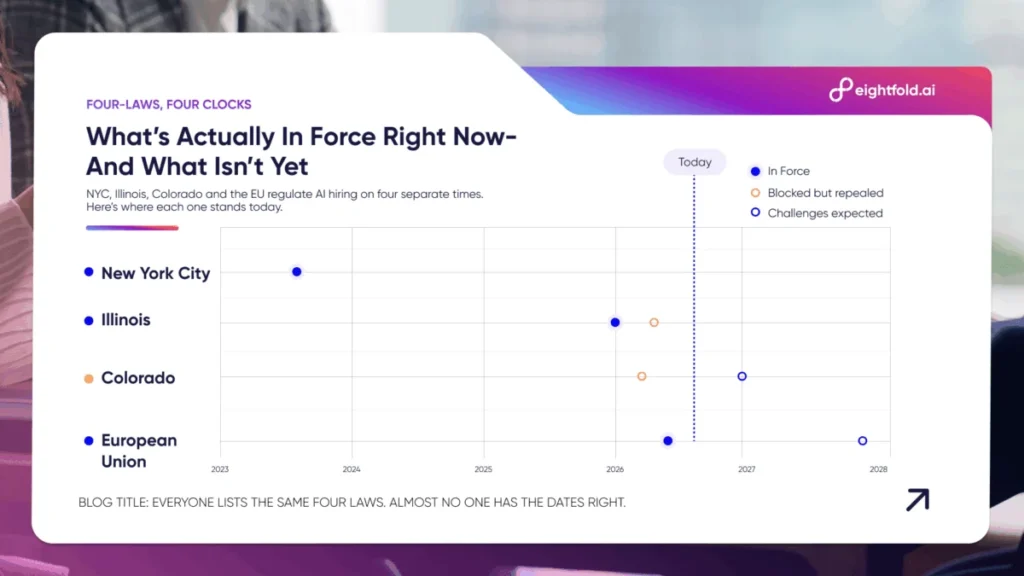
New York City’s Local Law 144 stands as a foundational piece of legislation in the AI hiring space, having been in effect since July 5, 2023. It is the only one of the four discussed laws with a significant track record of implementation. The law mandates that any automated tool used to evaluate candidates for roles based within New York City must undergo an independent bias audit. This audit is not a one-time event; it must be repeated annually, and a summary of its findings must be publicly accessible to candidates. This summary should detail selection rates and impact ratios categorized by demographic group, the date of the audit, and the data sources utilized.
Beyond the audit requirements, employers must provide candidates with a separate notice at least ten business days before an automated tool is used in the hiring process. This notice must include instructions on how candidates can request an alternative selection process. The New York City Department of Consumer and Worker Protection is responsible for enforcing this law. Crucially, operating an AI tool for candidate evaluation without a current, valid audit on file constitutes a compliance gap, irrespective of the tool’s performance. This proactive approach by New York City aims to instill transparency and accountability in the use of AI for employment decisions.
Illinois HB 3773: Integrating AI into Existing Anti-Discrimination Frameworks
Illinois’s approach, embodied in HB 3773, takes a different tack, with its statutory requirements slated to take effect on January 1, 2026. Rather than establishing a completely new audit regime, the state has integrated AI-assisted employment decisions directly into its existing Human Rights Act. This means that the legal ramifications of discriminatory outcomes are not viewed as novel "AI" violations but are prosecuted under the same established principles that have governed human decision-making for decades.
Under this legislation, employers are required to notify candidates when AI plays a role in decisions concerning hiring, promotion, discipline, or discharge. Furthermore, employers must be capable of explaining the functions of the AI tool in plain language. The principle that "the algorithm decided, not us" is explicitly not a viable defense. A significant development in Illinois’s regulatory landscape occurred in June 2026 when the Illinois Department of Human Rights withdrew its proposed implementing rules. This decision was made to facilitate ongoing coordination with other state agencies, and a revised timeline for these rules has not yet been provided. Despite this, the statute’s core duties concerning notification and non-discrimination remain fully applicable. Employers are now navigating a period of uncertainty regarding the precise language and timing that will satisfy the finalized regulatory details for these notices.
Colorado Senate Bill 26-189: A Shift Towards Transparency and Recourse
Colorado’s journey with AI regulation has been particularly dynamic. The state’s original AI Act, Senate Bill 24-205, which was set to become effective in April 2026, proposed a stringent framework including mandatory impact assessments, an explicit duty to prevent algorithmic discrimination, and ongoing risk-management programs. However, this initial legislation faced a significant hurdle when a federal court blocked its enforcement following a constitutional challenge.
In response to this legal pressure and industry pushback, Colorado’s legislature repealed SB 24-205 and enacted Senate Bill 26-189 in May 2026. This new legislation, scheduled to take effect on January 1, 2027, presents a considerably less demanding set of obligations. Key provisions include requiring advance notice to candidates before the use of "covered automated decision-making technology." Following an adverse decision, individuals have the right to receive a plain-language explanation within 30 days. They can also request data correction and human reconsideration, though the latter is qualified by the phrase "to the extent commercially reasonable," a significant qualifier that does not guarantee an unconditional review. Legal challenges to this revised version are reportedly anticipated, making the January 2027 effective date a target rather than a settled certainty.
The shift from the original, more prescriptive AI Act to the current SB 26-189 reflects a broader trend of legislative bodies re-evaluating the practical implementation and potential overreach of AI regulations. This recalibration aims to balance the need for fairness and transparency with the realities of technological development and business operations.
| Framework | Core Duty | Status |
|---|---|---|
| Original SB 24-205 | Impact assessments, discrimination-prevention duty, ongoing risk management | Blocked by federal court; repealed |
| SB 26-189 | Advance notice, 30-day adverse-decision explanation, data correction, conditional human reconsideration | Effective January 1, 2027; further challenges possible |
The European Union AI Act: A Comprehensive Framework for High-Risk AI
The European Union’s AI Act represents a comprehensive regulatory approach, with high-risk hiring obligations set to become effective on December 2, 2027. This timeline was confirmed following the final procedural steps of the Digital Omnibus deferral, which entered into force in July 2026 as Regulation (EU) 2026/1744. This extension pushed the implementation of Annex III high-risk obligations, which explicitly name recruitment and employee-evaluation tools, from August 2026 to the end of 2027.
The obligations for high-risk AI systems under the EU AI Act are substantial, encompassing mandatory risk management, detailed technical documentation, human oversight, and formal conformity assessments. Notably, one aspect of the AI Act is not subject to this extension: Article 50’s transparency duty. This means that any candidate interacting with an AI interviewer within the EU should already be informed that they are conversing with an AI system during that interaction. Non-compliance with high-risk provisions carries significant financial penalties, with potential fines reaching up to €15 million or 3% of a company’s global turnover – the middle tier of penalties, below the €35 million or 7% ceiling reserved for prohibited AI practices. The EU’s approach categorizes AI systems by risk level, applying the most stringent requirements to those deemed "high-risk."
The Enduring Baseline: Federal Anti-Discrimination Laws
It is crucial to recognize that none of these emerging AI-specific laws supersede the fundamental federal anti-discrimination statutes in the United States. Title VII of the Civil Rights Act of 1964, the Americans with Disabilities Act (ADA), and the Age Discrimination in Employment Act (ADEA) remain the bedrock of employment law for covered employers. Title VII and the ADA apply to employers with 15 or more employees, while the ADEA covers those with 20 or more. These statutes prohibit employment discrimination regardless of whether the decision was made by an AI tool or a human.
The Equal Employment Opportunity Commission (EEOC) provides guidance that complements these laws, rather than being integrated into them. While the EEOC’s 2022 ADA technical assistance and 2023 Title VII guidance address algorithmic risk, they are not enacted laws themselves. Furthermore, an AI vendor’s audit results do not absolve an employer of its own legal responsibilities and potential exposure under federal anti-discrimination statutes.

Four Distinct Levers, One Employer Answer: A Comparative Analysis
A direct comparison of these AI hiring compliance frameworks reveals fundamental structural differences, not mere cosmetic variations:
- New York City’s Audit-and-Publish Model: NYC demands annual public disclosure of bias audit results, requiring employers to prove their numbers or face non-compliance, irrespective of intent.
- Illinois’s Civil Rights Framework: Illinois integrates AI into its existing civil rights laws, meaning AI-assisted decisions are judged by the same standards as human ones, with established mechanisms for recourse.
- Colorado’s Notice-and-Recourse Approach: Post-legislative revision, Colorado emphasizes transparency by requiring advance notice, post-decision explanations, and the option for human review, albeit with commercial reasonableness caveats.
- The EU’s Product-Safety Analogy: The EU treats AI systems, particularly high-risk ones, akin to product safety regulations. This involves classification, documentation, assessment, and pre-market conformity, aligning more closely with how regulators approach medical devices than marketing claims.
While the underlying concern for fairness and bias mitigation is common across all four jurisdictions, the methods for ensuring employer accountability are entirely distinct. A vendor proficient in meeting only one of these compliance models is ill-equipped to serve clients operating in multiple jurisdictions.
Building an Effective AI Hiring Compliance Strategy
Developing a robust AI hiring compliance strategy requires a nuanced understanding of each applicable law, its specific requirements, and its effective date. This involves:
- Mapping Jurisdictional Coverage: Identifying which laws apply based on the location of the candidate, the role, and the employer’s operational footprint.
- Understanding Timelines: Maintaining a clear and updated understanding of each law’s effective date and any potential future amendments or regulatory changes.
- Implementing Auditing and Bias Mitigation: Conducting regular, independent bias audits for AI tools and implementing measures to mitigate identified risks.
- Ensuring Transparency and Notification: Developing clear and compliant notification procedures for candidates regarding the use of AI in hiring.
- Establishing Recourse Mechanisms: Providing clear pathways for candidates to request explanations, data correction, or human review.
- Maintaining Documentation: Keeping comprehensive records of AI tool usage, audit results, and compliance efforts.
- Continuous Monitoring and Review: Regularly reviewing and updating compliance strategies as laws and technologies evolve.
Unanswered Questions and the Importance of Legal Counsel
Despite the growing body of AI regulation, significant questions remain. None of these laws definitively outline what constitutes a "valid" bias audit, such as the required sample size for meaningful results or how to differentiate genuine statistical disparities from mere coincidental variations in data. These are not solely legal questions but also complex mathematical and statistical challenges that are often not clearly explained by auditors or regulators.
Furthermore, the dynamic nature of these regulations cannot be overstated. Effective dates can shift – as evidenced by the fact that three of the four discussed laws saw their timelines change during the research period for this article. Therefore, it is imperative for employers to consult with legal counsel to confirm the current statutory text and applicability before filing any compliance-related documentation based on information from secondary sources, including this article.
Frequently Asked Questions
Does a later EU deadline delay a live NYC or Illinois obligation?
No. Each jurisdiction’s timeline operates independently. Employers must meet all applicable deadlines currently in force, regardless of pending regulations elsewhere.
Is an employer responsible for a vendor’s AI tool?
Yes. While vendor contracts can allocate tasks, they do not remove the employer’s ultimate responsibility and exposure under employment law. A human decision-maker must remain involved at material stages of the hiring process.
Is a Local Law 144 alternative process the same as an ADA accommodation?
No. These are distinct requests handled through separate processes. One does not substitute for the other.
What do staffing firms need to know?
Under the EU AI Act, firms that develop or materially modify an AI tool are considered "providers" with documentation duties. Those that solely use a tool for recruitment are "deployers" and must follow the provider’s instructions. Both roles carry specific responsibilities that should be clearly defined in contracts, with legal counsel.
How does location affect coverage?
Employers must consider the candidate’s location, the role’s location, and their own operational footprint separately. For instance, NYC coverage can hinge on the job’s location, even if interviews occur remotely. Remote work scenarios are jurisdiction-specific and require consultation with legal counsel rather than assumptions.
What if an NYC audit is older than 12 months?
The AI tool cannot be used for covered NYC hiring activities until a current, independent bias audit is completed and the required summary is published.
How often should this compliance map be reviewed?
At a minimum, quarterly. It should also be reviewed before launching any new AI tool or expanding into new role locations, as these regulatory timelines are more dynamic than typical annual policy cycles.
The evolving landscape of AI hiring laws presents a significant compliance challenge for employers. By understanding the distinct requirements of each jurisdiction, staying abreast of legislative changes, and seeking expert legal guidance, businesses can navigate this complex terrain effectively and ensure fair and compliant hiring practices.