In today’s rapidly evolving global landscape, leaders are inundated with more data and potential solutions than ever before. This unprecedented access, amplified by advancements in artificial intelligence and digital technologies, presents a paradoxical challenge: while the volume of answers has surged, the ability to discern which answer is truly actionable, understand its ripple effects across an organization, and establish clear accountability for decisions has become increasingly arduous. More answers, it appears, do not automatically equate to greater knowledge or more effective leadership.
The modern organizational environment demands more than mere expertise. Leaders are compelled to navigate a volatile mix of ambiguity, competing priorities, and the imperative to lead across diverse and often fragmented organizational boundaries. In these complex conditions, leadership wisdom emerges not as a soft, aspirational virtue, but as a critical, learnable capability. Without it, leaders risk defaulting to the seductive but ultimately unsustainable substitutes of sheer speed or unfounded certainty, both of which crumble under genuine pressure. The cultivation of wisdom, therefore, is paramount not only for strengthening individual leaders but for shaping the resilience and effectiveness of teams and entire organizations when faced with uncertainty and urgency.
The emerging understanding of leadership wisdom challenges traditional notions that it is an innate trait reserved for a select few or a concept separate from the daily practice of leadership. Instead, wisdom is being redefined as a fundamental leadership capability that can be understood, intentionally developed, and actively applied. This development begins with its core components: sound judgment and effective decision-making.
The Interplay of Decision-Making, Judgment, and Wisdom
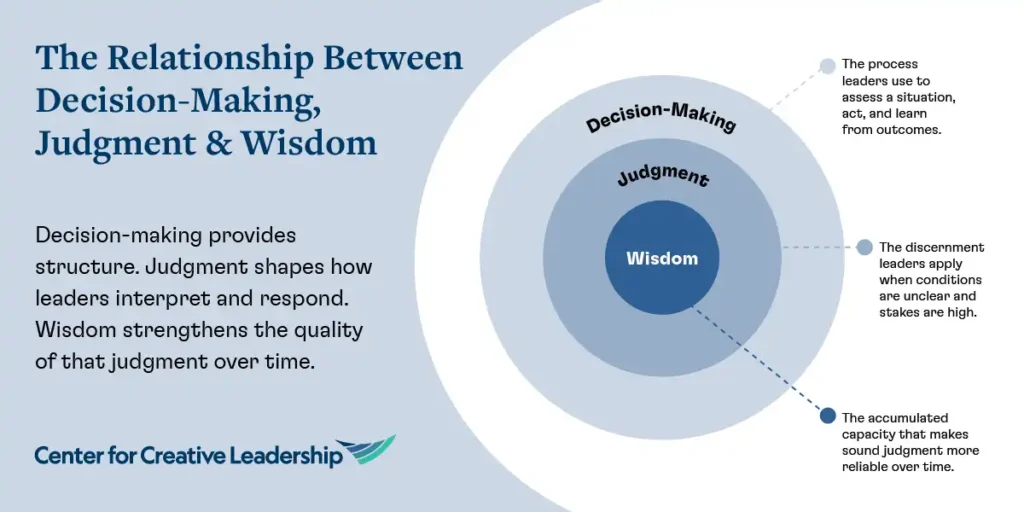
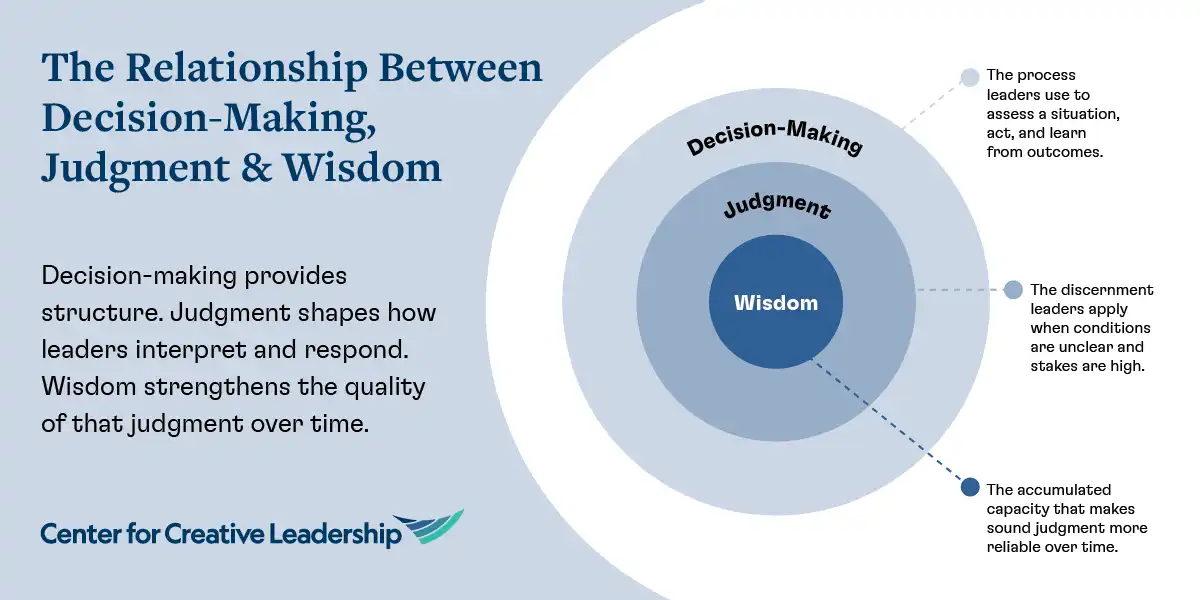
The process by which leaders navigate complexity is a sophisticated interplay of three distinct, yet interconnected, elements: decision-making, judgment, and wisdom.
Decision-making represents the structured process a leader employs to analyze a challenge, evaluate options, and arrive at a definitive conclusion. It is the operational framework for problem-solving.
Judgment is the more nuanced faculty of discernment that leaders apply within the decision-making process, particularly when confronted with ambiguous circumstances, incomplete information, or high-stakes outcomes. It is the art of weighing competing factors and making the best possible choice under imperfect conditions.
Wisdom, in this context, serves as the bedrock that makes judgment more sound and reliable over time. It is the accumulated understanding, insight, and perspective that informs and refines a leader’s ability to make consistently good decisions.

The integration of Artificial Intelligence (AI) is significantly reshaping the landscape of decision-making. AI can rapidly process vast datasets, identify patterns, and generate a multitude of potential solutions. However, AI’s capabilities are inherently limited when it comes to applying true leadership judgment and wisdom. An AI cannot reflect on the lessons learned from past decisions, empathize with the human impact of a chosen course of action, or engage in the collective sensemaking that imbues raw data with deeper meaning. While AI can amplify analysis and present an expanded array of possibilities, it is leadership wisdom that determines how these possibilities are interpreted, prioritized, and ultimately applied within a specific organizational and human context. As AI makes answers more abundant, wisdom becomes the scarce and invaluable resource that enables leaders to discern which answers are truly relevant and consequential.
Wise leaders and their teams demonstrate the capacity to dissect complex challenges, draw upon experiential knowledge and insights, and engage in collaborative sensemaking. This collective process leads to sound judgments that not only pave the way for progress but also serve the greater good.
The Escalating Urgency for Leadership Wisdom
Several powerful forces are converging to amplify the urgency for leadership wisdom in contemporary organizations. The transformative impact of AI on information access is undeniable, but it coincides with an era where the decisions leaders face are inherently more complex. These decisions often involve a greater number of interacting variables, fewer clear-cut trade-offs, higher stakes, and compressed timelines for deliberation. Leaders are increasingly expected to move with speed in environments where rapid action and thoughtful consideration are often at odds.
Adding another layer of complexity is the evolving composition of the workforce. With multiple generations now coexisting in many organizations, each brings a distinct relationship with experience, technology, and risk. This diversity, while a potential strength, also multiplies the challenge of achieving organizational alignment and consistent decision-making.
While individual leaders may possess strong judgment, the consistent application of sound decision-making across an entire organization, beyond a select few at the top, remains a significant hurdle. This challenge is particularly evident in areas like succession planning. Research consistently indicates that the transfer of wisdom is one of the most overlooked yet critical components of successful leadership transitions. The departure of a seasoned leader can result in the loss of invaluable, context-specific wisdom, a deficit that can have a more profound and lasting negative impact on an organization than the loss of their functional role alone.
Defining the Dimensions of Leadership Wisdom
Wisdom in leadership is not an exclusive attribute of the most senior executives, nor is it a binary trait that one either possesses or lacks. Extensive research and practical experience with global organizations reveal several key characteristics that define leadership wisdom:
- Profound Self-Awareness: A deep understanding of one’s own biases, strengths, limitations, and emotional responses, enabling more objective decision-making.
- Holistic Perspective: The ability to see the "big picture," considering the interconnectedness of various organizational functions, external factors, and long-term implications beyond immediate concerns.
- Empathy and Emotional Intelligence: The capacity to understand and share the feelings of others, recognizing how decisions impact individuals and teams, and factoring this into the decision-making process.
- Ethical Foundation: A strong moral compass and commitment to principles that guide decisions towards what is right and just, even when faced with pressure or expediency.
- Humility and Openness to Learning: The recognition that one does not have all the answers and a genuine willingness to seek diverse perspectives, learn from mistakes, and adapt one’s thinking.
- Strategic Foresight: The ability to anticipate future trends, potential challenges, and opportunities, and to make decisions that position the organization for long-term success.
- Capacity for Reflection: The deliberate practice of pausing to analyze past experiences, extract lessons learned, and integrate them into future actions.
- Courage and Conviction: The fortitude to make difficult decisions and stand by them, even in the face of opposition or uncertainty, when aligned with sound judgment.
- Balance and Integration: The skill to reconcile competing demands, find equilibrium between seemingly contradictory priorities, and foster harmony within complex systems.
- Sense of Purpose: A clear understanding of the organization’s overarching mission and values, which serves as a guiding star for all decisions.
Cultivating Leadership Wisdom: A Developmental Approach
Leadership wisdom, much like creativity or resilience, is cultivated rather than simply taught. It thrives in an environment that fosters its development, supports its formation at both individual and collective levels, and provides ongoing guidance. The development of leadership wisdom typically follows a three-pronged approach:
- Experiential Learning and Reflection: This involves engaging in challenging assignments, taking calculated risks, and then dedicating time and effort to critically reflect on these experiences. This reflection process includes analyzing what worked, what didn’t, and why, as well as understanding the impact of decisions on stakeholders.
- Intentional Development and Skill-Building: This prong focuses on actively acquiring skills and knowledge that underpin wisdom, such as critical thinking, emotional intelligence training, conflict resolution techniques, and strategic analysis. It also involves seeking out feedback and engaging in practices that broaden perspective.
- Supportive Environment and Mentorship: Creating organizational cultures that value learning, encourage open dialogue, and provide safe spaces for leaders to experiment and learn from mistakes is crucial. Mentorship from experienced, wise leaders offers invaluable guidance, context, and a model for developing judgment.
These dimensions are not independent but rather reinforce each other over time. Experience alone, without structured reflection and intentional development, does not automatically translate into wisdom. Leaders require a combination of diverse experiences, dedicated reflection, constructive feedback, the ability to adopt different perspectives, and continuous developmental challenges to effectively transform raw experience into refined discernment.
The Tangible Impact of Leadership Wisdom
The influence of leadership wisdom extends far beyond individual leaders, creating meaningful and lasting positive impacts across teams, organizations, and society at large.
For individuals, wisdom acts as a compounding force. Each decision informed by deeper insight, stronger judgment, and a clearer sense of purpose builds upon itself, enhancing a leader’s effectiveness and impact over their career.
For teams, the shared development of wisdom fosters a collective judgment that transcends the capabilities of any single individual. This shared wisdom enables teams to navigate complex challenges with greater agility and efficacy, particularly in global and cross-functional contexts where leveraging diverse perspectives is essential for achieving optimal, long-term outcomes.
For organizations, wisdom at scale cultivates environments characterized by psychological safety, robust dialogue, and continuous renewal. These are the very conditions that sustain high performance and foster innovation. Wise organizations elevate collective wisdom to the level of institutional wisdom, enabling them to navigate crises and disruptions with greater confidence and competence.
On a broader societal level, while wisdom is not a panacea for the persistent challenges humanity faces, it empowers societies to confront these issues with the maturity, foresight, and sustained momentum required for genuine progress.
Ultimately, the future will not be shaped by leaders who simply possess more information, move faster, or project an unshakeable, perhaps unfounded, certainty. Instead, it will be the leaders who can discern what truly matters, make sense of complexity collaboratively, and exercise sound judgment when the stakes are highest, who will lead the way forward.
Embracing the Path Forward
As the digital revolution continues to accelerate and the complexities of the global landscape deepen, the cultivation of leadership wisdom is no longer an optional enhancement but a fundamental necessity for navigating the challenges of the 21st century. Organizations that prioritize the development of wise leaders will be better equipped to adapt, innovate, and thrive in an ever-changing world, ensuring not only their own success but also contributing positively to the broader societal good.