The landscape of talent acquisition has undergone a significant metamorphosis over the past decade. Innovations such as sophisticated applicant tracking systems (ATS), robust recruitment marketing strategies, automated scheduling tools, and self-service career portals have fundamentally reshaped how organizations attract, engage, and manage their workforce. While these advancements have demonstrably accelerated numerous stages within the hiring funnel, a persistent and increasingly problematic metric, time-to-fill, continues to escalate. This paradox stems from a critical shift in the hiring bottleneck, which has migrated to the middle of the funnel – the crucial phase where human evaluation of candidates takes place.
This persistent challenge has been the primary impetus behind the development of Eightfold AI Interviewer, an innovative AI-led structured interviewing solution designed to address the inefficiencies plaguing candidate evaluation. Unlike the swift advancements seen in other recruitment technologies, the process of initial candidate screening has remained remarkably static for approximately two decades. Traditionally, this involved recruiters engaging in repetitive phone calls, posing a standardized set of questions, meticulously taking notes, and repeating this process across dozens of requisitions. This manual, high-touch approach, once adequate for managing more manageable applicant volumes, is now proving untenable in the face of surging candidate pools.
The Mathematical Impossibility of Traditional Screening
The current surge in applicant volumes is a multifaceted phenomenon. Across virtually every industry, organizations are experiencing an unprecedented influx of candidates. This trend is fueled by a confluence of factors, including the proliferation of user-friendly “easy apply” functionalities on job boards, expanded and more sophisticated sourcing strategies that cast a wider net, and, increasingly, the use of generative AI by candidates themselves to apply to a greater number of roles with greater speed and perceived personalization. Simultaneously, the capacity of recruitment teams, measured by recruiter-to-application ratios, has either remained stagnant or, in many cases, contracted.
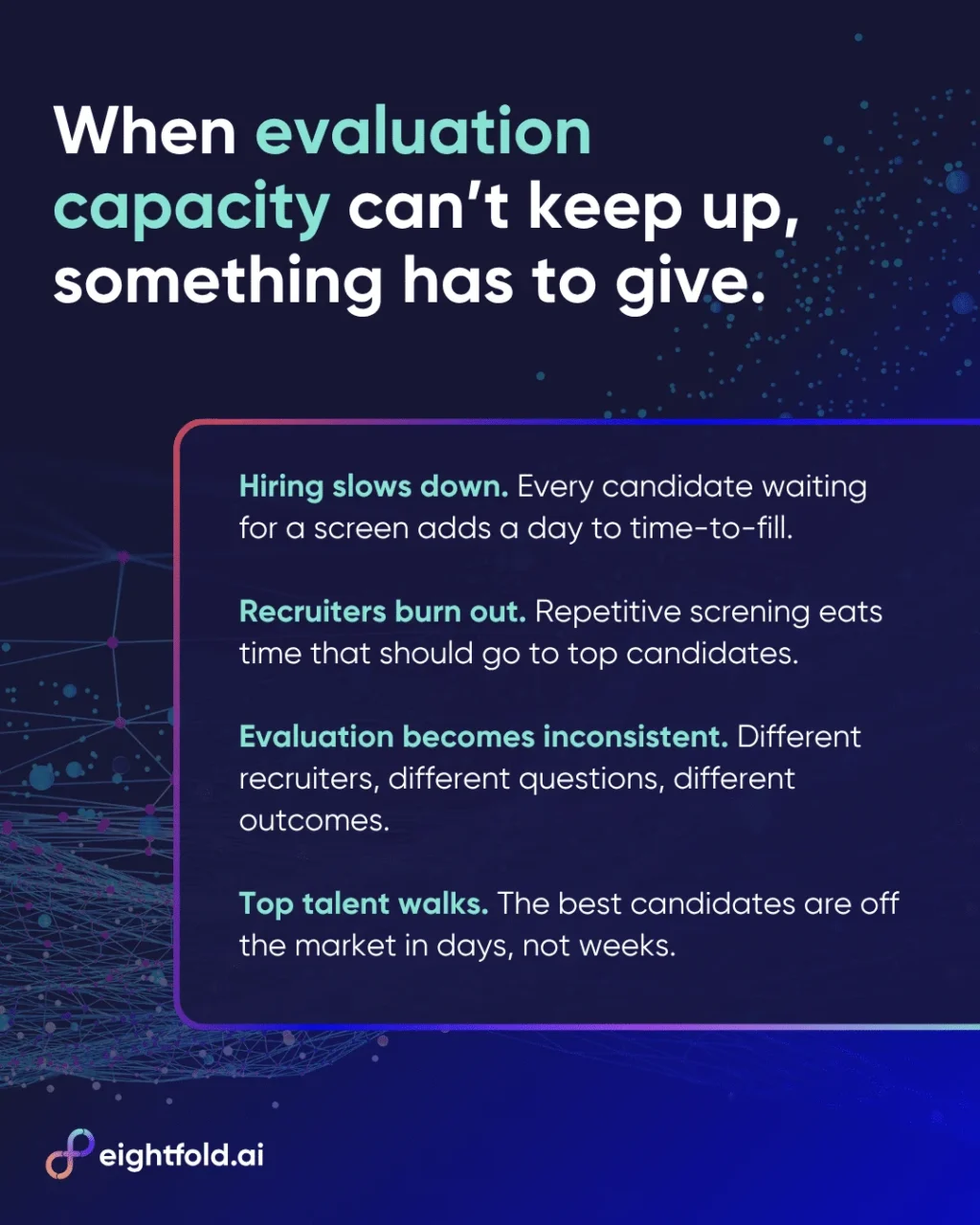
This disparity creates a mathematical challenge for many organizations. The issue is not a deficit of technology, but rather the failure to fully leverage existing technology investments by eliminating the residual manual processes that continue to impede hiring velocity. The expectations placed upon recruiting teams are immense: screen a larger volume of candidates, expedite the hiring process, and simultaneously enhance the candidate experience, all without the luxury of increased headcount. Something, inevitably, must yield. In most organizations, this results in a compromise across four key areas: candidate quality, hiring speed, recruiter workload, and the overall candidate experience.
The Illusion of a Tradeoff: Speed vs. Rigor
Faced with this escalating pressure, talent leaders often find themselves navigating a perceived tradeoff: either prioritize speed and conduct a cursory evaluation, or opt for thorough evaluation at the expense of considerable time. This frequently translates to screening fewer candidates per requisition, shortening interview durations, or placing an overreliance on the information presented in resumes.
However, this perceived tradeoff is itself the core of the problem. Resumes, often a curated and sometimes embellished representation of a candidate’s history, coupled with simple keyword matching, have always been insufficient inputs for making high-quality hiring decisions. When this inherently limited screening process is applied to exponentially higher volumes of applicants, the inherent risks are compounded. This leads to a greater likelihood of overlooking promising talent, a pervasive inconsistency in evaluation standards, and, critically, hiring misses that often manifest as increased employee attrition down the line, incurring significant costs in terms of lost productivity and the expense of backfilling roles.

For organizations that have strategically invested in technology as the bedrock of their talent acquisition strategy, this situation presents a significant opportunity for further optimization. Once the foundational recruitment operations have been streamlined through technology, the next frontier for improvement lies in enhancing the quality and consistency of candidate evaluation. The inherent conflict between speed and rigor in the hiring process arises primarily when candidate evaluation is exclusively dependent on synchronous, real-time human interactions. This dependency represents an operational constraint rather than an immutable law of recruitment.
The Evolution of Scalable Candidate Evaluation
Organizations that are successfully breaking through this hiring bottleneck are not resorting to simply increasing their recruiter headcount or replacing their existing technology stacks wholesale. Instead, they are strategically extending their recruitment capabilities by fundamentally restructuring where and how candidate evaluation occurs, while continuing to utilize their established platforms as the authoritative system of record.
This progressive approach complements existing recruitment workflows by providing more consistent and objective candidate insights. It empowers recruiters to dedicate more of their valuable time to high-impact activities, such as strategic candidate engagement, relationship building, and complex negotiation, while significantly reducing the time spent on repetitive, low-value screening tasks.
Eightfold AI Interviewer: Augmenting, Not Replacing, Recruitment
A prevalent misconception surrounding AI-enabled candidate evaluation is that it necessitates a complete overhaul of established recruiting processes. In reality, solutions like Eightfold AI Interviewer are meticulously designed to integrate seamlessly with existing Applicant Tracking Systems (ATS), serving as an augmentation rather than a replacement. The ATS continues to function as the central repository for candidate data and the system of record. The AI-enabled screening layer, conversely, introduces a structured and standardized evaluation framework, enabling recruiters to glean richer, more objective candidate insights much earlier in the hiring journey.
The implementation of such solutions is typically characterized by its straightforward nature. Organizations can build upon their existing workflows, processes, and technological investments. The ability to initiate the process with a single role or a specific hiring process allows for a controlled rollout. By standardizing screening questions and leveraging AI for initial evaluations, teams can rapidly establish a more consistent and equitable candidate experience without causing disruption to the daily routines of recruiters, hiring managers, or the established ATS workflows.
The ultimate outcome is not a fundamentally different recruiting process, but a significantly stronger and more efficient one. Recruiters are liberated from the drudgery of repetitive screening conversations, allowing them to focus on more strategic aspects of their role. Candidates experience a more streamlined and faster progression through the hiring funnel. Crucially, hiring teams gain access to more consistent and reliable information, empowering them to make more informed and ultimately better hiring decisions. This technological advancement promises to redefine the middle of the hiring funnel, transforming it from a bottleneck into a streamlined, data-driven gateway for talent acquisition. The future of efficient and effective hiring hinges on embracing these intelligent solutions.