Global corporations invest an estimated $370 billion annually in training and development, with a significant portion allocated to leadership programs designed to refine executive capabilities and drive organizational evolution. Despite this staggering financial commitment, a persistent disconnect remains between classroom proficiency and workplace application. Industry data suggests that while participant satisfaction with these programs often remains high, the actual rate of behavioral transfer—the application of learned skills to the job—frequently hovers between 10% and 20%. This phenomenon, often termed "The Great Training Robbery," highlights a critical failure in how organizations diagnose and address leadership performance.
The disconnect was recently underscored by a case study involving a major organization that undertook an extensive senior leadership initiative. The program featured high-quality content, expert facilitation, and months of collaborative learning. While feedback was overwhelmingly positive and leaders demonstrated a clear mastery of new frameworks and vocabulary, the Chief Executive Officer observed zero tangible change in executive behavior at the end of the fiscal year. This discrepancy raises a fundamental question for modern corporate governance: Why does knowledge fail to translate into action, and what systemic barriers prevent leaders from evolving?
The Chronology of Training Decay
To understand why leadership development often fails, it is necessary to examine the typical lifecycle of a corporate training initiative. The process usually begins with a perceived performance gap, leading to the commissioning of a high-level curriculum.
- The Enthusiasm Phase: Leaders engage in off-site workshops or intensive seminars. In this controlled environment, psychological safety is high, and the absence of daily operational pressure allows for the successful simulation of new behaviors.
- The Re-entry Phase: Participants return to their roles with a shared vocabulary and new conceptual frameworks. For the first 48 to 72 hours, there is often a visible attempt to implement new strategies, such as improved delegation or active coaching.
- The Systemic Friction Phase: Within two to four weeks, the "gravity" of the existing organizational culture begins to exert influence. As deadlines loom and high-stakes crises emerge, leaders instinctively revert to ingrained habits—often the very behaviors the training sought to eliminate.
- The Regression Phase: By the six-month mark, without specific structural support, the new behaviors have largely vanished. The organization remains unchanged, leading to executive skepticism regarding future development investments.
A Strategic Diagnostic: The Four Barriers to Change
Experts in organizational psychology suggest that before prescribing additional training, talent leaders must diagnose the specific nature of the performance barrier. Failure to change is rarely a simple lack of effort; rather, it is usually a result of one of four specific scenarios.
1. The Fundamental Knowledge Deficiency
In the most straightforward cases, a leader simply lacks the technical "how-to" for a specific management function. This is most common among newly promoted managers or technical experts transitioning into people leadership. They may not know the structural components of a performance review or the mechanics of effective feedback. In these instances, traditional Learning and Development (L&D) interventions are highly effective. However, industry analysis suggests that for senior leaders, a lack of raw knowledge is rarely the primary obstacle. Most senior executives can articulate the theory of good leadership; their failure lies in the execution.
2. The Impact of High-Stakes Pressure on Cognitive Access
A critical distinction exists between knowing a concept and being able to access that knowledge during a "cortical hijack"—a state of high stress where the brain’s prefrontal cortex loses dominance to the emotional centers. A leader may understand the value of empowering their team, but when a multi-million dollar client project begins to slip, the fear of reputational damage or financial loss triggers a command-and-control response.
In these moments, the barrier is not capability, but rather the inability to manage competing internal drivers such as the fear of losing control, the need for perfection, or the desire for senior-level approval. When the stakes are high, leaders do not rise to the level of their training; they sink to the level of their most deeply ingrained habits.
3. The Limitations of Simulation-Based Practice
The concept of "practice" in leadership development is frequently criticized for lacking "ecological validity"—the degree to which the practice environment mirrors the real world. Role-playing a difficult conversation in a comfortable hotel ballroom with a supportive peer does not replicate the political risk or emotional tension of challenging a powerful superior in a boardroom.
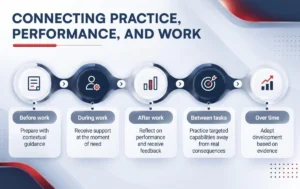
Effective development must transition from "practice in the room" to "practice in the work." This requires longitudinal support where leaders apply skills to real-time projects, receive immediate feedback, and iterate based on actual outcomes. Without the element of real-world consequence, the brain does not encode the new behavior as a viable survival strategy for the workplace.
4. Systemic Contradictions and Institutional Rewards
The most formidable barrier to leadership change is an organizational system that incentivizes the old behavior while verbally advocating for the new one. This creates a "double bind" for leaders. For example, a company may train its executives to be "collaborative" and "cross-functional," yet maintain a compensation structure that rewards only individual business unit performance.
When the formal message of the training program conflicts with the lived reality of the organization’s power structures and reward systems, the system invariably wins. Leaders are highly attuned to "safe" behaviors. if an organization claims to value risk-taking but penalizes every failure, leaders will continue to exhibit risk-aversion, regardless of how many workshops they attend on innovation.
Data-Driven Analysis of Organizational Impact
According to research from McKinsey & Company, only 25% of respondents to a global survey believed that their leadership development programs improved organizational performance. Furthermore, a study by the Association for Talent Development (ATD) found that organizations with "high-performance cultures" were significantly more likely to integrate leadership development into daily work rather than treating it as a discrete event.
The implications of these findings are clear: leadership development cannot be an isolated HR function. It must be a core component of organizational design. When behavior does not change, it is often a diagnostic signal that the organization’s internal "operating system"—its decision rights, performance metrics, and cultural norms—is incompatible with the desired leadership style.
Reactions from the C-Suite and Talent Leaders
The realization that "more training" is not always the answer has prompted a shift in how Chief Human Resources Officers (CHROs) approach executive growth. "We have moved away from the ‘event-based’ model of training," says one talent director at a Fortune 500 tech firm. "Now, we look at the ‘Monday Morning’ reality. If a leader goes back to an environment where their boss still micromanages them, our delegation workshop was a waste of money."
CEOs are also becoming more demanding regarding the Return on Investment (ROI) of these programs. The focus has shifted from "smile sheets" (participant satisfaction surveys) to observable behavioral metrics. The question is no longer "Did they like the program?" but "Are they delegating more effectively six months later, as verified by their direct reports?"
A New Framework for Leadership Impact
To bridge the gap between learning and doing, organizations are encouraged to adopt a more rigorous diagnostic framework before launching new initiatives. This involves asking four critical questions:
- Capability: Does the leader truly lack the skill, or is this a performance issue?
- Accessibility: What internal fears or pressures prevent the leader from using what they know?
- Realism: Does the training provide practice in high-stakes, high-tension environments?
- Alignment: Does the organization’s culture and reward system support or punish the new behavior?
By shifting the focus from content delivery to environmental alignment, organizations can ensure that their investment in leadership development yields actual transformation. The goal is not to produce leaders who can explain leadership, but to cultivate leaders who can execute it when the stakes are highest.
Future Implications for Corporate Governance
As the business landscape becomes increasingly volatile, the need for agile, self-aware leadership has never been greater. However, the traditional "workshop" model is proving insufficient for the complexities of the modern era. The future of leadership development lies in "embedded learning"—where the boundaries between work and development are blurred.
This shift will require a fundamental realignment of how leadership is measured. Success will be defined by long-term behavioral shifts, documented by 360-degree feedback and organizational health metrics, rather than the completion of a curriculum. Ultimately, the measure of a successful leadership program is not what happens in the classroom, but what becomes possible in the workplace that was not possible before. Organizations that recognize and address the systemic barriers to change will gain a significant competitive advantage, turning their leadership development from a sunk cost into a strategic engine for growth.