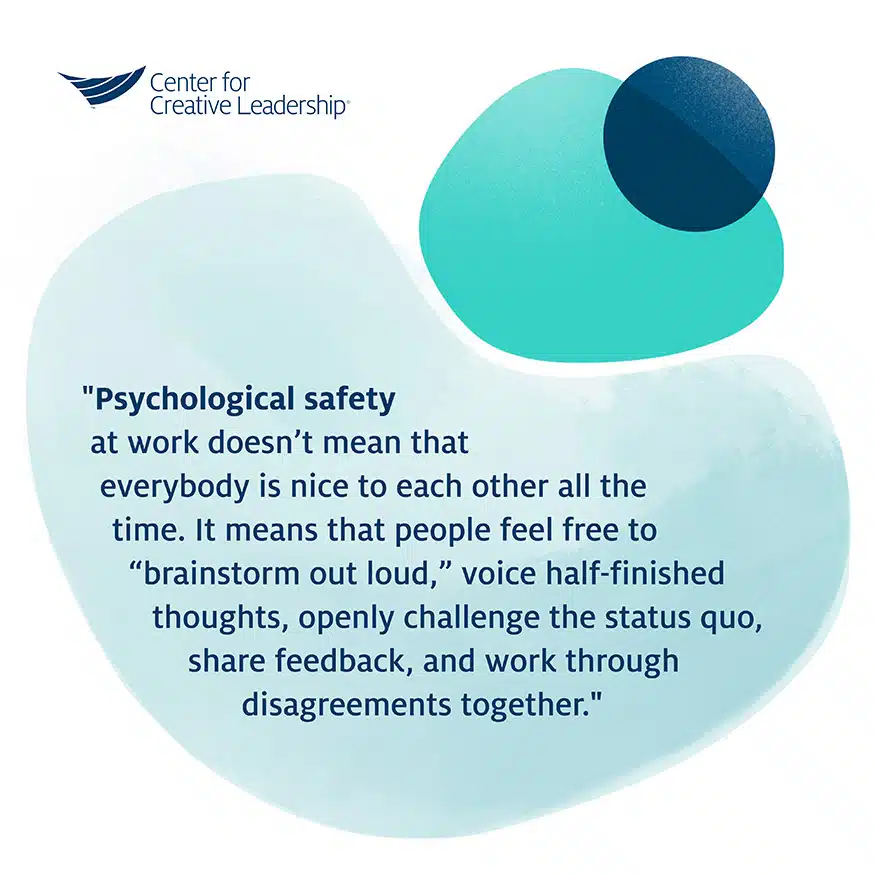
Psychological safety at work is defined as the shared belief that team members will not be punished or humiliated for speaking up with ideas, questions, concerns, or mistakes. It is the fundamental understanding that within a team, individuals will not face embarrassment, rejection, or retribution for expressing themselves, taking calculated risks, or soliciting feedback. This concept, however, does not imply a constant state of universal pleasantries. Instead, it fosters an environment where open brainstorming, the sharing of nascent thoughts, challenging the status quo, providing candid feedback, and navigating disagreements are not only accepted but actively encouraged, underpinned by a leadership commitment to honesty and truth-telling, and a strong sense of mutual support among colleagues.
When psychological safety is present, employees feel empowered to bring their authentic selves to work, comfortable with the inherent vulnerability of sharing their perspectives and contributions. Organizations that cultivate such environments—where bold questions are welcomed, concerns are openly addressed, assistance is readily sought, and risks are prudently taken—reap significant rewards. Research underscores this, with a comprehensive study spanning 2.5 years and involving nearly 300 leaders revealing that teams exhibiting high levels of psychological safety consistently reported enhanced performance metrics and a reduction in interpersonal conflicts.
However, it is crucial to acknowledge that perceptions of psychological safety are not uniform across all team members. Senior leadership teams, in particular, often exhibit the most significant disparities in perceived safety. The aforementioned research found that a substantial 62% of senior teams in the sample displayed considerable variability in their members’ experiences of psychological safety. This divergence carries tangible business repercussions, leading to the suppression of innovative ideas, stifled creative problem-solving, and a failure to fully leverage collective potential for collaboration and innovation. The ability to foster greater psychological safety, both in professional and personal spheres, is therefore paramount for organizational success.
The Indispensable Value of Psychological Safety in the Modern Workplace
Psychological safety is far more than a desirable attribute; it is a critical driver of an organization’s financial performance. A consistently high level of psychological safety unlocks the full spectrum of talent within an enterprise, bolstering its capacity to identify and preempt potential failures. Extensive research consistently highlights the benefits derived from diversity of thought. Teams composed of individuals with varied life experiences are inherently better equipped to detect complex problems and devise innovative solutions compared to homogenous groups.
The critical question then arises: what happens when a portion of team members feel inhibited from voicing their thoughts? What if they fear sharing their unique perspectives, raising critical concerns, or posing challenging questions? What if the apprehension of repercussions dissuades them from proposing novel and innovative ideas? Unfortunately, this scenario is a pervasive reality for many in today’s workplaces. Data from the 2025 Gallup engagement survey, for instance, indicates that a mere three out of ten employees strongly agree that their opinions hold weight at work.
The challenges in fostering psychological safety are often amplified for members of social identity groups that have historically faced marginalization. Individuals belonging to underrepresented groups may experience a heightened awareness of this lack of safety. Conversely, colleagues who perceive their work environment as psychologically safe are demonstrably more inclined to engage in interpersonal risk-taking behaviors that are crucial for organizational innovation. These behaviors include speaking up proactively, asking clarifying questions, articulating unspoken reservations, and engaging in respectful dissent. The cumulative effect is the cultivation of a more robust, dynamic, innovative, and inclusive organizational culture.
In stark contrast, environments characterized by low psychological safety, where individuals feel disinclined to voice concerns, often see initiatives that are demonstrably failing proceed unchecked. Such organizations become ill-equipped to prevent systemic failures, leading to talent disengagement. When employees are not fully committed to shared organizational success, ideas are not rigorously stress-tested, processes remain suboptimal, solutions are not thoroughly vetted, and the enterprise forfeits the invaluable contributions of its entire workforce.
Why Psychological Safety is More Critical Than Ever in Today’s Landscape
The proliferation of hybrid work models and the widespread adoption of virtual work arrangements have introduced a new layer of complexity to establishing psychological safety at work. Leaders face increased challenges in cultivating a cohesive and safe "workplace" when employees are geographically dispersed and many operate remotely. The question of how to build trust and foster open communication when interpersonal interactions require deliberate scheduling and are frequently mediated by screens becomes paramount.
Paradoxically, leading remote teams can present leaders with unique opportunities to forge stronger connections and enhance psychological safety, provided they are attuned to these possibilities. During virtual meetings, sustained eye contact, which can sometimes feel awkward in person, becomes more feasible. This allows leaders to observe speakers more intently, absorbing not just their verbal communication but also their underlying emotions and values. Leaders can leverage this to explore authentic communication in virtual settings by prioritizing active listening.
Furthermore, many individuals find it easier to articulate vulnerable thoughts or concerns through the intermediary of a screen, such as via meeting chat, than in a face-to-face setting. This medium can provide them with the necessary time to carefully craft their messages for maximum impact. Leaders who acknowledge and appreciate the courage it takes for individuals to share their honest thoughts, responding with empathy and recognition, can significantly bolster psychological safety.
Cultivating a Psychologically Safe Workplace: Essential Strategies for Leaders
Creating a more psychologically safe workplace requires intentional and consistent effort from leadership. Here are eight key strategies leaders can implement:
1. Make Psychological Safety an Explicit Organizational Priority
Leaders must openly communicate the importance of psychological safety, articulating its direct link to enhanced organizational innovation, increased team engagement, and a more inclusive environment. This involves modeling desired behaviors, such as asking for help when needed and readily offering support to others. Adopting inclusive leadership practices is foundational to setting the right tone.
2. Foster an Environment Where Everyone Feels Empowered to Speak Up
Cultivating genuine curiosity and valuing frankness and truth-telling are paramount. Leaders should strive to be open-minded, compassionate, and receptive listeners, particularly when challenging ideas or the status quo are presented. Organizations that promote a coaching culture are more likely to develop team members with the confidence to speak their truth.
3. Establish Clear Norms for Handling Failure
Punishing experimentation and reasonable risk-taking is counterproductive. Instead, leaders should frame mistakes as valuable learning opportunities. Encouraging learning from failures and disappointments, and openly sharing personal lessons learned from past errors, is crucial for fostering innovation rather than stifling it. Candor should be employed with both disappointment and appreciation.

4. Create Ample Space for Novel and Even Unconventional Ideas
Providing support that contextualizes challenges is vital. Leaders must consider whether they exclusively seek well-tested ideas or are open to highly creative, out-of-the-box concepts that may not yet be fully formed. While asking probing questions is acceptable, it should always be done within a supportive framework. Understanding how to nurture innovative mindsets within a team is an ongoing developmental process.
5. Embrace and Manage Productive Conflict
Promoting sincere dialogue and constructive debate is essential for growth. Leaders should actively work to resolve conflicts productively, setting the stage for incremental change by establishing clear team expectations for behaviors that contribute to psychological safety. Facilitating discussions around how team members can support each other’s growth and contribution can be highly effective.
6. Maintain Keen Observation and Identify Patterns
Leaders must focus on the perceived patterns of psychological safety among team members, rather than solely on the overall average. This involves discerning whether certain individuals experience significantly more or less psychological safety than others, or if the experience is relatively uniform across the team.
Psychological safety is not a static state; it can fluctuate from one interaction to another. Relying solely on periodic surveys may not adequately capture these shifts. Research literature identifies four key behavioral signal categories—learning behaviors, voice, openness, and integrating behaviors—that leaders can observe in real-time to gauge their team’s current level of psychological safety.
7. Make a Deliberate Effort to Promote Dialogue and Feedback
Developing proficiency in giving and receiving feedback, and creating safe spaces for raising concerns, are critical. Leaders should pose powerful, open-ended questions and actively listen to understand not only the factual content but also the underlying feelings and values expressed by colleagues. Providing opportunities for team members to learn how to share constructive feedback and engage in respectful responses is invaluable. Investing in the quality of organizational conversations can lead to a better culture overall. Enhanced feedback skills, coupled with a psychologically safe environment, empower colleagues to voice unspoken reservations and propose more rigorously vetted solutions.
8. Proactively Celebrate Successes
Acknowledging and celebrating what is going well, no matter how small, is essential for building trust and mutual respect. Sharing credit and embracing collective expertise over a "hero" mentality reinforces positive team dynamics. Expressing gratitude and appreciation for efforts, and giving team members the benefit of the doubt when they take risks, ask for help, or admit mistakes, fosters a reciprocal environment of trust.
The Four Stages of Psychological Safety: A Framework for Growth
As organizations mature in their pursuit of psychological safety, four distinct and recognizable stages typically emerge. This progression is rooted in the fundamental human need for belonging, a concept akin to Maslow’s hierarchy of needs, where individuals must feel accepted before they can fully contribute to organizational improvement. According to Dr. Timothy Clark, author of "The 4 Stages of Psychological Safety: Defining the Path to Inclusion and Innovation," employees must navigate these stages to feel empowered to make valuable contributions and challenge established norms.
Stage 1: Inclusion Safety
This foundational stage addresses the basic human need to connect and belong. In an environment of inclusion safety, individuals feel secure in being their authentic selves, accepted for their unique attributes and characteristics.
Stage 2: Learner Safety
Satisfying the need to learn and grow, learner safety enables individuals to engage freely in the learning process. This includes feeling comfortable asking questions, exchanging feedback, experimenting, and acknowledging mistakes without fear of reprisal.
Stage 3: Contributor Safety
Contributor safety fulfills the need to make a meaningful impact. In this stage, individuals feel secure in leveraging their skills and abilities to make a tangible contribution to the organization’s goals.
Stage 4: Challenger Safety
This final stage addresses the need to improve and innovate. Challenger safety empowers individuals to speak up and challenge the status quo when they identify opportunities for positive change or enhancement.
By nurturing and promoting their team’s sense of psychological safety, leaders can help individuals progress through these stages, ultimately fostering an environment where interpersonal risk-taking and open communication become the norm. When an organizational climate is characterized by interpersonal trust, respect, and a palpable sense of belonging, team members are more inclined to collaborate effectively and take the necessary risks that drive innovation.
Psychological Safety: A Mirror to Your Organizational Culture
The prevailing levels of psychological safety within a workplace serve as a direct reflection of the organization’s overall climate and culture. Culture, in essence, is defined by "the way we do things around here," and every individual plays a role in shaping these practices. Leaders, in particular, hold significant influence in molding organizational culture, impacting both their immediate teams and the broader enterprise.
Transforming organizational culture to embed psychological safety for all is a challenging but profoundly rewarding endeavor. It is important to recognize that cultural transformation is an incremental process. Adopting a mindset of making small, consistent improvements—perhaps aiming for a 1% daily enhancement—can lead to exponential organizational strength over time.
The ultimate objective is to cultivate a work environment where team members do not fear rejection for speaking up. When this is achieved, interpersonal risk-taking becomes the norm, and teams become significantly more adaptable and resilient in the face of change. Such environments empower individuals to understand the challenges and opportunities present within the organization and recognize their own vital role in contributing to a better workplace.