The concept of servant leadership, a philosophy that champions leaders prioritizing the needs and development of their teams, has long been lauded as a cornerstone of effective management. Popularized by Robert Greenleaf in his seminal 1970 essay, "The Servant as Leader," this approach advocates for a "flipped pyramid" of leadership, where those in authority focus on empowering and elevating their subordinates. However, a growing body of critique suggests that the traditional interpretation of servant leadership, when taken to its extreme, can inadvertently lead to the detriment of the leader themselves, potentially undermining the very sustainability and effectiveness it aims to foster. This has sparked a crucial conversation: can the profound benefits of servant leadership be harnessed while ensuring leaders prioritize their own well-being, thereby enabling them to serve their teams more effectively and sustainably?
The Genesis and Core Tenets of Servant Leadership
Servant leadership, as conceptualized by Greenleaf, is fundamentally about shifting the focus of leadership from command and control to service and support. The core principle is that a leader’s primary motivation should be a deep desire to serve, and through this service, they inspire and empower others to achieve their full potential. This model is often associated with fostering high levels of employee engagement, boosting productivity, and ultimately contributing to organizational success.
Key elements of the servant leadership model include:
- Empowerment: Granting autonomy and resources to team members, fostering a sense of ownership and responsibility.
- Development: Investing in the growth and learning of individuals, helping them acquire new skills and advance their careers.
- Ethical Conduct: Upholding integrity and acting with honesty, fairness, and transparency.
- Community Building: Creating a supportive and collaborative work environment where individuals feel valued and connected.
- Stewardship: Taking responsibility for the well-being of the organization and its stakeholders, with a long-term perspective.
When effectively implemented, servant leadership can yield significant organizational benefits, contributing to what is often referred to as the DAC framework for effective leadership: Direction, Alignment, and Commitment. Leaders who embody servant principles can effectively provide clear direction, ensure that all team members are aligned with organizational goals, and cultivate a deep sense of commitment among their workforce. This often translates into improved decision-making, enhanced problem-solving capabilities, and a more resilient organizational culture.
The Shadow Side: Pitfalls of the Traditional Model
Despite its lauded benefits, the traditional interpretation of servant leadership is not without its critics. The emphasis on selflessness and putting others first, while noble, can, in practice, lead to a dangerous imbalance. When leaders become so consumed with serving others that they neglect their own needs, the model can break down, leading to burnout and diminished effectiveness.
A systematic review of research on servant leadership, published in The Leadership Quarterly, has highlighted several ways this imbalance can manifest. These include:
- Leader Burnout: The constant demand to prioritize others’ needs can deplete a leader’s energy reserves, leading to chronic stress and exhaustion.
- Suppressed Personal Growth: When leaders exclusively focus on developing their team members, their own professional and personal development may stagnate, limiting their capacity to adapt and innovate.
- Reduced Decision-Making Capacity: An overly self-sacrificing leader might struggle to make tough decisions that could negatively impact some individuals, even if those decisions are in the best interest of the organization.
- Erosion of Personal Boundaries: The blurred lines between serving and being overwhelmed can lead to a lack of clear boundaries, making it difficult for leaders to disconnect and recharge.
In countless instances observed in global leadership development programs, leaders with the best intentions find themselves gravitating towards an extreme of self-neglect. They genuinely wish to support their employees and contribute positively to their organizations and communities. However, they overlook the fundamental prerequisite for sustained service: self-understanding and self-care. As their personal well-being deteriorates, their capacity to effectively lead and support their teams diminishes. When a leader’s own basic needs—physical, emotional, and psychological—are unmet, it becomes an increasingly formidable challenge to provide the robust support their team members require. This phenomenon is not merely anecdotal; research consistently points to the detrimental effects of neglecting one’s own well-being on leadership effectiveness.
A New Paradigm: Serving Others by Starting With Self
The prevailing discourse on servant leadership is undergoing a crucial evolution, advocating for a more sustainable and holistic approach. This reimagined model posits that the most effective way to serve others is to begin with a strong foundation of self-awareness, self-reflection, and self-care. It’s a paradigm shift that acknowledges that a leader’s capacity to give is directly proportional to their capacity to nurture and replenish themselves.
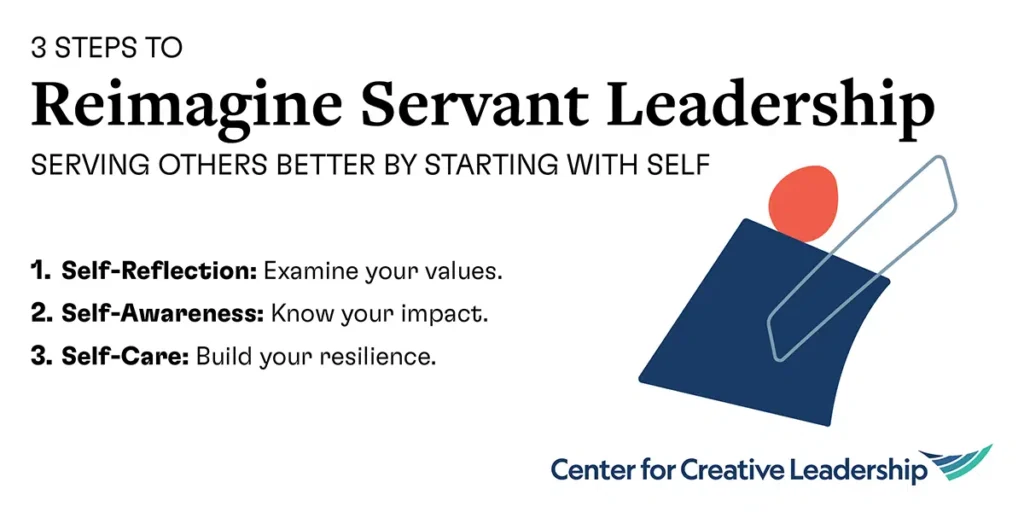
This approach, far from being selfish, is a strategic imperative for long-term leadership success. By investing in oneself, leaders can cultivate the resilience, clarity, and energy necessary to navigate complex challenges and inspire their teams. The three foundational pillars of this evolved model are:
1. Self-Reflection: Understanding Your Core Values and Motivations
Just as servant leaders guide their teams to identify their values, learn from experiences, uncover needs, and set goals, they must also apply these principles to themselves. Self-reflection is the process of looking inward to understand one’s own motivations, beliefs, and behaviors. It involves critically examining one’s values and how they shape leadership approaches.
Tools like 360-degree assessments can provide valuable external perspectives, but the journey of self-reflection often begins with introspection. Leaders are encouraged to ask themselves probing questions:
- What are the core values that guide my decisions and actions?
- What past experiences have most significantly shaped my leadership style?
- What are my strengths and weaknesses as a leader, and how do they manifest in my interactions?
- What are my personal and professional aspirations, and how do they align with my current path?
- What situations tend to bring out the best and worst in me, and what strategies can I employ to foster more positive responses?
Organizational psychologist Adam Grant emphasizes this experiential focus, suggesting that instead of dwelling on "why" one is a certain way, which can lead to unproductive rumination, leaders should focus on "what" situations elicit particular responses and "how" they can improve. This outward-looking reflection on experiences and skills offers a more actionable path to self-understanding.
Furthermore, self-reflection is an opportune moment to assess the inclusivity of one’s value system. Have critical life experiences been shaped by diverse perspectives? If a leader identifies a lack of inclusivity in their past, actively seeking out connections with individuals from varied backgrounds—perhaps by diversifying their professional network on platforms like LinkedIn—can be a tangible step towards practicing more inclusive leadership. This conscious effort to broaden one’s perspective is integral to developing a well-rounded and empathetic leadership approach.
2. Self-Awareness: Comprehending Your Impact on Others
Effective servant leadership is inextricably linked to a high degree of self-awareness. Leaders must possess a deep understanding of their own values and how these values translate into their daily interactions and decisions. This awareness allows them to consciously manage their impact on their team members.

Research consistently identifies self-awareness as one of the four fundamental core leadership skills essential for success at every career stage. In today’s rapidly evolving and complex professional landscape, cultivating this skill is more critical than ever.
A powerful method for enhancing self-awareness is actively soliciting feedback from various sources—colleagues, team members, mentors, and even family. This external input can illuminate discrepancies between a leader’s intentions and their actual impact, revealing potential blind spots in their behavior.
The key to effectively engaging with feedback lies in maintaining a stance of genuine curiosity. Approaching feedback with an open mind and a sincere desire to understand how one’s actions affect others can transform defensiveness into receptiveness, fostering a growth mindset. Curiosity fuels self-awareness and encourages others to participate in a leader’s development journey.
Through feedback-driven self-awareness, leaders can foster an environment of mutual exchange rather than one characterized by dependency or power imbalances. A leader’s curiosity not only deepens their understanding of their influence but also enhances the quality of their relationships and the effectiveness of their team’s work.
3. Self-Care: Building Personal Resilience and Preventing Burnout
Resilience has always been a critical component of navigating professional challenges. However, the traditional focus on achieving a rigid "work-life balance" has become increasingly outdated as the lines between professional and personal lives have blurred. The conversation has shifted to the paramount importance of resilience in the face of uncertainty and setbacks, transforming it from an aspirational ideal to a mission-critical competency.
The concepts of self-care, burnout prevention, and recovery from overwork are at the forefront of discussions in both individual and organizational spheres. Yet, the practical application of resilience-building practices remains a significant hurdle for many.
The traditional servant leadership model, with its strong emphasis on prioritizing others, can inadvertently push leaders to neglect their own well-being. The subtle but vital balance between caring for others and caring for oneself is often disrupted.
Organizations like the Center for Creative Leadership (CCL) have dedicated significant research to understanding and promoting resilience. Their insights offer practical strategies for leaders to cultivate their own resilience:
- Prioritize Sleep: Adequate rest is foundational for cognitive function, emotional regulation, and overall well-being.
- Engage in Physical Activity: Regular exercise is a proven stress reliever and mood enhancer.
- Practice Mindfulness or Meditation: These techniques can help leaders stay present, manage stress, and improve focus.
- Set Realistic Boundaries: Establishing clear limits between work and personal life is essential for preventing overextension.
- Seek Social Support: Connecting with trusted friends, family, or colleagues can provide emotional ballast during challenging times.
- Engage in Hobbies and Interests: Pursuing activities outside of work provides a vital outlet for relaxation and personal fulfillment.
As with all aspects of leadership, the balance between self-care and caring for others will naturally fluctuate. Practicing servant leadership is not about a static commitment but a dynamic interplay. Instead of perpetually placing others’ needs above one’s own, leaders must intentionally carve out time for self-nurturing. This commitment is fundamental to both personal well-being and sustained leadership effectiveness.
Crafting a Sustainable Servant Leadership Model
This evolved approach to servant leadership fosters a more harmonious equilibrium between the energy invested in self and the energy directed towards others. It leverages a leader’s self-reflection and self-awareness to cultivate a deeper understanding of their impact, while unequivocally valuing self-care as an indispensable element of success.
These "self-centric" dimensions of servant leadership are increasingly vital in our complex global environment, where leaders are frequently called upon to make difficult decisions amidst constant change. To effectively bring their best selves to their work, leaders must move beyond viewing servant leadership solely as an outward-facing endeavor. Instead, they should encourage their teams and colleagues to embrace a similar holistic approach. This collective shift can cultivate a culture where shared achievement is paramount, mutual support is ingrained, and personal well-being is recognized as a collective responsibility.
The implications of this shift are profound. Organizations that foster this balanced approach to servant leadership are likely to see increased innovation, reduced employee turnover, and enhanced overall organizational performance. Leaders who model self-care and self-awareness can inspire their teams to adopt similar practices, creating a virtuous cycle of well-being and productivity. In essence, by serving themselves well, leaders are better equipped to serve their organizations and the individuals within them in a lasting and impactful manner.
The future of effective leadership hinges on embracing this integrated model. It acknowledges that the strength of the servant leader is not diminished but amplified when they prioritize their own foundation of well-being. This allows them to lead with greater clarity, resilience, and sustained energy, ultimately benefiting everyone they serve.
For organizations seeking to cultivate this more sustainable approach to leadership, investing in programs that focus on resilience and self-awareness is no longer optional but essential. By empowering leaders to "burn bright instead of burning out," businesses can unlock their full potential and navigate the complexities of the modern world with greater efficacy and enduring impact.