The moment arrives with a quiet solemnity. A valued team member, their voice tinged with an unmistakable tremor, shares the devastating news of a significant loss – the death of a loved one. In that instant, the leader’s instinct to offer support is met by a surge of internal uncertainty. For many, a quiet panic sets in: "What do I do now?" This common, yet often unspoken, dilemma highlights a critical gap in leadership development, particularly in addressing the universal human experience of bereavement within the professional sphere.
The very etymology of "bereaved" – derived from a word meaning "to be robbed" – speaks volumes about the profound sense of loss that grief entails. It suggests that this emotional state cannot simply be managed away or compartmentalized as if it were a logistical challenge. Yet, within many organizational cultures, this is precisely the expectation placed upon employees experiencing loss, and by extension, upon their leaders.
Bereavement is one of the most universally experienced aspects of the human condition. It is a certainty that nearly every working adult will encounter it, often multiple times throughout their careers. Despite its pervasiveness, a striking deficiency exists in the preparation and training provided to leaders tasked with supporting their grieving employees. While the intention to offer support is abundant, the effectiveness of that support often falls short. Research underscores a significant chasm between leaders’ aspirations to help and the tangible impact of their actions, presenting a clear opportunity for robust leadership development initiatives. This is not about transforming managers into grief counselors, but rather equipping them with the essential skills to be present, honest, and capable of acknowledging what they cannot fix.
Bereavement at Work: The Profound Toll It Takes
Understanding the scope of the challenge is paramount. Bereavement in the workplace occurs when the deeply personal experience of loss collides with the structured demands of professional life. Grief, by its nature, does not adhere to schedules or respect professional boundaries. It does not cease to exist at the office door. A comprehensive, three-perspective approach, surveying managers, coworkers, and the bereaved employees themselves, reveals a truth often overlooked in traditional bereavement research: the impact extends far beyond the individual at the epicenter of the loss.
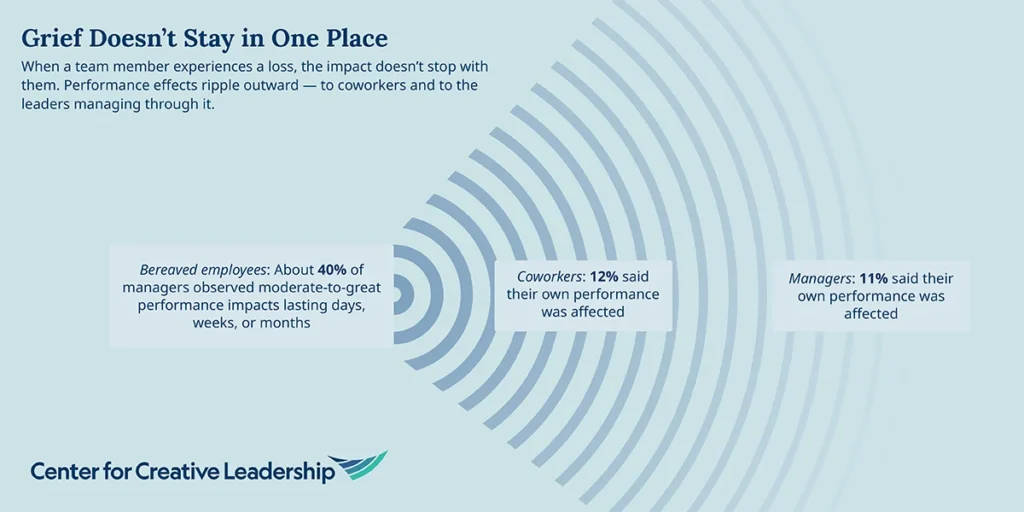
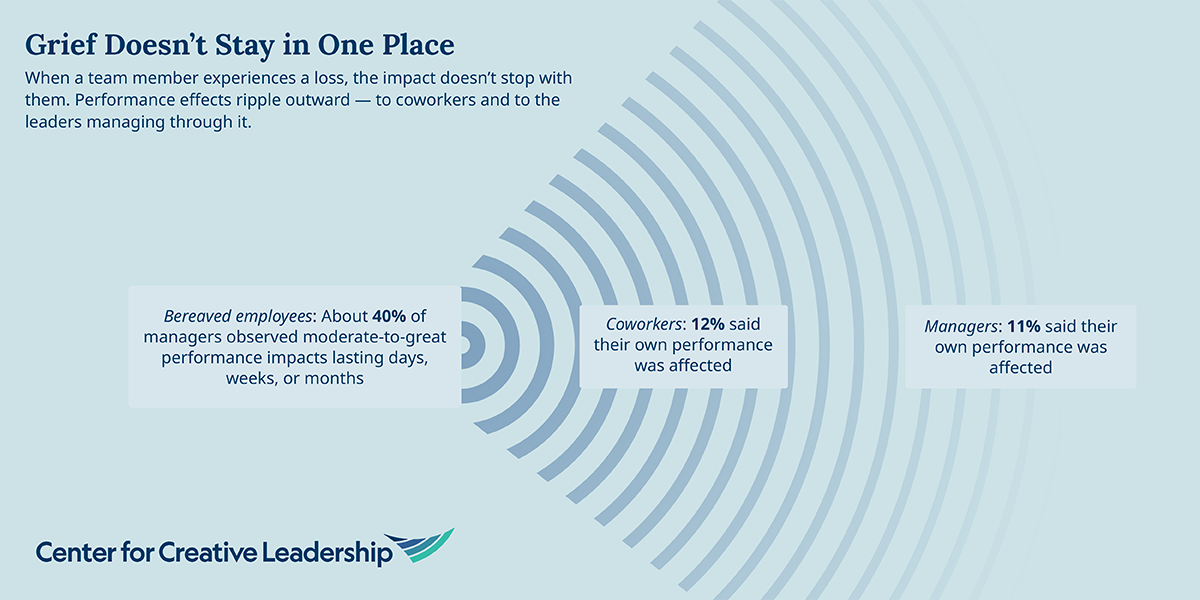
Data consistently indicates a significant performance impact stemming from bereavement. Approximately 90% of managers report observing some form of performance alteration in employees experiencing grief. Crucially, about 40% of these managers noted moderate to significant performance impacts, which can persist for days, weeks, or even months. However, the ripple effect of grief is not confined to the bereaved employee. A startling 11% of managers reported their own performance being affected, and among coworkers, this figure rose to 12%. This demonstrates that bereavement, like a stone dropped in water, sends ripples outward, disrupting not only the individual experiencing the loss but also those within their immediate professional orbit.
The inadequacy of current bereavement leave policies further exacerbates these challenges. A substantial 73% of bereaved employees reported that their allocated time off was insufficient to adequately grieve. This figure is particularly alarming considering that 28% of employees had no bereavement leave available to them whatsoever. Consequently, employees are often compelled to return to work before they are emotionally or mentally prepared, attempting to navigate the arduous process of grief while simultaneously striving to fulfill professional responsibilities. This emotional burden is compounded by practical considerations such as funeral arrangements, estate management, and the emotional labor of supporting other grieving family members. These statistics are not mere metrics of productivity; they are stark indicators of the silent weight employees are asked to bear, frequently without adequate organizational support.

Supporting Grieving Employees: When Good Intentions Fall Short
The desire to act compassionately when a team member is grieving is a common sentiment among leaders. However, the aspiration to help and the knowledge of how to help are distinct. Research indicates that while a significant 60% of bereaved employees felt their manager treated them with a high degree of compassion, a concerning 20% reported receiving little to no support. This translates to one in five individuals navigating one of life’s most profound challenges feeling isolated and unsupported by their direct leadership.
It is crucial to clarify what is not expected of leaders in these situations. Leaders are not tasked with finding the perfect words, nor are they expected to "fix" grief – an inherently impossible endeavor. Accelerating someone’s healing process is also an unreasonable expectation. Leaders are not therapists. The core of effective support, as illuminated by research, is far more fundamental: to show up, to pay attention, to offer options, and crucially, to follow the lead of the grieving employee.
Subtle Signals, Significant Impact
A common pitfall for leaders is the tendency to await overt signs of distress before intervening – a public breakdown, a missed deadline, or an obvious struggle. However, grief in the workplace rarely announces itself with such dramatic clarity. More often, it manifests in subtler, less easily discernible changes that managers may observe. These can include a decline in engagement, a withdrawal from social interactions, increased irritability, or a noticeable decrease in proactivity. These are not immediate, glaring red flags; they are nuanced indicators. Missing these subtle signals means missing a critical window of opportunity to offer support.
Conversely, certain leader behaviors can inadvertently exacerbate the situation. For instance, avoiding the topic of grief altogether, offering platitudes that minimize the loss, or pushing for a return to "normalcy" too quickly can be counterproductive. The simple act of checking in, without demanding a specific response or solution, requires attentiveness rather than certainty.
Small Gestures, Lasting Impressions
In supporting grieving employees, grand gestures often pale in comparison to a consistent, understated presence. A signed card, a cup of coffee brought without fanfare, or a brief, non-intrusive check-in that doesn’t require the employee to feign normalcy can carry significant weight. These small acts convey a powerful message: "I see you as a person, not just as a role within the organization."
In contrast, employees have identified unhelpful responses such as offering unsolicited advice, sharing personal grief anecdotes that shift the focus, or making assumptions about what the grieving person needs. The gesture itself is less important than the underlying signal it sends: recognition and empathy.
One Size Does Not Fit Grief
One of the most critical findings from research in this area is that individual responses to grief are highly varied. Not everyone seeks the same type of support or requires the same level of engagement. Some employees may need increased personal space, while others may benefit from opportunities to talk. Some may find solace in immersing themselves in work, while others require adjusted expectations and a more gradual reintegration.
However, many leaders tend to adopt a standardized approach to bereavement at work, often defaulting to avoidance or excessive checking-in, rather than engaging in the simple act of asking. The solution is remarkably straightforward and hinges on a fundamental leadership skill: inquiry. Questions such as, "How can I support you right now?" or "Would you prefer to ease back in, or jump in?" signal that the employee’s experience is valued and remove the guesswork that often leads to mismatched support. It is also important to acknowledge that employees may not always know what they need; offering options and allowing them to adjust their needs over time is key.
When Leaders Get It Right
Bereaved employees vividly recall leaders who were present and supportive during their time of loss. Some of the most impactful positive responses observed in research involved nothing more than flexibility, consistent presence, and advocacy. Leaders who excel in these situations demonstrate attentiveness, acting on what they observe. They may advocate for extended time off, maintain regular but unobtrusive check-ins, allow employees to set their own pace for returning to full duties, and most importantly, acknowledge the loss. This acknowledgment of grief is far more significant than many leaders realize.
Bereavement at Work is a Leadership Development Opportunity
Even comprehensive leadership development programs often have blind spots when it comes to navigating unscripted human interactions. A team member’s bereavement is a prime example of such a moment, and a majority of leaders find themselves unprepared. Research indicates that a substantial 73% of managers feel they require training on how to effectively support a bereaved employee, signifying that nearly three-quarters of leaders are actively seeking the fundamental human skills needed to be there for their teams.
These essential skills are not novel concepts in leadership development; they are foundational. The capabilities required to effectively support a grieving employee – emotional intelligence, self-awareness, empathy, the ability to conduct difficult conversations, and coaching presence – are precisely those that define exceptional leadership more broadly. Bereavement in the workplace serves as a high-stakes test of these skills, one for which most leaders have historically lacked adequate preparation.
The most effective approach is not to introduce a standalone bereavement program, but rather to integrate these competencies into existing leadership development frameworks. Bereavement scenarios offer a natural context for honing these core leadership abilities. Every module on emotional intelligence can implicitly address how a leader might navigate grief in the workplace. Similarly, coaching skills training prepares leaders to ask, without pressure, "How are you really doing?" and "What else do you need to feel supported?" This integration is not about adding a new layer to leadership development, but about applying a more nuanced and human-centered lens to what already exists.
The Path Forward: Cultivating Human-First Leadership
Bereavement is an inevitable aspect of the human experience that will touch every workplace and team. The critical question is whether leaders will be adequately prepared when confronted with it. This readiness is not about possessing an arsenal of perfect phrases, but about cultivating the skills to notice, to inquire, and to follow the lead of those who are grieving. It is, as one research participant aptly put it, about being "human first."
Organizations and leadership development professionals should therefore consider where their current curricula address the leader’s capacity to sit with another person’s pain. Where do leaders practice the vulnerable acknowledgment, "I don’t know what to say, but I am here"? Addressing these questions and actively developing leaders who can show up for their people in the ways they truly need is work of profound and lasting value. This ongoing commitment to fostering empathetic and prepared leadership is essential for creating workplaces that not only acknowledge but actively support their employees through life’s most challenging moments.