
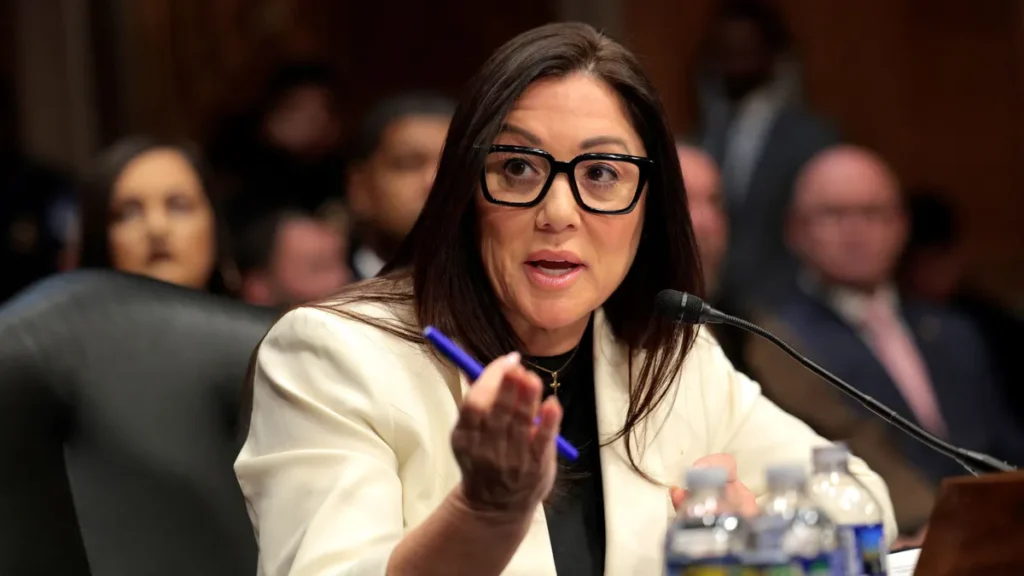
Lori Chavez-DeRemer, the U.S. Secretary of Labor, abruptly resigned from her post on Monday, April 20, 2026, after serving just over one full year in the high-profile Cabinet position. Her departure comes in the wake of escalating misconduct investigations targeting both the Secretary herself and several of her top aides, casting a shadow over the Department of Labor’s (DOL) mission and raising significant questions about accountability within the current administration. The White House confirmed her resignation in a brief statement, thanking her for her service while emphasizing the administration’s commitment to upholding the highest ethical standards.
Chavez-DeRemer, a former Republican Congresswoman representing Oregon’s 5th congressional district and previously a mayor, was confirmed as Secretary of Labor in early 2025, following a contentious Senate hearing process that highlighted partisan divisions over labor policy and regulatory approaches. During her confirmation hearing on February 19, 2025, she had articulated a vision centered on workforce development, promoting job growth in emerging industries, and ensuring a balanced approach to worker protections that considered both employer and employee interests. Her tenure, however, quickly became embroiled in controversy, detracting from her stated policy objectives and culminating in a premature exit that marks one of the shortest tenures for a Cabinet Secretary in recent history. The average term for a U.S. Secretary of Labor typically spans several years, often aligning with the presidential term, making Chavez-DeRemer’s one-year service an anomaly, particularly under such circumstances.
The Genesis of the Allegations: A Chronology of Scrutiny
The first whispers of impropriety began to surface in the summer of 2025, mere months into Chavez-DeRemer’s tenure. Initial reports from anonymous whistleblowers within the Department of Labor alleged instances of favoritism in hiring practices, particularly concerning senior advisory roles. These claims suggested that individuals with close personal ties to the Secretary, rather than those with the most relevant expertise, were being fast-tracked into influential positions, bypassing standard vetting and hiring protocols. By late summer, these allegations were amplified by several detailed investigative reports published by reputable news outlets, which pointed to questionable travel expenditures by the Secretary and her inner circle. These reports highlighted first-class air travel, luxury accommodations, and lavish dining expenses for what were described as routine official engagements, raising concerns about potential misuse of taxpayer funds.
The situation escalated significantly in October 2025 when the Department of Labor’s Office of Inspector General (OIG) formally announced that it had initiated an inquiry into several of the reported allegations. The OIG’s scope included a review of travel records, expense reports, and hiring documents from Chavez-DeRemer’s office. Concurrently, a bipartisan group of legislators on the House Oversight Committee also began their own preliminary investigation, requesting extensive documentation from the DOL. This dual-pronged scrutiny from both internal watchdogs and external congressional oversight signaled the gravity of the unfolding situation.
Throughout late 2025 and early 2026, the investigations intensified. Public attention shifted from mere financial impropriety to broader ethical concerns, including allegations of a hostile work environment within the Secretary’s executive office. Several mid-level DOL employees anonymously described a culture of intimidation and retaliation against staff members who raised concerns about administrative irregularities or policy decisions. One particularly damaging report in February 2026 detailed an instance where a senior aide to Chavez-DeRemer allegedly pressured career civil servants to alter data in official reports to align with specific political narratives, a charge that, if proven, could constitute a serious breach of public trust and scientific integrity.
The pressure on Secretary Chavez-DeRemer became immense in March 2026. Weekly news cycles were dominated by updates from the OIG and Congressional investigations, with leaked documents and further whistleblower accounts painting an increasingly dire picture. Major labor unions and advocacy groups, initially cautious in their criticism, began to issue public statements demanding greater transparency and accountability. Some even called for Chavez-DeRemer’s immediate resignation, arguing that the ongoing scandals were paralyzing the Department and undermining its critical mission of protecting American workers. Faced with a complete loss of political capital and the prospect of protracted public hearings and potentially damaging legal proceedings, the decision to step down became all but inevitable.
The Department of Labor’s Mandate and the Impact of Disruption
The Department of Labor plays a crucial role in the American economy and workforce, overseeing a vast array of programs and policies designed to foster fair wages, safe working conditions, equal employment opportunities, and unemployment insurance. It is responsible for enforcing over 180 federal laws covering approximately 150 million workers and 10 million workplaces. Key agencies within the DOL include the Occupational Safety and Health Administration (OSHA), the Wage and Hour Division (WHD), the Bureau of Labor Statistics (BLS), and the Employee Benefits Security Administration (EBSA).
The continuous swirl of investigations and the ultimate resignation of Secretary Chavez-DeRemer have undoubtedly created significant disruption within these vital agencies. Policy initiatives, particularly those requiring the Secretary’s direct approval or active advocacy, are likely to face delays. For instance, planned updates to overtime rules, new enforcement guidelines for worker misclassification, and initiatives aimed at improving apprenticeship programs might be stalled as the Department grapples with leadership transition and internal morale challenges. The integrity of the DOL’s mission relies heavily on public trust and the perception of impartiality, both of which have been severely tested by these events. The drain on resources, both human and financial, from responding to extensive investigations further diverts attention from the Department’s core responsibilities.
Reactions from Across the Political Spectrum
The White House, in its official statement released shortly after the resignation, expressed "regret" at Secretary Chavez-DeRemer’s departure. White House Press Secretary Sarah Jenkins stated, "The President thanks Secretary Chavez-DeRemer for her service to the nation over the past year. We wish her well in her future endeavors. This administration remains steadfastly committed to transparency, accountability, and the highest ethical standards across all federal agencies. We will move swiftly to identify and nominate a new Secretary of Labor who can continue the vital work of supporting America’s workforce without interruption." The statement carefully avoided any direct commentary on the substance of the misconduct allegations, maintaining a formal and diplomatic tone.

Lori Chavez-DeRemer, through a spokesperson, issued a brief statement herself, asserting her decision was made "in the best interest of the Department of Labor and the American people." The statement read, "I have always strived to serve with integrity and dedication. The recent investigations have, regrettably, become a distraction from the critical work of the Department. To ensure the DOL can continue its important mission unimpeded, I have chosen to step down. I remain confident in the rectitude of my actions and those of my dedicated team, and I look forward to clearing my name." This carefully worded response sought to acknowledge the investigations without admitting guilt, framing her resignation as a selfless act to protect the institution.
Congressional reactions were sharply divided along partisan lines. Senator Michael Chen (D-NY), Chair of the Senate Committee on Health, Education, Labor, and Pensions, commented, "While the resignation is a necessary step, it does not absolve anyone of accountability. These investigations must continue to their full conclusion. The American people deserve to know the full extent of any wrongdoing and to have confidence that their government operates ethically. We stand ready to work with the White House to confirm a new Secretary who prioritizes workers’ rights and departmental integrity above all else."
Conversely, Representative Eleanor Vance (R-TX), a vocal supporter of Chavez-DeRemer, decried the situation as a "partisan witch hunt." "Secretary Chavez-DeRemer has been subjected to relentless, politically motivated attacks from day one," Vance stated. "This resignation is a tragic loss for the Department and for the President’s agenda. It is a testament to how hyper-partisanship and baseless accusations can destroy a public servant’s career, regardless of their dedication."
Labor union leaders offered a mix of relief and renewed demands. MaryBeth Carter, President of the American Federation of Labor and Congress of Industrial Organizations (AFL-CIO), remarked, "The departure of Secretary Chavez-DeRemer provides an opportunity for the Department of Labor to refocus on its core mission: protecting and empowering working families. We urge the President to nominate a successor with a proven track record of advocating for workers’ rights and a deep understanding of the challenges facing the American labor force, free from the cloud of ethical questions."
Ethics watchdog groups, such as Citizens for Government Accountability, emphasized the importance of the ongoing investigations. "This resignation underscores the critical role of independent oversight," said Executive Director David Klein. "No public official, regardless of their position, should be above the law. We call on the Inspector General and Congress to continue their thorough review to ensure full accountability and to prevent similar issues from arising in the future."

Broader Implications and the Road Ahead
Chavez-DeRemer’s resignation marks a significant political setback for the administration, coming at a sensitive time with upcoming midterm elections looming in November 2026. The controversy could become a political talking point for the opposition, fueling narratives about government inefficiency and ethical lapses. For the White House, the immediate challenge is to quickly identify and nominate a successor who can navigate a potentially difficult confirmation process in an already polarized Senate. The President will need a nominee who possesses not only deep expertise in labor issues but also impeccable ethical credentials and the ability to garner bipartisan support, a rare commodity in today’s political climate. The confirmation battle itself could become a proxy fight for broader ideological clashes over labor policy, further delaying the Department’s ability to operate at full capacity.
Historically, high-profile Cabinet resignations due to ethical concerns, while not unprecedented, often leave a lasting impact on public perception. Such events can erode public trust in government institutions, fostering cynicism about the integrity of public service. For the Department of Labor, this period of instability demands strong interim leadership to maintain continuity and reassure career staff. Deputy Secretary of Labor, Dr. Marcus Thorne, is expected to assume the role of Acting Secretary, providing temporary stability while the search for a permanent replacement proceeds.
Looking ahead, the next Secretary of Labor will face the dual challenge of restoring internal morale and external credibility while advancing critical policy goals. They will inherit a department potentially scarred by recent events, requiring a leader capable of uniting diverse stakeholders and reaffirming the DOL’s commitment to its mission. The events surrounding Lori Chavez-DeRemer’s brief tenure serve as a stark reminder of the intense scrutiny and high ethical bar demanded of those entrusted with public office, particularly at the Cabinet level, and the profound ripple effects when those standards are perceived to be compromised. The coming months will be crucial in determining how the Department of Labor recovers and whether the administration can effectively address the fallout from this significant leadership change.






