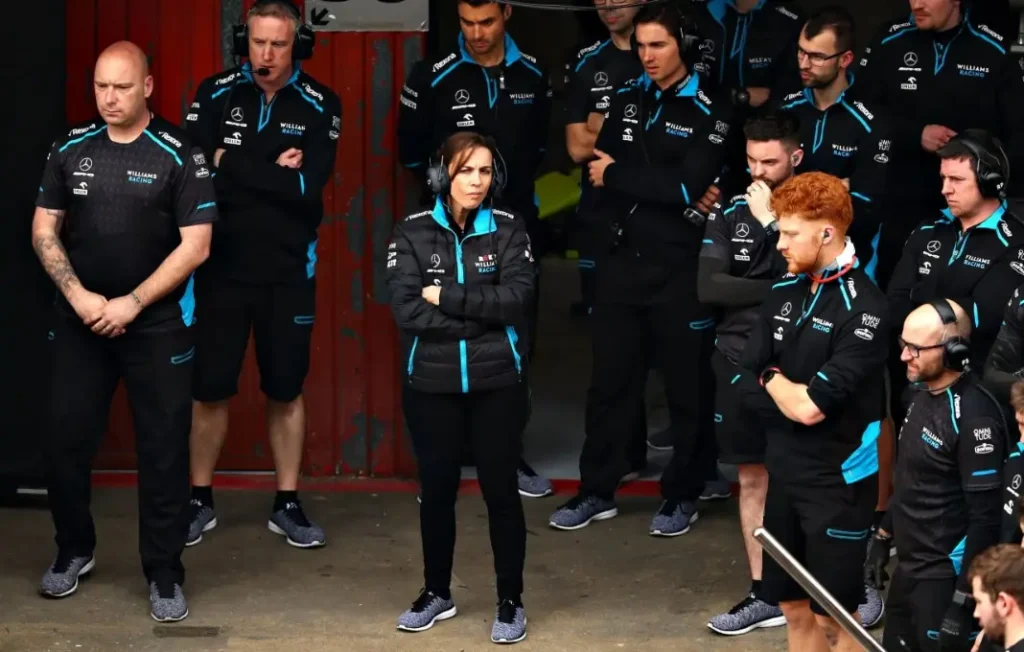
In the intense, high-octane environment of Formula 1, decisions are forged in fractions of a second, under an unforgiving spotlight, with incomplete intelligence and consequences that ripple through entire seasons. For Claire Williams OBE, the former Team Principal of Williams Racing, this was not a theoretical construct but the relentless daily rhythm of leadership. Her tenure, from 2013 to 2020, saw her at the helm of one of motorsport’s most storied franchises, navigating a turbulent era marked by immense pressure, significant financial headwinds, and the perpetual churn of technological advancement. During her leadership, the team achieved a commendable two third-place finishes in the Constructors’ Championship and amassed 15 podiums, all while orchestrating the complex transition that ultimately led to the sale of the family-owned team. As only the second woman in the annals of Formula 1 to lead a team, Williams faced an unprecedented level of public scrutiny. Her story, however, transcends the confines of the racetrack, offering profound insights for business leaders grappling with similar challenges in today’s fast-paced and often unforgiving corporate landscape. The power of her narrative lies not solely in her achievements, but in the fundamental principles of clarity, humility, and a deeply human understanding of performance that underpinned her leadership.
The Crucible of the Pit Wall: Decision-Making Under Extreme Pressure
The pit wall, as described by Williams, represents "probably one of the scariest places in sport." It is the nexus where critical decisions are made at the blistering pace of a race, demanding immediate action with severely limited information. "You’re expected to make split-second decisions with very limited information," she explained, highlighting the volatile nature of the environment where variables can shift instantaneously, all while being under constant media observation.
Williams’ strategic approach to this high-pressure environment was remarkably pragmatic: pre-defined clarity. Before stepping onto the pit wall, she established clear decision-making criteria. For Williams Racing, one paramount principle guided all choices: "Whatever consequence a decision was going to have on our constructor’s position, that was king," she stated unequivocally. "That was all that mattered." This unwavering focus served as a critical anchor amidst the chaos.
This approach directly counters findings from behavioral science research. A study originating from the Medical School Berlin, focusing on decision-making under pressure, reveals a tendency for leaders to shift from analytical reasoning to heuristics—faster, more intuitive strategies—when faced with time constraints. Crucially, if these heuristics are not pre-defined, individuals may develop them spontaneously in the moment, often leading to inconsistent or emotionally driven choices. Williams’ methodology exemplifies the antidote: establishing clear decision-making frameworks before the pressure intensifies, ensuring a consistent and principled response.
Navigating the Data Deluge: The Art of Discerning Signal from Noise
In Formula 1, data is undeniably the lifeblood of the sport. "Data is the heartbeat of Formula One," Williams acknowledged. "Without it, the sport wouldn’t exist." However, she was equally resolute about its limitations, emphasizing the indispensable role of human judgment: "We mustn’t forget that we still have brains as humans."
A particularly illustrative anecdote involved weather forecasting. Despite substantial investments in sophisticated meteorological systems, Williams often found greater reliability in the direct observations of a team member stationed remotely, observing the skies from a van for extended periods. This seemingly rudimentary method, she admitted, "was invariably more reliable." In one instance, while engineers poring over data screens maintained it wasn’t raining, drivers on track and team members in the garage could clearly see otherwise. The most experienced engineers, Williams noted, would instinctively extend a hand from the pit wall canopy to feel the rain. "It’s a brilliant example of not allowing ‘because the computer’s saying it’ to override human judgment."
This wisdom is supported by research from the University of Illinois, which highlights the detrimental effects of information overload. Studies indicate that excessive data can lead to delayed decisions, a decline in decision quality, and elevated stress levels. Elite performers, rather than becoming inundated, possess the acumen to step back and re-establish situational awareness.
Risk Management in Motion: Contextualizing Decisions and Protecting the Downside
Contrary to the popular perception of Formula 1 as a sport driven by reckless gambling, Williams identified herself as fundamentally risk-averse. "You only have to ask my bank manager," she quipped, illustrating this ingrained caution. This instinct permeated her leadership philosophy.
During periods of success for Williams Racing, her priority was safeguarding accumulated points rather than pursuing potentially ill-advised ambitious gambits. "The jeopardy was always too high," she explained, recognizing that a failed gamble could trigger cascading financial repercussions throughout the organization. Conversely, when the team faced significant challenges, her appetite for risk naturally increased. "We had nothing to lose," she stated with stark realism.
This approach demonstrates not a fixed risk profile, but a dynamic, context-dependent one. Williams understood that risk tolerance must be fluid, adapting to prevailing circumstances. This aligns with decision-velocity frameworks such as the OODA Loop (Observe-Orient-Decide-Act), which prioritizes speed and adaptability over the pursuit of unattainable perfect foresight.
Learning at Race Speed: The Power of Blame-Free Debriefs
Formula 1 teams engage in rigorous debriefing processes, meticulously analyzing every practice session and race to extract lessons that are promptly implemented. "It’s the only way we learn," Williams asserted. In a particularly challenging year, when Williams Racing failed to deliver its car for pre-season testing on schedule – a critical setback in Formula 1 terms – Williams initiated a comprehensive six-month review. "Everybody in the factory was interviewed," she recalled. The objective was not to assign blame but to foster understanding.
"I was very clear that I wanted people to be open and honest, and there would be no negative consequence for them being so," she stated. This commitment to psychological safety fostered an environment where failure was deemed acceptable, provided individuals proactively raised concerns. This approach fundamentally transformed not only performance but also the level of trust within the organization.
The Silent Saboteur: Communication Breakdowns and Their Cost
When asked to identify the single failure that invariably guarantees disaster in Formula 1, Williams’ answer was immediate and emphatic: "Communication." Disconnects between aerodynamic departments, design teams, manufacturing, and the race crew significantly hampered performance. The remedies she implemented were both practical and deeply human. For instance, integrating aerodynamicists into race weekends allowed them to witness performance firsthand and foster a shared language with race engineers.
The business implications of poor communication are starkly evident. Research cited by Talaera estimates that miscommunication costs U.S. businesses approximately $1.2 trillion annually in lost productivity. Furthermore, Sci-Tech Today reports that a significant 86% of employees attribute poor communication as the primary driver of workplace failures. Williams’ experience underscores a vital lesson: communication is not a "soft skill" but a fundamental structural element of successful operations.
Cultivating an Ambidextrous Organization: Discipline Tempered with Humanity
Williams described Williams Racing as a confluence of structure and familial warmth. While clear processes and routines were in place, there was a deliberate absence of hierarchical distance. "No one’s more important than anyone else," she maintained, fostering an open-door policy that encouraged accessibility.
This delicate balance mirrors the concept of the "ambidextrous organization" championed by the Harvard Business Review. Such entities skillfully integrate disciplined execution with the flexibility and empathy inherent in human-centric management. These organizations demonstrate a significantly higher propensity to sustain performance while fostering innovation under duress.
Perhaps the most potent aspect of Williams’ leadership was its foundation in genuine care. She possessed a deep commitment to understanding her team members – their motivations, their well-being, and their challenges. "It broke my heart when people weren’t happy," she admitted, revealing a profound emotional investment in her people.
This humanity proved particularly crucial as she navigated leadership as a woman in a predominantly male domain. Periods of underperformance, compounded by the personal journey of motherhood, intensified the scrutiny she faced. "When I feel under threat, I fight," she stated, acknowledging her resilience. However, she also came to appreciate the vital importance of rest, recovery, and cultivating a supportive network of individuals.
Conclusion: Leadership Beyond the Stopwatch
Claire Williams’ journey offers a compelling counter-narrative to the often-held myths of elite performance, which tend to emphasize bravado, heroic feats, or the illusion of perfect data. Instead, her experience highlights the profound impact of clarity established before pressure descends, the art of discerning critical signals amidst overwhelming noise, the imperative of learning without the paralyzing fear of blame, and leadership rooted in fundamental human connection.
In an era where the business world increasingly mirrors the relentless pace and unforgiving nature of the Formula 1 pit wall, her lessons hold significant resonance far beyond the racetrack. As Williams herself eloquently articulated, leadership is not defined by an infallible record of being right. "It’s about how you pick yourself up and how you respond in the aftermath. That’s the most important thing." This enduring perspective may well offer the most profound definition of elite performance, applicable to any arena of high-stakes endeavor.