
The rapid proliferation of artificial intelligence across the global corporate landscape has created a paradoxical environment where investment is surging, yet measurable returns remain elusive for the majority of organizations. According to recent data from a McKinsey global survey, while more than 50% of enterprises have significantly increased their AI expenditures over the past fiscal year, only a small fraction report achieving a transformative impact across the entire organization. This discrepancy highlights a fundamental weakness in current corporate approaches: the absence of a structured AI strategy framework. Without such a framework, AI initiatives frequently devolve into a series of disconnected pilot programs that lack the cohesion necessary for scaling or long-term value creation.
The Landscape of AI Implementation in 2025
The transition from generative AI experimentation to industrial-scale application has defined the corporate agenda entering 2025. In previous years, the focus was primarily on "discovery"—identifying what large language models and machine learning could theoretically achieve. Today, the priority has shifted toward "execution." However, the "state of AI" reports suggest that most organizations still treat AI as a modular add-on rather than a foundational system. This fragmented approach leads to duplicated efforts across departments, where marketing, operations, and customer service teams may be deploying redundant tools without a centralized data architecture or shared governance.
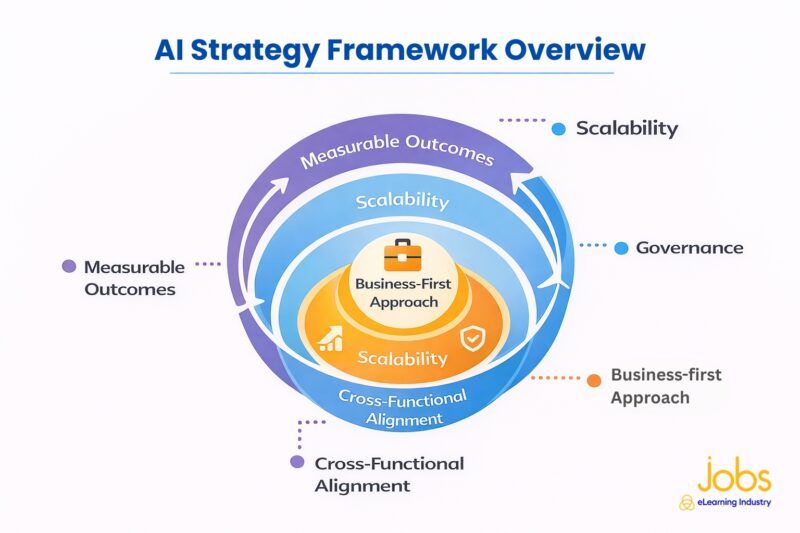
Industry analysts observe that the primary obstacle to AI success is not a lack of technological access or talent, but a lack of alignment. An effective AI strategy model acts as a connective tissue between high-level business objectives and operational output. It provides a sequence for decision-making, helping leaders determine which use cases to prioritize, which data infrastructures to modernize, and where to pause expansion to ensure safety and compliance.
The SCALE Framework: A Comprehensive Five-Layer Model
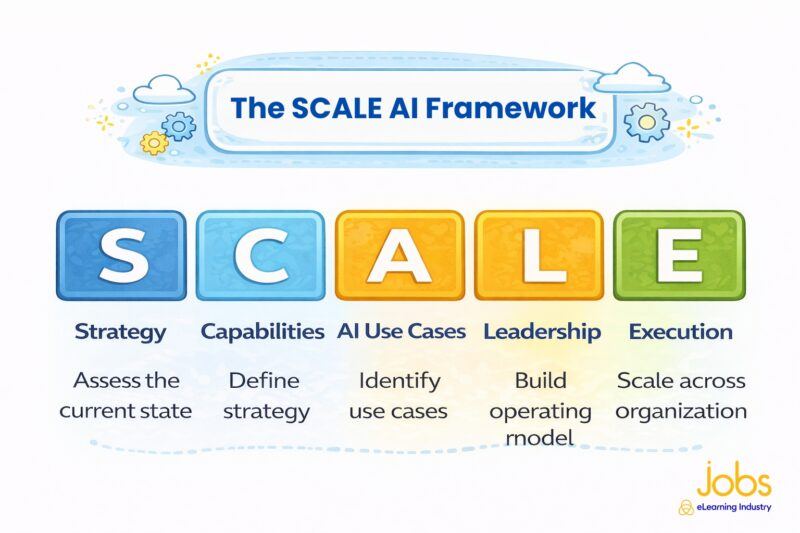
To move beyond "pilot purgatory"—the state where AI projects never move past the initial testing phase—organizations are increasingly adopting structured models such as the SCALE framework. This five-layer approach provides a roadmap for turning technical potential into financial and operational performance.

1. Strategy and Business Alignment
The foundation of any AI initiative must be rooted in specific business problems rather than technological novelty. Strategic alignment requires leaders to define what AI is intended to improve: revenue growth, operational efficiency, or customer retention. Analysts suggest that the most successful firms are those that prioritize "outcome-first" thinking. For instance, rather than asking "How can we use generative AI?", a high-performing organization asks, "How can we reduce our supply chain latency by 15%?" By anchoring AI in core business goals, companies avoid the "experimentation for its own sake" trap that often drains resources without providing ROI.
2. Capabilities and Data Infrastructure
AI is only as effective as the data that fuels it. This layer addresses the organization’s readiness, focusing on data hygiene, accessibility, and integration. Historical context shows that many digital transformation efforts in the late 2010s failed because data remained in silos. In the AI era, this problem is magnified. A robust framework requires a technology stack where systems integrate seamlessly, allowing for the flow of clean, structured data across departments. Without this foundation, AI outputs become unreliable, leading to a loss of trust among internal stakeholders and customers.
3. AI Use Cases and Prioritization
Modern enterprises are often overwhelmed by the sheer number of potential AI applications. The SCALE framework necessitates a rigorous filtering process. Use cases are evaluated based on two primary axes: business impact and feasibility. High-impact, high-feasibility projects—often referred to as "quick wins"—are prioritized to build internal momentum and secure further funding. This stage prevents the dilution of resources and ensures that the workforce is focused on initiatives that can realistically move the needle on corporate performance.
4. Leadership, Governance, and the Operating Model
Governance is frequently viewed as a barrier to speed, but in a structured AI strategy, it is a catalyst for scale. This layer defines ownership and accountability. It establishes who is responsible for model accuracy, data privacy, and ethical decision-making. As global regulations like the EU AI Act begin to take effect, having a formalized governance structure becomes a matter of legal necessity as well as operational efficiency. Cross-functional alignment is critical here; AI must be a collaborative effort between the C-suite, IT, and legal departments to ensure that deployment is both safe and consistent.
5. Execution and Scaling
The final layer involves moving from validated pilots to enterprise-wide production. Scaling requires a shift in mindset from "building a tool" to "managing a lifecycle." This includes continuous monitoring of AI performance, iterative improvements based on user feedback, and the expansion of successful models into new departments or geographical regions. True scaling is achieved when AI becomes an invisible part of the workflow, enhancing productivity across the entire organization rather than serving as a standalone feature.
Chronology of a Successful AI Strategy Rollout
The implementation of a structured framework typically follows a specific chronological order to ensure stability and growth:
- Month 1-2: Maturity Assessment. Organizations conduct a thorough audit of their current data state, existing technical capabilities, and departmental AI usage. This baseline identifies gaps and prevents the duplication of existing tools.
- Month 3-4: Strategic Direction and Roadmap. Leadership translates business goals into an actionable AI plan. This involves setting measurable KPIs and establishing the governance board.
- Month 5-8: Pilot Development and Validation. Selected high-priority use cases are tested in controlled environments. The focus is on gathering data to prove ROI and technical viability.
- Month 9 and Beyond: Industrialization. Successful pilots are integrated into the broader corporate ecosystem. Training programs are launched to upskill the workforce, and the operating model is refined for continuous scaling.
Supporting Data and Economic Projections
The drive toward structured AI frameworks is supported by significant economic data. Research by Gartner indicates that by 2026, organizations that apply a consistent AI strategy framework will see a 25% higher return on their AI investments compared to those using ad-hoc approaches. Furthermore, International Data Corporation (IDC) projects that global spending on AI-centric systems will surpass $300 billion by 2026.
However, the risks of failure are equally documented. Gartner also predicts that at least 30% of generative AI projects will be abandoned after the proof-of-concept stage due to poor data quality, inadequate risk controls, or escalating costs. These statistics underscore the reality that while the budget for AI is growing, the margin for error is shrinking.
Common Pitfalls in Strategic Execution
Despite the availability of frameworks, many organizations fall victim to recurring errors. The "Technology-First Trap" remains the most prevalent mistake, where companies invest in expensive platforms before identifying a business need. This often leads to "shelfware"—sophisticated technology that remains unused because it does not fit into the existing employee workflow.
Another significant barrier is the "Governance Gap." Without clear rules on how data is handled or how models are audited, initiatives often stall when they hit legal or compliance reviews. Furthermore, many companies fail because they treat AI as a technical project owned solely by the IT department. Experts argue that AI is a business transformation tool; if the leadership team does not take active ownership of the strategy, the cultural shift required for AI adoption will never occur.
The Evolving Role of Leadership
For an AI strategy to succeed, leadership must move beyond mere financial approval. The emergence of the Chief AI Officer (CAIO) role in many Fortune 500 companies reflects the need for a dedicated executive who can bridge the gap between technical possibility and business strategy.
Leadership’s role is also cultural. They must manage the "AI skills gap" by investing in upskilling and reskilling programs. As AI automates routine tasks, the workforce must be prepared to move into more strategic, oversight-oriented roles. Organizations that ignore the human element of AI strategy often face internal resistance, which can derail even the most technically sound frameworks.
Broader Impact and Market Implications
The long-term implication of adopting structured AI frameworks is the creation of a permanent competitive advantage. Companies that successfully scale AI can respond to market changes with unprecedented speed. In marketing, AI-driven insights allow for hyper-personalization at a scale previously impossible. In operations, predictive analytics can mitigate supply chain disruptions before they occur.
As we move toward 2026, the "AI divide" will likely widen between companies that have implemented a structured framework and those that continue to rely on fragmented experiments. Those with a framework will benefit from repeatable processes, lower operational costs, and a more agile decision-making structure. In contrast, companies without a strategy will find themselves trapped in a cycle of high costs and low impact, struggling to keep pace with an increasingly automated marketplace.
In conclusion, the transition from AI as a "trend" to AI as a "business reality" requires more than just capital; it requires a disciplined, structured approach. By utilizing frameworks like SCALE and following a rigorous implementation roadmap, organizations can ensure that their AI investments deliver not just temporary innovation, but sustained enterprise value and market leadership.