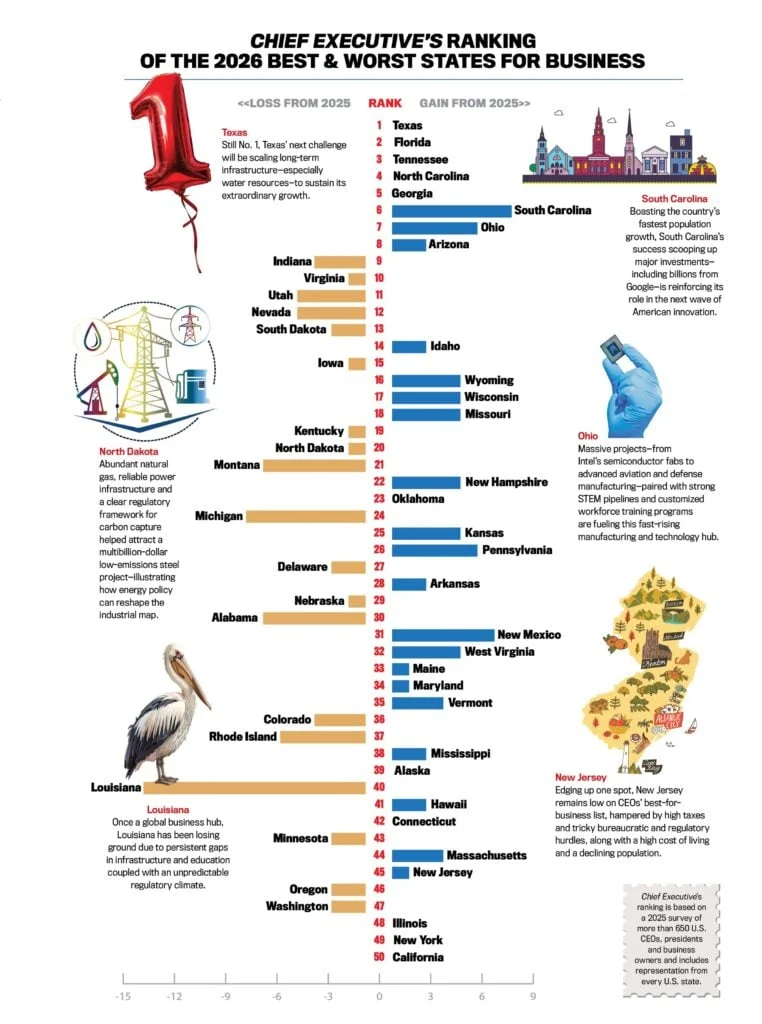
As the United States approaches its 250th anniversary, a significant reevaluation of its economic landscape is underway. Chief Executive’s annual survey of the Best & Worst States for Business offers a critical snapshot, revealing which states are adeptly transforming seismic demographic, technological, and economic shifts into enduring competitive advantages, and which are beginning to falter. This year’s findings underscore a fundamental truth: sustained success is increasingly tied to proactive adaptation and the foundational execution of core business needs.
The transformative power of strategic investment and long-term planning is vividly illustrated by South Carolina’s economic trajectory. When Google established its first data center in Moncks Corner in 2007, the scale of its future commitment was largely unforeseen. Nearly two decades and an initial $4.5 billion later, Google has pledged an additional $9 billion through 2027, signaling a deepening integration of the state into its global AI infrastructure. Ruth Porat, Alphabet and Google’s president and chief investment officer, emphasized this long-term vision, stating the company is building upon a 15-year foundation to ensure South Carolina’s prosperity "during the next wave of American innovation." This substantial investment, however, is not merely a headline; it represents the culmination of years of diligent, often unglamorous, foundational work. The state’s readiness in critical areas such as power infrastructure, workforce development, transportation networks, site availability, and streamlined permitting processes created the fertile ground for such a significant capital injection.
South Carolina’s experience is not an isolated phenomenon. Similar narratives of proactive development are unfolding across the nation. Ohio has successfully cultivated a diverse industrial portfolio, attracting giants like Intel, alongside innovative companies such as Joby Aviation and Anduril. North Dakota is demonstrating its capacity to secure major projects, including a low-emissions steel facility that traditional steel-producing states struggled to attract. In a notable shift, North Carolina is becoming a magnet for climate-tech entrepreneurs who historically gravitated towards coastal hubs. The economic map of America is in flux, a transformation that may appear gradual in public perception but is accelerating rapidly in terms of capital allocation.
This evolving economic geography holds particular significance as the nation braces for its semiquincentennial. The enduring tension between federal and state power, a foundational debate among the nation’s founders, continues to shape the American economic engine. The Founders, while grappling with the distribution of authority, understood the inherent power of inter-state competition. They envisioned states vying for commerce, industry, and talent, a constructive rivalry that, two centuries later, remains a potent force in determining where the next era of economic growth will concentrate and where it will stagnate.
Inside the Survey: A Shifting Economic Landscape
Chief Executive’s 2026 Best & Worst States for Business survey, a comprehensive analysis derived from hundreds of CEO responses, reveals a dynamic interplay of continuity and change. Texas maintains its leading position at No. 1, with Florida closely following at No. 2. Tennessee, North Carolina, and Georgia round out the top five, demonstrating a consistent strength in fostering business-friendly environments. However, below this established tier, significant shifts are occurring, signaling a reordering of economic fortunes.
South Carolina’s ascent to No. 6, a jump of seven spots, is directly attributable to its focus on fundamental strengths, mirroring the Google investment narrative. Ohio’s climb of five places to No. 7, positioning it as the highest-ranked Midwestern state, is a testament to its aggressive and targeted marketing strategies, compelling economic development narratives, and a sustained commitment to upskilling its existing workforce.

In the mid-tier rankings, more subtle but equally impactful shifts are underway. Wyoming, Wisconsin, and Missouri each advanced four spots this year. Wisconsin’s progress is particularly noteworthy, building on a nine-place surge last year, suggesting a growing structural momentum rather than mere statistical anomaly. Pennsylvania’s rise of five places to No. 26 indicates that consistent performance in foundational areas can reshape CEO perceptions over time. Larry Gigerich, executive managing director of Ginovus consultants, a leading site selection firm, observes, "The states focusing on the fundamentals—talent, infrastructure, tax, and regulatory climate—are the ones that will continue to do well."
This perspective is echoed by global futurist Jim Carroll, who offers a more pointed assessment: "There are states in denial about the reality of where the future is going and those that are not—those that are not will have the opportunity." Carroll contends that future economic dominance will not be determined by the next incentive bidding war, but by states that cultivate environments where investment becomes an inevitability. This includes fostering robust research and development, modernizing energy grids, forging genuine alignment between industry and academia, supporting incubators that nurture new companies, and implementing skills training programs that extend well beyond the initial ribbon-cutting ceremony.
Collectively, the survey’s rankings, alongside insights from CEOs, economists, and economic development experts, converge on a singular conclusion: as the United States approaches its 250th year, "winning the future" is not an elusive strategy but a matter of relentless, often understated, execution across a core set of fundamental principles that yield compounding returns over time.
Migration: The Unseen Force Reshaping the Economic Map
Arguably the most potent force reshaping the long-term business landscape is not a specific tax policy or incentive package, but the fundamental movement of people. Recent Census Bureau estimates highlight South Carolina’s remarkable population growth of 1.5 percent between July 2024 and July 2025, outpacing every other state and nearly tripling the national rate. This marks the second consecutive year South Carolina has led the nation in population growth.
Dr. Joseph Von Nessen, a research economist at the University of South Carolina’s Darla Moore School of Business, identifies this demographic surge as the state’s "secret sauce." He argues that in-migration injects not only consumers but also a vital supply of workers and taxpayers. This influx, in turn, accelerates demand for housing, healthcare, and essential services, fostering a more diverse and robust industrial base.
However, Von Nessen cautions against a simplistic focus on headline growth figures. He stresses that the composition of migrating populations is critically important. A state attracting young engineers and entrepreneurial talent will chart a fundamentally different economic trajectory than one primarily fueled by retirees. The former implies a different labor supply, distinct wage pressures, and a distinct form of long-term dynamism.
For entrepreneurs like Natasha August, founder of the Dallas-based creator platform RM11, this distinction is a tangible business imperative. Texas is a significant draw for the working-age talent her company requires, and at cost points that facilitate both hiring and retention. "Everything around Dallas and in Texas in general is just more reasonable to live here," August states. "Thus, the employee retention is a lot higher for us."
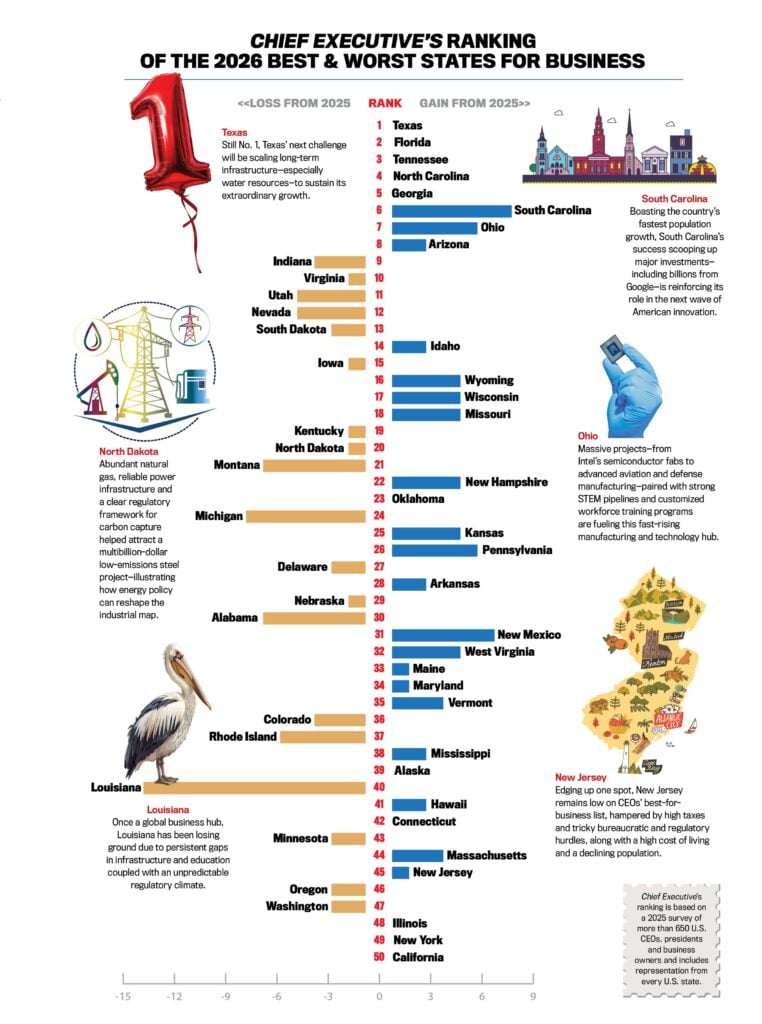
Beyond the current growth corridors, Michigan exemplifies a region experiencing a nascent economic revival. After decades of decline, the state has recorded four consecutive years of population gains and its first net in-migration in 35 years. This data suggests that Michigan’s value proposition is beginning to resonate once again with both businesses and families. Despite a seven-place slip to No. 24 in this year’s rankings, this movement is less a definitive verdict and more a reflection of a strategic transition. Michigan is actively pivoting from a recession-sensitive, automotive-centric economy towards a more diversified and "recession-resilient" mix encompassing technology and life sciences, all while preserving its foundational automotive sector. Michelle Grinnell of the Michigan Economic Development Corporation emphasizes that the state is not competing on cost alone. "But we believe we deliver the greatest value, both to companies and to people," she asserts, highlighting a unified "Team Michigan" approach. This includes coordinated inter-agency efforts, proactive engagement on permitting, and a precise alignment between projects, communities, and available sites, enabling companies to receive "one answer" and experience "no surprises"—factors that CEOs highly value for long-term investments.
Furthermore, a significant contingent of CEOs argue that the economic strengths of the Midwest remain profoundly underestimated. Sean Donegan, founder and CEO of Satelytics, an AI-driven geospatial analytics firm based in Perrysburg, Ohio, expresses frustration with prevailing narratives. "I’m tired of people believing that the only software companies that exist are on the West and East Coasts—and that’s just completely untrue," Donegan states. "The Midwest is greatly undervalued. People here are incredibly smart, loyal, trustworthy, and honest—key attributes for any successful business."
Talent and Education: The Bedrock of Competitive Advantage
In today’s economic climate, the paramount concern for businesses is the availability and quality of human capital. States that are successfully attracting and retaining talent are treating it not as a static asset but as a dynamic operating system. This involves a holistic approach encompassing recruitment, training, strategic matching, retention, and continuous upskilling in response to evolving industry demands.
This strategic focus on talent was a primary driver for Steven Boal’s decision to relocate Matia Mobility from the Bay Area to Salt Lake City, where he found the "logistics of manufacturing were becoming prohibitive." Boal identifies "Utah’s greatest asset is its demographics." He elaborates, "The brain drain has reversed. We are seeing more talent stay in Utah post-graduation, and more experienced leaders moving here for the quality of life, which helps us tackle the pipeline challenge from both ends." The proximity to leading research institutions like the University of Utah and BYU is also a significant advantage. "These universities aren’t just churning out graduates—they are actively commercializing technology and fostering an entrepreneurial mindset in their engineering departments," Boal notes.
South Carolina has cultivated a highly effective talent development system, characterized by its scale and speed. Its technical college network, coupled with programs like readySC and Apprenticeship Carolina, are lauded by Commerce Secretary Harry Lightsey as "best-in-class examples of what workforce development can and should look like." With nearly 2.5 million South Carolinians employed and a working-age participation rate exceeding 82 percent, these figures underscore decades of strategic alignment between educational institutions and employer needs.
Ohio presents a similar success story, with a distinct emphasis on tailored workforce solutions. J.P. Nauseef, CEO of JobsOhio, highlights robust STEM pipelines and community colleges that develop bespoke programs aligned with employers’ long-term forecasts. Significant investments in upskilling the existing adult workforce, not just new graduates, are a cornerstone of this strategy. "If we don’t have the talent, we’ll develop a program to certify the type of talent they need with one of the many community colleges and four-year degree-granting institutions and job centers," Nauseef explains. This proactive approach has been instrumental in attracting capital-intensive projects, including Intel’s multi-billion-dollar chip fabs, the Honda-LG EV power-systems complex, and Joby Aviation’s air-taxi manufacturing hub.
For CEOs, the critical question has evolved from "Can I find workers here?" to "Can this state consistently produce and retain the diverse skill sets I will require as AI, automation, and new energy systems transform my industry?" The answer increasingly hinges on the strength of the partnership between business and education, and the agility of this joint system to adapt to emerging technological waves.

Energy Infrastructure: A Prerequisite for Modern Industry
In the current economic climate, reliable and sufficient energy supply has transitioned from a secondary consideration to a primary, non-negotiable requirement at the outset of any major investment decision. The burgeoning demands of data centers, electric vehicle supply chains, and high-intensity manufacturing necessitate a rigorous due diligence process. Before even considering incentives or labor availability, CEOs are prioritizing one fundamental question: Can the chosen location reliably power operations, 24 hours a day, seven days a week?
North American Iron’s decision to establish a multi-billion-dollar, low-emissions pig iron facility in Minot, North Dakota, bypassing traditional steel-producing states like Indiana and West Virginia, exemplifies how quickly the economic landscape can shift when energy considerations are optimally met. CEO Jim Bougalis points to a unique confluence of factors that proved difficult to replicate elsewhere: abundant and cost-competitive natural gas, a robust grid infrastructure designed for continuous operations, and a carbon storage framework he describes as "unmatched in North America."
Bougalis elaborates on North Dakota’s strategic foresight: "North Dakota spent more than a decade putting rules in place so companies can safely store captured CO2 underground under a clear, state-run permitting process." He underscores that "energy certainty" is paramount, with regulatory clarity a close second. "Companies don’t need fast or loose, they need predictable. North Dakota’s consistency and transparency in permitting allowed us to make long-term commitments with confidence," he states.
Ohio has similarly focused on streamlining energy-related processes. House Bill 15 aims to expedite energy project permitting timelines. Designated energy-infrastructure zones and behind-the-meter regulations offer industrial consumers greater flexibility, while a $100 million initiative is designed to unlock more of the state’s natural gas reserves for industrial use. Nauseef articulates the state’s objective clearly: "Power should never be the reason a project dies in Ohio. We have programs to get power there quickly."
South Carolina offers a distinct advantage through its nuclear-dominant grid, which generates over half of its electricity from reactors. This provides the consistent, 24/7 baseload power critically needed by data center operators and advanced manufacturers. This reliable energy source was a key factor for grid hardware manufacturer Eaton, which invested $340 million last year to construct its third U.S. manufacturing facility for three-phase transformers in the state, contributing to over $1 billion in state investments since 2023.
For certain manufacturers, the energy equation extends to on-site generation feasibility. Nathan Silvernail, founder and CEO of Plantd, a climate-tech company manufacturing carbon-negative building materials, generates power through waste-biomass gasification and is incorporating solar capacity. He chose rural Oxford, North Carolina, citing fewer permitting layers and less punitive tariffs. "A state that makes it easy to feed excess power back to the grid or offset industrial consumption with on-site generation changes our operating economics significantly," Silvernail explains, noting that industrial power rates in rural areas can lag if utilities haven’t invested proactively in anticipating demand.
The overarching takeaway for CEOs is clear: the energy briefing should be a foundational element of site selection, not an afterthought. Inquiries regarding grid capacity, timelines, reliability, behind-the-meter options, interconnection processes, nuclear energy policies, and carbon strategies should be prioritized early in the evaluation process. Any ambiguity or delays in these areas should prompt a swift reevaluation of the location.
Infrastructure: The Backbone of Modern Commerce
Historically, "infrastructure" primarily referred to roads and bridges. Today, it encompasses a broader spectrum of critical elements: port capacity, rail connectivity, broadband access, and truly shovel-ready development sites. At its core, it addresses a fundamental operational question for every CEO: Can my inputs arrive and my products depart with the speed and efficiency my business demands?
Arizona serves as a compelling case study of growth outpacing the infrastructure designed to support it. Last year, the state experienced a decline in its rankings as population growth and inbound investment began to strain its grid and existing infrastructure. In response, regulators and utilities have undertaken significant efforts to catch up, approving nearly 5,000 megawatts of new generation and storage capacity, launching multi-billion-dollar grid expansion plans, and directing new funding towards resilience upgrades benefiting 1.6 million customers. Nick Myers, chair of the Arizona Corporation Commission, stated, "As Arizona continues to grow, we must ensure the power grid keeps pace to meet the growing energy demands of the future. Every megawatt and mile of transmission approved by the Commission represent more than growth and economic development—they represent a more reliable and resilient grid and a commitment to long-term energy security for families and businesses across the state."
This strategic focus on infrastructure is evident not only in energy capacity but also in tangible improvements to transportation networks. ADOT has initiated a $410 million widening of I-10 between Phoenix and Casa Grande, a crucial step in facilitating freight movement between Phoenix, Tucson, California, and Mexico. Such concrete infrastructure investments, representing substance over slogan, contributed to Arizona’s climb of two spots to No. 8 in the rankings.
Texas faces a different, yet equally critical, infrastructure challenge: water resources. "Because of all the growth they’ve had, the water resources are getting really pressured in a significant way," notes Gigerich. The state is now confronting the urgent need for a comprehensive water management plan for the "next 50 years."
Ohio’s infrastructure advantage is less publicly heralded but often more decisive in practice: preparedness. Through years of dedicated effort by port authorities and local partners, the state has amassed one of the Midwest’s most extensive inventories of development-ready industrial sites. These locations typically have utilities, zoning, access, and preliminary due diligence already addressed. For CEOs operating under tight project timelines, this level of pre-development can be the decisive factor in enabling a project to proceed within a critical window.
Speed and efficiency are paramount for companies seeking to establish operations. Silvernail, whose company converts former tobacco land into carbon-negative building material platforms, required more than just a factory. He needed an integrated ecosystem capable of rapid deployment: thousands of acres of suitable land near the plant, efficient logistics for biomass transportation, industrial power at a viable rate, and a local workforce possessing skills in both robotics engineering and agricultural labor. "Innovation is moving to where you can build things, not where you can pitch things," Silvernail asserts. "Governors should understand that companies like ours aren’t looking for innovation districts—we’re looking for cheap industrial real estate, accessible electricity, ag land, and workforces that can handle both hard physical manufacturing and advanced automation."
This pursuit of operational efficiency is leading some founders to rediscover legacy industrial corridors. Food-tech startup Savor established its first 25,000-square-foot facility in Batavia, Illinois, by acquiring a fats-and-oils plant that served as a tolling partner. "It was the exact kind of infrastructure our company needed," says co-founder and CEO Kathleen Alexander. The existing plant already possessed key permits, and local officials were "welcoming and supportive," allowing her team to focus on equipment upgrades rather than "navigating a long regulatory process." Alexander believes Illinois’s deep food-manufacturing ecosystem—encompassing talent, suppliers, and nearby corporate headquarters—can offset higher labor costs.

Business-Friendly: Beyond Taxes and Incentives
The definition of "business-friendly" has evolved significantly. Once shorthand for competitive tax rates and incentive packages, CEOs now interpret it more literally: How quickly can I receive a clear and direct answer? How predictable are the processes involved? And when challenges arise—whether in permitting, inspections, or utility connections—does the state offer solutions or introduce additional layers of complexity?
In Utah, Boal defines "business-friendly" in terms of "accessibility and speed." This translates to responsive regulators and economic development leaders who are readily available, and a permitting process that moves at a pace dictated by market demands, particularly for regulated industries like medical devices, rather than bureaucratic inertia.
Texas offers a comparable level of operational clarity at scale, according to Danny Sit, CEO of mobile phone manufacturer NUU. He describes the company’s relocation from California to Irving in the Dallas-Fort Worth metroplex as "a strategic move that helped set the foundation for our growth." Sit argues that Texas combines pro-business policies with "a deep and expanding workforce" and operating costs that enable companies to "stay lean while investing more into innovation and customer experience." Irving’s strategic location within the DFW area provides what CEOs value even more than a slogan: centralized distribution access, robust infrastructure, and proximity to critical partners and customers.
Florida’s advantage, as cited by several founders, lies in the day-to-day operational experience. Victor Ragone, founder of Sgt. Rags Beef Jerky, describes it as "less red tape, fewer hoops, and people [who] actually want to help you get things done," a stark contrast to his previous experiences in Oregon and California. This efficiency allows for greater focus on product development and distribution, rather than navigating bureaucratic hurdles.
Thomas Aronica, founder and CEO of Biller Genie, makes a similar case for Orlando, which he characterizes as "big enough to recruit and scale, but not so expensive or noisy that it pressures you into bad hiring and bloated burn." The presence of STEM-focused universities, a burgeoning tech ecosystem, and a lower cost base compared to Miami make internships, recruitment, and retention "more actionable than in many ‘brand-name’ hubs." Additionally, Orlando International Airport’s extensive nonstop routes enable go-to-market teams to engage with customers effectively without "turning travel into a weekly tax on the team."
South Carolina has explicitly branded its operational approach as being a "handshake state." Commerce Secretary Harry Lightsey contends that a shared pro-business ethos and coordinated efforts "at all levels—local, regional, and state—" enable swift decision-making and the fulfillment of commitments. For CEOs contemplating 20- or 30-year investments, this reputation can hold as much weight as any incentive matrix.
Ohio’s JobsOhio model operationalizes this principle. It serves as a unified point of contact, orchestrating across a complex home-rule landscape to shield companies from navigating it independently. Deal structures are designed around critical constraints—power, water, sites, buildings, talent, and timing. Incentives are often tied to payroll tax performance, with payback periods averaging under two years. Over the next two decades, the disparity between states that operate with such fluidity and those that do not is expected to widen. As Alexander observes, CEOs should prioritize states that possess the requisite ecosystem and are actively engaged in dismantling barriers. "Bureaucracy kills or significantly hampers innovation," she states, adding that states must "pair their regional strengths with a regulatory environment that moves at the speed of innovation. Do those two things—leverage what’s already there and clear the red tape—and they’ll win the industries that define the next century."