The moment a team member shares news of a significant loss in their life is a universal human experience, yet for many leaders, it triggers a profound sense of unpreparedness. The etymology of "bereaved," meaning "to be robbed," hints at the profound disorientation and sense of absence that accompanies grief. Despite its universality, with nearly all working adults experiencing it, often multiple times, the workplace remains a largely unequipped space for navigating this deeply personal journey. While intentions to support are plentiful, effective strategies are often lacking, creating a critical gap in leadership development. This gap is not about training managers to be grief counselors, but rather to equip them with the fundamental human skills to be present, honest, and willing to acknowledge what cannot be fixed.
Bereavement at Work: The Pervasive Toll
Bereavement in the workplace represents the intersection of profound personal loss and the persistent demands of professional life. It is a phenomenon that cannot be confined by schedules or compartmentalized within organizational boundaries, as grief rarely ceases to exist at the office door. A comprehensive study, employing a three-perspective approach involving managers, coworkers, and bereaved employees, reveals that the impact of loss extends far beyond the individual experiencing the death.
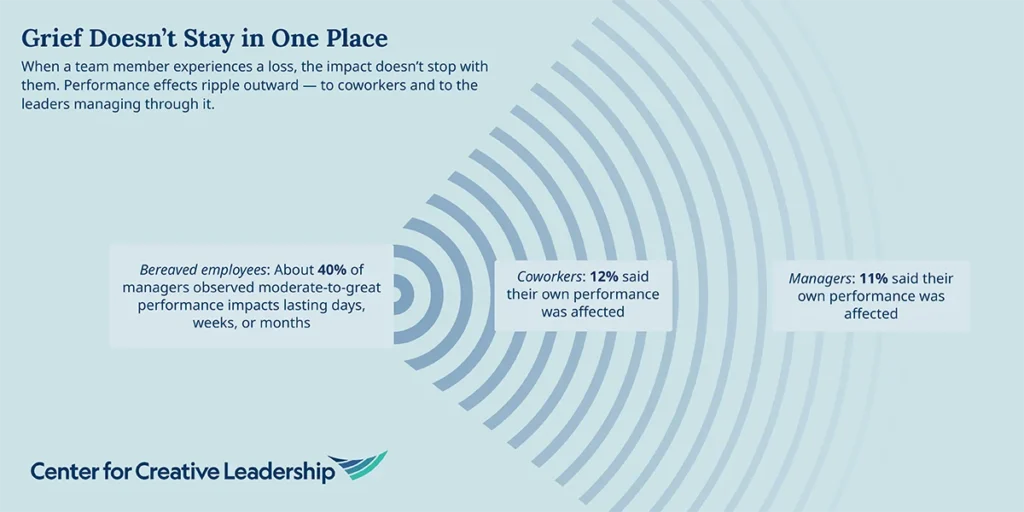
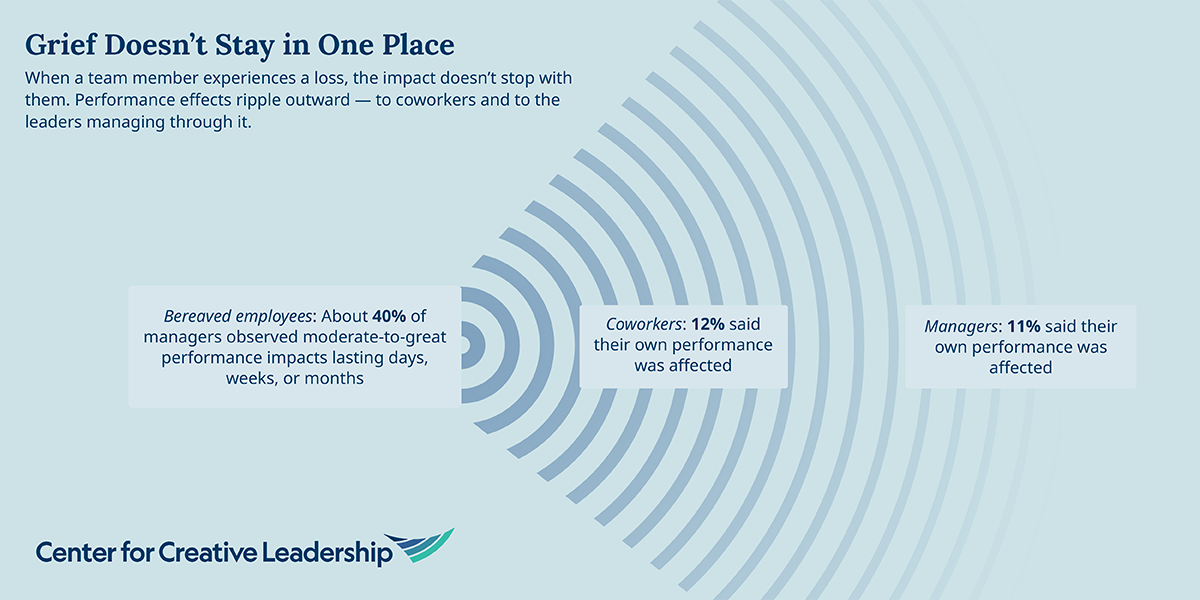
The research indicates a significant ripple effect: 90% of managers observed some level of performance impact in a bereaved employee, with approximately 40% noting moderate to significant impacts that could persist for days, weeks, or even months. Crucially, the disruption is not isolated. Eleven percent of managers reported their own performance was affected, and among coworkers, this figure rose to 12%. This data underscores that bereavement is not solely an individual burden but a force that can disrupt team dynamics and overall organizational productivity.
This disruption is further exacerbated by inadequate bereavement leave policies. A striking 73% of bereaved employees reported not having sufficient time off to adequately grieve. Compounding this, 28% of employees had no access to bereavement leave at all. Consequently, many individuals are compelled to return to their professional duties before they are emotionally or mentally ready, attempting to navigate the complex emotional landscape of grief while simultaneously fulfilling work responsibilities. This is often compounded by the practical and emotional burdens of supporting grieving family members and managing post-death logistics such as funeral arrangements and estate matters. These statistics serve as stark indicators of the silent weight employees often carry without sufficient organizational support.
When Good Intentions Fall Short: Supporting Grieving Employees
The desire to support a grieving team member is a common sentiment among leaders. However, the ability to translate this good intention into effective support is often hindered by a lack of preparedness. Research indicates a concerning disparity: while 60% of bereaved employees felt their manager offered compassion to a great extent, a significant 20% reported receiving little to no support. This means that one in five individuals navigating one of life’s most challenging experiences felt unsupported by their direct leader.
It is crucial to clarify what is not expected of leaders in these situations. The expectation is not to possess the perfect words, nor to fix grief – an impossible task – or to accelerate an individual’s healing process, which is an unreasonable demand. Leaders are not expected to be therapists. Instead, the research highlights a more fundamental requirement: to show up, to be attentive, to offer choices, and to allow the employee to guide the process.
Subtle Signals, Significant Impact
A critical finding from the research is the necessity for leaders to be attentive to subtle cues. Often, leaders may wait for overt signs of distress, such as a breakdown or a missed deadline, before intervening. However, grief in the workplace rarely manifests so clearly. More frequently, it appears as quieter, less obvious changes that managers may observe. These can include shifts in engagement, a decrease in social interaction, a change in communication style, or a subtle withdrawal from team activities. These are not immediate red flags but rather subtle indicators that, if missed, represent a lost opportunity for timely support.

Conversely, certain leadership actions can inadvertently worsen the situation. These might include:
- Minimizing the loss: Phrases like "they’ll get over it" or "you need to be strong" can invalidate the employee’s feelings.
- Imposing solutions: Offering unsolicited advice or pushing the employee to "move on" can be counterproductive.
- Avoiding the topic: Silence or an inability to acknowledge the loss can make the employee feel isolated.
- Over-scheduling or overwhelming with tasks: This can exacerbate stress and prevent the employee from processing their grief.
Checking in does not require certainty of the right words; it requires the act of noticing and reaching out.
Small Gestures, Lasting Impressions
The impact of support often lies in consistent, understated gestures rather than grand pronouncements. A simple signed card, a quiet offer of coffee, or a brief check-in that doesn’t demand the employee perform normalcy can leave a lasting positive impression. These small acts signal a recognition of the employee’s humanity beyond their professional role.
In contrast, employees often recall unhelpful interactions that left them feeling more isolated or misunderstood. These might include:
- Overly cheerful or dismissive responses: Attempts to "brighten the mood" that ignore the gravity of the situation.
- Sharing personal anecdotes that shift the focus: While well-intentioned, this can inadvertently make the grieving employee feel unheard.
- Inconsistent or absent communication: Sporadic check-ins or complete avoidance can create uncertainty and distress.
- Pressuring for immediate return to full productivity: This can feel like a lack of empathy for their current state.
The essence of these gestures is the signal they send: "I see you as a person, not just as a role."
One Size Doesn’t Fit Grief
One of the most critical findings is that grief is not a monolithic experience; individuals respond to and require support in different ways. Some may need space and solitude, while others may find solace in talking. Some may wish to immerse themselves in work as a distraction, while others require reduced expectations and flexibility. However, many leaders tend to adopt a one-size-fits-all approach, frequently defaulting to avoidance or excessive checking in, rather than inquiring about the employee’s specific needs.
The most effective solution is remarkably simple and hinges on a core leadership skill: asking. Phrases such as, "How can I support you right now?" or "Would you prefer to ease back in, or jump in?" are invaluable. Such questions signal that the employee’s experience is acknowledged and valued, and they circumvent the guesswork that often leads to mismatched support. It is important to recognize that an employee may not always know what they need. Offering options, allowing them time to adjust, and revisiting these conversations over time are crucial components of effective support.
When Leaders Get It Right
Bereaved employees vividly remember leaders who demonstrated genuine support. The most impactful responses often involved nothing more complex than flexibility, consistent presence, and protective advocacy. Leaders who excel in these situations typically:
- Pay attention and act on observations: They notice subtle changes and proactively offer support.
- Advocate for extended leave: They champion the employee’s need for more time off when necessary.
- Maintain consistent, measured check-ins: They offer support without being intrusive.
- Allow employees to set the pace: They respect the individual’s timeline for returning to full engagement.
- Practice active listening: They listen attentively and empathetically to what the employee shares.
- Acknowledge the loss directly: Simple acknowledgment of the death and the employee’s grief holds significant weight, more so than many leaders realize.
Bereavement at Work: A Crucial Leadership Development Opportunity
Even robust leadership development programs often fall short when it comes to addressing unscripted human moments. A team member’s bereavement is precisely such a moment, and most leaders find themselves unprepared to navigate it. The research indicates that a substantial 73% of managers feel they need training on how to support a bereaved employee, highlighting a widespread call for basic human skills development within leadership roles.
These essential skills are not foreign to existing leadership development frameworks; they are, in fact, foundational. The competencies required to effectively support a grieving employee are intrinsically linked to broader leadership effectiveness. These include emotional intelligence, self-awareness, empathy, the ability to conduct difficult conversations, and coaching presence. Bereavement in the workplace serves as a high-stakes scenario that tests these skills, often without prior preparation.
The solution is not to create isolated bereavement programs but to integrate this critical aspect into existing leadership development. Every discussion about emotional intelligence can, and should, encompass how a leader might navigate grief within their team and offer solace to those who are grieving. Similarly, modules on coaching skills inherently prepare leaders for asking sensitive yet vital questions like, "How are you really doing?" and "What else do you need to be supported?" This integration does not represent an added burden but rather a refined lens through which to view and enhance existing leadership development initiatives.
The Path Forward: Cultivating Empathetic Leadership
Bereavement is an inevitable reality that will touch every workplace and team. The critical question is whether leaders will be equipped to respond with the necessary empathy and skill when faced with it. This readiness is not about possessing a script for every eventuality but about cultivating the skills to notice, to inquire, and to follow the lead of the individual experiencing the loss. It is, as one research participant eloquently put it, about being "human first."
Consider the existing leadership development curriculum: where do managers learn to sit with another person’s pain? Where do leaders practice saying, "I don’t know what to say, but I am here"? Addressing these questions and actively developing leaders who can show up for their people in the ways they truly need is an endeavor of profound importance and lasting value.
Organizations that proactively integrate these human-centric skills into their leadership development frameworks will not only better support their employees through times of profound personal loss but will also foster a more resilient, empathetic, and ultimately, more effective workforce. The investment in empathetic leadership is an investment in the well-being of individuals and the strength of the organization as a whole.