The year 2026 marks a significant inflection point in the realm of talent acquisition, where Artificial Intelligence has not merely augmented human workflows but has fundamentally reshaped the entire recruiting landscape. What began earlier in the decade as AI-assisted workflow tools—designed to recommend candidates, flag biases in job descriptions, or draft initial outreach messages—has rapidly evolved into a more autonomous, agentic paradigm. Today, sophisticated AI tools proactively engage candidates, conduct initial screenings through voice or chat interfaces, and meticulously schedule interviews, often without direct human intervention from a recruiter. This shift toward autonomous AI agents underscores a new era of efficiency and scale, but it simultaneously introduces complex responsibilities and regulatory considerations that organizations must meticulously navigate.
The Rise of Agentic AI in Recruitment: A Paradigm Shift
The journey to 2026 has seen AI mature from a supportive technology to an active participant in the hiring process. Early iterations focused on automating repetitive tasks like resume parsing and basic candidate matching, aiming to free up recruiters for more strategic work. However, the advancement of natural language processing (NLP), machine learning (ML), and large language models (LLMs) has propelled AI into an "agentic" state. These systems are now capable of understanding context, making independent decisions within defined parameters, and executing multi-step tasks that mimic human cognitive processes.
This evolution is driven by several factors: persistent global talent shortages, the increasing demand for efficiency in high-volume hiring, the need for data-driven insights to improve candidate quality, and a growing emphasis on diversity, equity, and inclusion (DEI) initiatives. According to a recent SHRM report, "The State of AI in HR in 2026," a remarkable 39% of organizations have already integrated AI into their HR functions, with recruitment leading the charge at a 27% adoption rate. Projections from Market Research Future further highlight this trajectory, anticipating the AI recruitment industry to expand from USD 660.23 million in 2025 to a staggering USD 1,289.13 million by 2035, signifying a sustained annual growth rate of approximately 7.5%. This exponential growth underscores the irreversible integration of AI into the very fabric of talent acquisition.
Navigating the New Legal and Ethical Landscape
The rapid deployment of autonomous AI in hiring has not gone unnoticed by legislative bodies worldwide. The year 2026 is characterized by a robust, albeit evolving, regulatory framework governing AI’s application in critical decisions, particularly in employment. The landmark EU AI Act, which came into full effect, serves as a global benchmark, categorizing AI systems used in hiring as "high-risk." This designation mandates stringent requirements for transparency, human oversight, data quality, robustness, accuracy, and detailed documentation of the AI’s performance and potential biases. Organizations operating within or interacting with the EU market are now legally obligated to conduct thorough impact assessments and ensure their AI tools are explainable and auditable.
Concurrently, emerging U.S. state-level legislation has begun to complement federal guidelines, addressing specific concerns unique to the American labor market. States like New York and Illinois, pioneers in AI regulation, have expanded their statutes to require explicit disclosure to candidates when AI is used in hiring, along with regular bias audits conducted by independent third parties. For instance, New York City’s Local Law 144, initially focused on automated employment decision tools, has been strengthened to include penalties for non-compliance and mandates for public-facing bias audit summaries. This patchwork of regulations demands that organizations adopting AI tools possess a deep understanding of these legal boundaries, extending far beyond merely recognizing the tools’ capabilities. Failure to comply can result in substantial fines, reputational damage, and legal challenges.
Key AI Use Cases Transforming Talent Acquisition
The integration of AI into recruitment is no longer a niche phenomenon; it pervades nearly every stage of the talent acquisition lifecycle. Organizations leverage AI to address diverse hiring goals, from reducing interview times and streamlining job description management to sourcing highly qualified passive talent. The versatility of AI platforms means there is often a specialized solution for almost any talent acquisition challenge.
Core applications include:
- Job Description Optimization: AI analyzes JDs for biased language, gendered terms, and exclusionary jargon, ensuring inclusivity and wider appeal.
- Candidate Sourcing: AI scours vast databases and online profiles to identify and engage qualified candidates, including underrepresented groups.
- Automated Screening: AI chatbots and voice agents conduct initial candidate interactions, assessing qualifications and cultural fit.
- Interview Management: AI schedules interviews, transcribes conversations, and even offers "Actionable Skill Validation" based on demonstrated abilities.
- Outbound Recruiting: AI identifies target candidates and crafts personalized outreach messages for higher response rates.
- Candidate Engagement: AI-powered chatbots provide instant support, answer FAQs, and guide candidates through the application process.
- Programmatic Job Advertising: AI optimizes ad spend by predicting cost-per-hire and distributing job postings across thousands of channels.
- Employee Onboarding: AI automates onboarding workflows, manages digital paperwork, and facilitates a seamless transition for new hires.
- Talent Experience Management: AI creates personalized candidate journeys, from initial career site interaction to post-offer engagement.
- Agentic Sourcing/People Intelligence: Advanced AI autonomously identifies, scores, and ranks candidates based on complex career trajectories and predicted performance.
Spotlight on Leading AI Hiring Solutions in 2026
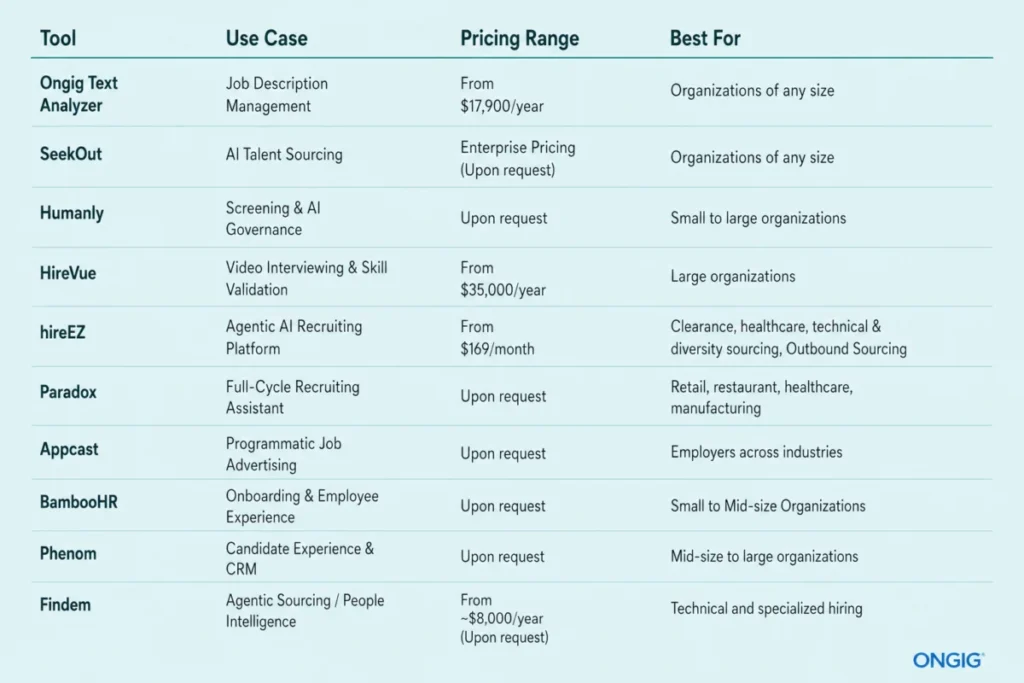
The market for AI recruitment tools is robust and competitive, with several platforms standing out for their innovative features and compliance-focused designs. Below are 10 notable solutions making an impact in 2026:
1) Ongig Text Analyzer – Best for Job Description Management
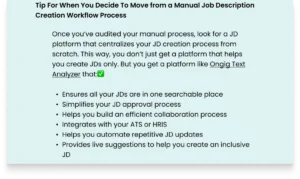
Ongig Text Analyzer remains a leader in ensuring equitable and effective job descriptions. Its AI-powered engine rapidly crafts JDs from simple job titles, then meticulously analyzes them for unconscious bias, gendered language, industry jargon, and exclusionary terms. Its mission to eliminate biased language is critical in 2026, as regulations increasingly scrutinize hiring processes for fairness. The tool flags age bias, ableism, and other subtle forms of discrimination, providing real-time suggestions for inclusive alternatives. This not only broadens candidate pools but also aligns organizations with stringent anti-discrimination laws. Pricing starts at $17,900 annually, reflecting its comprehensive feature set and importance for compliance.
2) SeekOut – Best for Sourcing Qualified Talent
SeekOut has solidified its position as a premier AI sourcing tool, leveraging a vast database of over 750 million public profiles, including 330 million underrepresented candidates. By 2026, it has heavily emphasized "Skills-Based Sourcing" and internal talent mobility, differentiating itself from traditional platforms. Its dual offerings, "Recruit" and "Spot," showcase its advanced capabilities. Recruit is an AI-powered platform for recruiters to search billions of profiles, while Spot pairs AI agents with human recruiters to deliver interview-ready candidates within an average of two weeks. SeekOut’s natural language processing scanner continuously learns, providing data-driven insights that significantly enhance the quality of hires and drastically reduce manual sourcing time.
3) Humanly – Best for AI-Powered Screening and Candidate Engagement
Humanly has emerged as a critical AI-powered, end-to-end hiring platform, particularly lauded in 2026 for its "Governance" and "Audit-ready" record-keeping capabilities—essential for meeting new global AI transparency laws. The platform uses machine learning to conduct natural conversations with candidates, handling initial phone screens via "voice-to-data" technology and summarizing interactions directly into the Applicant Tracking System (ATS). It can join Zoom interviews, take notes, and schedule follow-ups, saving recruiters up to 75% of time on repetitive tasks. Its ability to record and analyze every candidate interaction provides invaluable analytical data, ensuring both efficiency and compliance.
4) HireVue – Best for AI-Powered Video Interviews and Assessments
HireVue continues to be the go-to video interviewing software for large enterprises, evolving significantly in 2026 with a focus on "Actionable Skill Validation" within its video analytics. Beyond mere transcription, its AI now interprets demonstrated abilities, allowing companies to hire based on practical skills rather than solely academic degrees. A major enhancement is its "Explainable AI" features, designed to meet 2025/2026 global regulations for transparency in candidate scoring. HireVue supports both asynchronous and live interviews, offers mobile-friendly experiences, and provides extensive job-specific interview guides developed by organizational psychologists, streamlining the interview process for consistency and fairness.
5) hireEZ – Best for Agentic Outbound Recruiting
Renaming itself an "Agentic AI Recruiting Platform," hireEZ in 2026 focuses on three core modules: Sourcing/CRM, Applicant Match, and Hiring Intelligence. It scans over 100 million profiles to identify qualified applicants, offering robust market insights by analyzing job descriptions to reveal labor market data, salary ranges, and talent hotbeds. This platform is particularly strong in diversity sourcing, filtering for university affiliations, diversity organization memberships, and pronoun usage to identify underrepresented groups. Its AI crafts targeted and automated outreach emails, boasting significantly higher response rates, thereby optimizing outbound recruiting efforts.
6) Paradox (Olivia) – Best for Automated Chatbots for Candidate Engagement
Paradox has firmly positioned its AI assistant, Olivia, as a full-cycle "Recruiting Assistant" capable of managing the entire candidate journey from application to offer letter, especially for high-volume roles. Olivia conducts natural conversations in over 100 languages, handles interview scheduling across hundreds of calendars with complex timezone conversions autonomously, and provides instant answers to candidate questions via web chat, SMS, Facebook Messenger, and WhatsApp. Its AI matches applicants to relevant job openings based on expressed preferences and qualifications, significantly enhancing candidate experience by providing timely, personalized communication and reducing administrative burden on recruiting teams.
7) Appcast – Best for Programmatic Job Advertising
As a leader in programmatic job ads with over 2000 customers, Appcast launched AppcastOne in 2026, an AI-powered system that predicts "Cost-per-Hire" before any advertising spend. AppcastOne leverages intelligent programmatic technology to identify qualified applicants through a blend of search engines, automated advertising, traditional media, and social media. It reaches both active and passive job seekers across more than 100 countries and 30,000+ job boards. Its pay-per-applicant model ensures efficient ad spend, making it an indispensable tool for employers seeking to optimize their recruitment marketing strategies and secure the best candidates globally.
8) BambooHR – Best for AI-Enhanced Employee Onboarding
BambooHR remains a top AI recruitment platform for streamlining the entire HR process, from hiring to payroll and, notably, onboarding. Its onboarding module offers extensive customizations based on job role, location, and department, ensuring a personalized experience for every new employee. The platform automates various onboarding tasks, assigns responsibilities to managers and colleagues, and includes features like digital welcome emails, pre-boarding packages, e-signatures, and IT checklists. By digitizing and personalizing the onboarding process, BambooHR enables new hires to become productive immediately, eliminating traditional paper-based inefficiencies and fostering a positive initial employee experience.
9) Phenom – Best for Talent Experience Management
Phenom’s talent experience platform comprehensively covers the full candidate journey within a single, integrated system: career site, AI chatbot, and CRM. In 2026, its ability to surface relevant roles to visitors based on their background and seamlessly transition them to an AI chatbot for screening and question-answering is a game-changer. Poor communication and "radio silence" often deter qualified candidates, and Phenom directly addresses this by maintaining continuous engagement. Its CRM allows recruiters to nurture relationships over time, ensuring that strong candidates who might not fit one role aren’t lost. This continuity is vital for organizations aiming to improve candidate satisfaction and retention.
10) Findem – Best for Agentic Sourcing / People Intelligence
Findem’s "Agentic Sourcing" is recognized as the 2026 gold standard for technical talent and a leader in People Intelligence. It uses "3D data" by pulling information from hundreds of sources to track a candidate’s entire career trajectory, predicting future performance and enabling "hyper-personalized" sourcing. This platform goes beyond current job titles, analyzing growth patterns to provide deeper insights, particularly crucial for specialized technical roles. Findem’s agentic AI autonomously identifies, scores, and ranks candidates in the background, allowing recruiting teams to focus on strategic decisions rather than manual searching. Its deep candidate context also enables more targeted outreach, resulting in higher response rates and a more efficient hiring process for niche talent.
Strategies for Implementing AI Hiring Tools in Your Organization
Successful integration of AI into hiring processes requires a structured and thoughtful approach. Organizations must move beyond mere adoption to strategic implementation, ensuring alignment with business goals, ethical guidelines, and regulatory requirements.
- Define Clear Objectives: Before investing in any AI tool, clearly articulate the specific hiring challenges you aim to solve. Whether it’s reducing time-to-hire, improving candidate quality, enhancing diversity, or cutting costs, precise objectives will guide your selection.
- Start Small and Scale: Implement AI tools incrementally. Begin with pilot programs in specific departments or for particular job types to gather data, refine processes, and build internal confidence before a broader rollout.
- Prioritize Human Oversight: While AI offers autonomy, human judgment remains paramount. Design workflows that incorporate human review points, especially for critical decisions, to mitigate risks and ensure ethical outcomes. The principle of "human-in-the-loop" is crucial for high-risk AI applications.
- Ensure Data Quality and Privacy: AI models are only as good as the data they are trained on. Invest in cleaning and structuring your HR data to prevent bias propagation. Adhere strictly to data privacy regulations (e.g., GDPR, CCPA, and emerging AI-specific privacy laws) to protect candidate information.
- Conduct Bias Audits and Ethical Reviews: Regularly audit AI tools for algorithmic bias, both internally and through independent third parties. Be transparent about your AI’s limitations and how you address fairness. This is a non-negotiable requirement under 2026 regulations.
- Provide Comprehensive Training: Equip your recruiting and HR teams with the necessary skills to effectively use and manage AI tools. Training should cover not just functionality but also ethical considerations and regulatory compliance.
- Measure and Iterate: Continuously track key performance indicators (KPIs) related to AI tool usage, such as time-to-hire, quality of hire, candidate satisfaction, and diversity metrics. Use this data to iterate on your implementation strategy and optimize performance.
- Foster a Culture of Trust: Communicate openly with candidates about your use of AI in hiring, explaining its benefits and how their data is protected. This builds trust and enhances the candidate experience.
The Broader Implications: Reshaping the Future of Work
The widespread adoption of agentic AI in recruitment is not just about efficiency; it’s about fundamentally redefining the roles of recruiters and the expectations of candidates. Recruiters are transitioning from administrative task executors to strategic talent advisors, focusing on complex problem-solving, relationship building, and ethical governance of AI systems. The demand for "AI ethicists" and "AI compliance officers" within HR departments has surged, reflecting the new responsibilities.
For candidates, AI-driven processes promise a more streamlined and personalized experience, but also raise concerns about depersonalization and algorithmic unfairness. Organizations that successfully balance efficiency with a human touch, leveraging AI to enhance rather than replace meaningful interactions, will be the ones that thrive in the evolving talent landscape. The future of recruitment in 2026 and beyond is undeniably AI-powered, but its ultimate success will still hinge on human ingenuity, ethical stewardship, and a commitment to fairness.
April 28, 2026 by Harrison Mbuvi in AI Recruitment