A groundbreaking large-scale study by Gallup has revealed a perplexing paradox in the contemporary business landscape: while artificial intelligence (AI) demonstrably enhances individual employee productivity, its impact on companies at a macro, organizational level remains largely insignificant. The comprehensive "State of the Global Workplace report 2026" points to a surprising culprit hindering AI’s broader transformative potential: middle and senior managers who are often failing to actively support its adoption and integration within their teams. This finding challenges the prevailing narrative of AI as an immediate, universally beneficial technological panacea, instead underscoring the indispensable human element in realizing its true value.
The Gallup Report’s Revelations: A Deep Dive into Findings
Gallup’s extensive research, drawing on insights from 263,810 respondents across 160 countries, painted a clear picture of AI’s dual nature. On one hand, a significant majority of individual workers reported tangible benefits. Among US employees in organizations that had implemented AI, 65% indicated that AI had a "somewhat" or "extremely" positive impact on their personal productivity. This suggests that AI tools are effectively streamlining tasks, automating mundane processes, and empowering individuals to work more efficiently. However, this individual-level success does not translate into widespread organizational transformation. A mere 12% of these same employees strongly agreed that AI had fundamentally altered how work is done within their companies. This stark disparity forms the core of the AI paradox.
The report meticulously identified the top two drivers of frequent AI use within organizations: robust AI integration with existing systems and, crucially, manager-led AI adoption. These two factors are not merely correlative; the study’s authors found that managers were pivotal in shaping employees’ perceptions of AI’s value. In US organizations investing in AI technology, employees who strongly agreed that their manager actively supported their team’s use of AI were overwhelmingly more likely to strongly agree that the technology had transformed their work processes and provided them with greater opportunities to leverage their strengths daily. This indicates a direct causal link between proactive managerial involvement and positive employee experiences with AI, which in turn fuels adoption and perceived efficacy.
The Critical Role of Leadership: Unlocking AI’s Potential
Despite these clear benefits tied to active managerial support, the study uncovered a concerning deficiency in leadership engagement. Less than a third of US employees in organizations that had begun implementing AI technologies strongly agreed that their manager actively supported their team’s use of the technology. The situation was equally challenging in Germany, where a separate Gallup study found only 21% of employees in AI-using organizations reported active managerial support. This widespread lack of endorsement from immediate supervisors acts as a significant impediment, effectively creating a bottleneck that prevents the trickle-down of individual productivity gains into broader organizational efficiencies and strategic advantages.
Gallup researchers concluded that AI, paradoxically, could be the key to improving management practices at scale. Their report posits: "Effective people management is a skill. But few managers have natural management talent, and many have not received the training they need to successfully coach teams and individuals toward high performance. AI tools have the potential to provide real-time, personalised manager advice grounded in the best management science. Such capabilities could be a game-changer for the world’s workplace." This perspective highlights an intriguing full circle: the very technology currently hindered by managerial inertia could eventually empower managers to become more effective, thereby unlocking its own potential. The historical challenge of cultivating strong leadership skills, often through costly and inconsistent training programs, could be augmented by AI-driven coaching and performance insights, transforming the supervisory role itself.
The Elusive Macro-Economic Impact: A Broader Perspective
The observed disconnect between individual productivity and organizational outcomes is not an isolated finding. Surveys of leaders themselves reinforce this trend. A recent National Bureau of Economic Research (NBER) survey involving thousands of executives across the US, UK, Germany, and Australia revealed that despite widespread AI use in corporations, a staggering 89% of leaders reported no measurable impact of AI on their company’s labour productivity over the past three years. This figure is particularly striking given the considerable investment in AI technologies globally. While these executives expressed optimism, expecting AI to boost productivity by an average of 1.4% over the next three years, the current reality paints a picture of substantial investment yielding minimal immediate macro-level returns.
Jon Clifton, CEO of Gallup, articulated this paradox with pointed clarity: "The technology works. Large language models can draft legal contracts, write code and synthesise research at speeds no human team can match. But those gains are not showing up in the bottom line." He further underscored this by citing an MIT study which found that despite approximately $40 billion in enterprise investment, 95% of organizations had seen "zero measurable impact on profits." This economic reality highlights that simply deploying advanced AI tools is insufficient; the crucial step lies in integrating these tools effectively into workflows and strategic operations, a process heavily reliant on human leadership and change management. The "productivity paradox," a concept first popularized in the 1980s with the advent of information technology, appears to be replaying itself with AI, where transformative potential takes time and significant organizational restructuring to materialize into tangible economic gains. The initial phase of technological adoption often involves a learning curve and re-engineering of processes, which can temporarily depress productivity metrics before long-term benefits are realized.
Employee Engagement: The Human Element in AI Adoption
Central to the successful harnessing of AI’s possibilities is the critical factor of employee engagement. The Gallup study emphasized this point, stating: "AI is a major disruption; organisations with engaged employees tend to navigate disruptions more successfully. In the age of AI, productivity gains will depend in part on how effectively individual workers use these tools. Disengagement will erode those gains, and active disengagement could create serious security risks." Engaged employees are more open to change, more willing to experiment with new tools, and more proactive in identifying ways to integrate AI into their work for optimal benefit. They view AI as an enabler rather than a threat, fostering a collaborative environment where human ingenuity complements artificial intelligence.
Conversely, a disengaged workforce can actively sabotage AI initiatives, either through passive resistance, failure to adopt new tools, or even intentional misuse. This can lead to underutilization of expensive AI systems, a failure to achieve desired productivity increases, and, as the report warns, potential security vulnerabilities. When employees are not bought into the strategic vision behind AI adoption, they are less likely to adhere to new protocols or safeguard sensitive data processed by AI, thereby increasing operational risks. Building a culture of trust and transparency around AI implementation is paramount, ensuring that employees understand its purpose, benefits, and how their roles will evolve, rather than be replaced.

AI and the Workforce: Evolving Headcount and Job Security
The integration of AI into the workplace naturally raises significant questions about its impact on employment and job security. US data from Q1 of 2026 indicated a concerning rise in fears of AI-related job losses. Overall, 18% of US employees believed it was "very" or "somewhat" likely their job would be eliminated in the next five years due to technological innovations like automation or AI. This figure surged to 23% in organizations that had already implemented AI, suggesting a direct correlation between exposure to AI and heightened job insecurity. Certain industries exhibited even higher levels of anxiety, with 32% in finance, 32% in insurance, and 31% in technology expressing such concerns. A similar sentiment was observed in Germany, where 19% of employees in AI-using organizations anticipated job elimination within five years due to the technology.
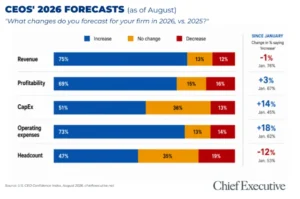
However, the report also presented a nuanced picture regarding actual workforce changes. In Q1 of 2026, Gallup surveyed US employees about their employer’s workforce plans. Among employees in organizations where AI had been implemented, those in large organizations (10,000-plus employees) were more likely to report their employer was reducing their workforce (33%) than expanding it (30%). This suggests that larger enterprises might be leveraging AI to optimize existing operations and potentially streamline headcount. In contrast, employees in smaller organizations (e.g., 5,000-10,000 employees) were more likely to report workforce expansion (38%) versus reduction (23%). This differential impact could indicate that smaller, more agile organizations are using AI to enhance capabilities and pursue growth opportunities, necessitating an expanded workforce, albeit potentially with new skill sets. The overarching conclusion was that organizations implementing AI were more likely to experience change in workforce size – either expansion or reduction – than those that had not adopted AI. This suggests AI is indeed reconfiguring organizational structures and roles, but its effects on employment are not uniformly negative; rather, they are complex and dynamic, requiring proactive workforce planning and reskilling initiatives. This aligns with a recent EY-Parthenon study, reported by Personnel Today, which found that the number of CEOs expecting AI to reduce hiring had more than halved, with executives focusing instead on reshaping workforce plans.
The Managerial Imperative: Bridging the Gap
Gallup CEO Jon Clifton directly addressed the core issue: "So, if the technology isn’t the problem, what is? Gallup’s data points to an answer the corporate world has largely ignored: the manager. In organisations investing in AI, the strongest predictor of employee adoption, aside from technical integration, is whether their direct manager actively champions it. Even the most sophisticated neural network cannot overcome an indifferent team leader." This powerful statement succinctly captures the essence of the AI paradox. The technological prowess of AI is undeniable, yet its potential remains largely untapped due to a fundamental human failing in its implementation – a failure of leadership at the frontline.
The reasons for this managerial inertia can be multifaceted. Many managers may lack adequate training in understanding AI’s capabilities and how to effectively integrate it into their team’s workflow. Some might harbor fears of their own roles becoming obsolete or diminished by AI, leading to passive resistance. Others may simply be overwhelmed by the pace of technological change and lack the resources or support to become AI champions. This challenge is not entirely new. A decade ago, researchers at Stanford, Harvard Business School, and MIT found that differences in management practices accounted for approximately 30% of the variation in total factor productivity (TFP), a broad measure of how efficiently an economy uses its labor and capital. For decades, organizations worldwide have grappled with the challenge of effective people management. However, as Clifton emphasizes, "Now, the financial stakes are far higher. Winning the AI revolution will depend not just on the technology you deploy but also on how well you lead the people using it." This places an unprecedented emphasis on the quality of leadership as a determining factor for competitive advantage in the AI era.
Strategic Implications for Organizations and HR
The findings of Gallup’s report carry profound implications for organizational strategy, particularly for human resources (HR) departments. HR professionals are uniquely positioned to address the managerial bottleneck and facilitate the successful integration of AI. Their role must evolve from simply managing personnel to strategically enabling technological adoption through human capital development.
Key areas of focus for HR include:
- Redefining Manager Training: Traditional management training programs must be updated to include comprehensive modules on AI literacy, change management in the context of AI, and practical strategies for integrating AI tools into daily workflows. Managers need to understand not just what AI can do, but how to champion its use, manage employee concerns, and leverage it to enhance team performance.
- Fostering a Culture of Experimentation and Psychological Safety: Organizations need to create environments where managers and employees feel safe to experiment with AI, learn from failures, and share best practices. This requires transparent communication from senior leadership about the strategic importance of AI and a commitment to supporting its adoption.
- Developing AI Literacy Across the Workforce: Beyond managers, general AI literacy programs for all employees can demystify the technology, reduce fears of job displacement, and highlight the benefits of human-AI collaboration. This can improve engagement and proactive adoption.
- Strategic Workforce Planning and Reskilling: Given the nuanced impact on headcount, HR must engage in proactive workforce planning, identifying roles that will be augmented or redefined by AI. Comprehensive reskilling and upskilling initiatives are essential to prepare employees for new roles and ensure a smooth transition.
- Leveraging AI for HR Itself: HR departments can also be pioneers in adopting AI for their own functions, such as personalized learning recommendations for managers, AI-powered tools for performance feedback, and data analytics to identify engagement trends or training needs, thereby demonstrating AI’s value firsthand.
The EY-Parthenon study, indicating that CEOs are increasingly focused on reshaping work rather than merely reducing headcount, underscores the strategic imperative for HR to guide organizations through this transformation. This involves not just managing job changes, but redesigning job roles, career paths, and organizational structures to effectively integrate AI and unlock its full potential.
Conclusion: Navigating the AI Frontier
Gallup’s "State of the Global Workplace report 2026" delivers a sobering yet actionable message: the future of AI’s transformative power hinges less on the sophistication of the technology itself and more on the efficacy of human leadership. While AI has proven its capability to boost individual productivity, its failure to translate into measurable macro-level organizational gains and profits is a direct consequence of insufficient managerial support and strategic integration. The paradox is clear: the technology designed to augment human capabilities requires robust human leadership to fulfill its promise.
To truly win the AI revolution, organizations must pivot their focus from mere technological deployment to comprehensive human enablement. This requires significant investment in leadership development, particularly at the managerial level, fostering a culture of engagement, and proactive workforce planning. By empowering managers to become active champions of AI, providing the necessary training, and addressing employee concerns, businesses can bridge the gap between individual efficiency and organizational transformation. Only then can AI move beyond isolated productivity gains and truly become the game-changer for economic growth and human potential that it is widely predicted to be.