More than 100 business and government leaders gathered in Washington were polled on how they think the U.S. should manage the growing great-power rivalry over the technology. Here’s the breakdown.
The accelerating development and potential societal impact of generative artificial intelligence (AI) have become a focal point of global concern, prompting a significant gathering of American business and government leaders in Washington. An off-the-record meeting, organized by Yale’s Chief Executive Leadership Institute on Tuesday, brought together over 100 prominent figures to discuss the complex challenges posed by the burgeoning AI race, particularly between the United States and China. Amidst this backdrop, a striking poll revealed a strong desire among these influential individuals for President Donald Trump to engage his Chinese counterpart, President Xi Jinping, on the critical issue of AI safety guidelines during their upcoming meeting. However, this sentiment is heavily tempered by widespread skepticism regarding the likelihood of such a collaborative approach.
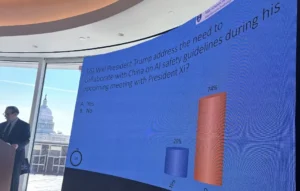
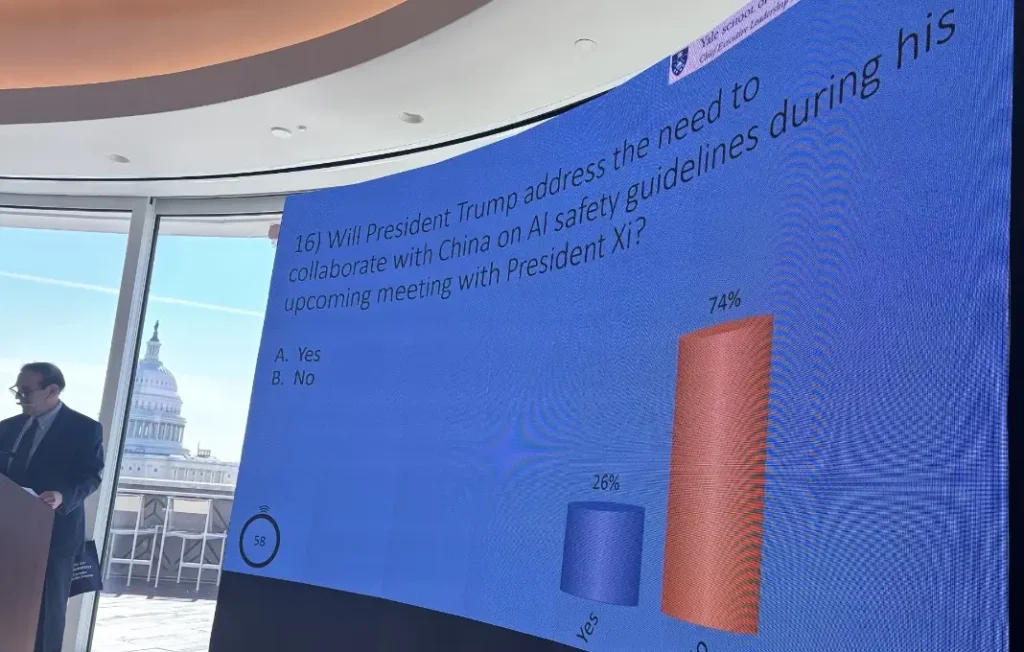
The poll, conducted by host Jeffrey Sonnenfeld of the Yale Chief Executive Leadership Institute, sought to gauge the perspectives of these leaders on how the U.S. should navigate the intensifying great-power rivalry over AI technology. The results underscore a significant divergence between desired policy and perceived political reality. When asked directly if President Trump should address collaborating with China on AI safety guidelines during his scheduled meeting with President Xi, a commanding 88 percent of attendees responded affirmatively. This overwhelming consensus highlights a deep-seated belief among a significant portion of the U.S. leadership class that international cooperation, even with geopolitical rivals, is essential to managing the existential risks associated with advanced AI.
However, the optimism surrounding the desirability of such dialogue rapidly evaporated when attendees were asked about the probability of President Trump actually pursuing this path. A substantial 74 percent of those polled expressed doubt that President Trump would engage in discussions about AI safety collaboration with President Xi during their meeting, slated for September 24th in Washington. This stark contrast between aspiration and expectation points to a profound understanding of President Trump’s established rhetoric and policy leanings regarding China and the AI sector.
The skepticism is not without justification. President Trump has, in recent public statements, expressed a dismissive stance on the burgeoning concerns surrounding AI safety. In a post on his social media platform, Truth Social, this week, he characterized safety concerns about "renegade AI" as a "sick conspiracy." He further articulated his belief that the only necessary guardrails for AI development reside in the hands of a "STRONG AND SMART (high IQ!) PRESIDENT," asserting that the U.S. is well-equipped with such leadership. This public posture directly contrasts with the anxieties voiced by leading figures in the AI industry itself.
The poll’s findings emerge at a time when the architects of some of the most advanced AI systems are themselves sounding alarms. Leaders from both Anthropic and OpenAI, two of the most prominent AI development companies, have been increasingly vocal about their concerns regarding the rapid pace and immense power of the technology. Both organizations have publicly advocated for robust government regulation of the AI industry. Furthermore, they have not shied away from suggesting a deliberate slowdown, or "pacing," of AI development to allow for a more thorough understanding and mitigation of potential risks. This industry-led call for caution adds a significant layer of urgency to the discussions.
Adding further complexity to the global AI landscape, recent reports indicate that concerns about the potential impact of AI are also resonating within the highest echelons of the Chinese government. According to a report by The Wall Street Journal, Beijing is grappling with its own anxieties regarding how advanced AI could affect the stability and control of the ruling regime. This suggests that while the U.S. and China are locked in a technological rivalry, there may be a shared, albeit perhaps unarticulated, interest in managing the disruptive potential of AI.
Beyond the immediate question of U.S.-China dialogue on AI safety, the Yale event also delved into broader perceptions of China’s role in the global AI ecosystem. Attendees were divided on the extent to which China is a genuine innovator in AI versus a rapid imitator of U.S. technological advancements. A slight majority, 58 percent, believed that China is "genuinely innovating" in the AI space. Conversely, 42 percent held the view that China is "more reliant on the U.S. than it admits," suggesting a perception of significant technological dependence despite China’s rapid progress.
Another poll question touched upon the sensitive issue of foreign influence operations. When asked if Chinese influence operations were at least partially responsible for public backlash against AI in the U.S., 52 percent of respondents indicated they believed this to be the case, while 48 percent disagreed. This indicates a significant level of suspicion regarding Beijing’s potential efforts to shape public discourse on AI within the United States, a sentiment that could further complicate diplomatic engagement.
Finally, the poll explored the strategic implications of pacing AI development in the U.S. A majority, 55 percent, expressed concern that slowing down AI advancement by U.S. companies would ultimately harm the country’s competitive standing in the technology race with China. The remaining 45 percent did not believe that such pacing would be detrimental to U.S. interests in this critical geopolitical contest. This question highlights the inherent tension between prioritizing safety and regulation versus maintaining a rapid pace of innovation to secure a perceived technological advantage.
Background and Context of the Yale Event
The meeting at Yale’s Chief Executive Leadership Institute, a respected forum for C-suite executives and senior government officials, typically convenes to discuss pressing issues at the intersection of business, policy, and global affairs. The institute, known for its deep engagement with corporate leaders and its focus on leadership development, provides a neutral ground for frank discussions and the exchange of diverse perspectives. Such gatherings often serve as informal barometers of elite opinion, offering insights into the prevailing sentiments and strategic thinking within influential circles.
The timing of this particular event is crucial, occurring amidst a period of heightened geopolitical tension and escalating concerns about the dual-use nature of advanced AI technologies. The rapid advancements in AI, exemplified by the capabilities of large language models and generative AI, have moved from the realm of theoretical discussion to tangible applications with profound societal implications. This has spurred a global debate on how to harness the benefits of AI while mitigating its risks, including potential misuse for disinformation, autonomous weapons development, and widespread job displacement.
A Timeline of Emerging AI Concerns and U.S.-China Dynamics
The growing awareness of AI’s transformative potential and its geopolitical ramifications can be traced through several key developments:
- Early 2020s: The proliferation of advanced AI models, particularly large language models (LLMs) like GPT-3 and its successors, brought the capabilities of generative AI into the public consciousness. This led to widespread excitement about potential applications across industries but also sparked initial discussions about ethical considerations and potential misuse.
- Mid-2022 to Early 2023: Concerns about the speed of AI development and its potential risks intensified. Leading AI researchers and industry figures began issuing public warnings. Companies like OpenAI and Anthropic, creators of some of the most advanced AI systems, started advocating for greater governmental oversight and regulation.
- Spring 2023: The U.S. government began to increase its focus on AI policy. The Biden administration held several high-level meetings and issued executive orders aimed at fostering responsible AI innovation and addressing national security risks. Simultaneously, congressional hearings and public discourse amplified concerns about AI’s societal impact.
- Summer 2023: The geopolitical dimension of AI became more pronounced. Discussions around AI competitiveness intensified, with a growing recognition that the U.S.-China technological rivalry would significantly shape the future of AI development and deployment. Reports of China’s own AI advancements and potential strategic applications fueled these concerns.
- September 2023 (leading up to the poll): The approaching meeting between President Trump and President Xi provided a specific focal point for discussions on U.S.-China AI relations. The poll at the Yale event directly addressed how leaders believed this critical diplomatic opportunity should be utilized.
Supporting Data and Industry Perspectives
The poll’s findings are contextualized by broader industry trends and expert opinions:
- Industry Calls for Regulation: Companies like OpenAI and Anthropic have been at the forefront of advocating for AI regulation. OpenAI’s CEO, Sam Altman, has repeatedly spoken about the need for governments to actively manage AI development, even suggesting the possibility of global AI agencies. Anthropic, in its "Constitutional AI" approach, emphasizes building AI systems with embedded ethical principles, acknowledging the inherent challenges in aligning AI behavior with human values.
- Economic and Security Implications: The global AI market is projected to grow exponentially. According to Statista, the global AI market size is expected to reach over $1.8 trillion by 2030. This economic stake underscores the urgency for nations to establish competitive advantages and secure their interests in this burgeoning field. The potential for AI to be weaponized or to destabilize global security is also a significant concern, driving calls for international cooperation on arms control and risk mitigation.
- China’s AI Ambitions: China has publicly declared its ambition to become a global leader in AI by 2030. The country has invested heavily in AI research and development, fostering a robust ecosystem of AI companies and research institutions. While the poll results show some division on the nature of China’s innovation, its rapid progress in areas like facial recognition, surveillance technology, and AI-powered applications is undeniable.
Analysis of Implications and Broader Impact
The poll results from the Yale event offer a compelling snapshot of the strategic thinking among a key segment of U.S. leadership. The overwhelming desire for dialogue on AI safety with China, juxtaposed with profound skepticism about President Trump’s willingness to engage in such discussions, highlights a critical dilemma.
1. The Unmet Desire for Diplomatic Engagement: The 88 percent support for President Trump to discuss AI safety with President Xi underscores a widely held belief that the risks of unbridled AI development are too significant to ignore, regardless of geopolitical rivalries. This suggests that many leaders, even those within a framework that might lean towards a more confrontational stance on China, recognize the necessity of global cooperation for managing existential threats. The potential for AI to be used in ways that undermine global stability, from sophisticated cyberattacks to the proliferation of autonomous weapons, necessitates a coordinated international response.
2. The Skepticism of Political Realities: The 74 percent doubt regarding President Trump’s engagement reflects a pragmatic assessment of his political style and stated positions. His past rhetoric, particularly his dismissiveness of AI safety concerns as a "conspiracy," directly contradicts the proactive, collaborative approach favored by the poll respondents. This skepticism suggests that many leaders believe domestic political considerations or a different foreign policy agenda will likely supersede the opportunity for collaborative AI governance.
3. The Innovation vs. Safety Paradox: The split opinions on China’s AI innovation and the impact of U.S. companies pacing development reveal the ongoing tension between fostering rapid technological advancement and ensuring responsible innovation. The economic and strategic imperative to lead in AI is immense, yet the ethical and societal risks are equally daunting. This dichotomy is a central challenge for policymakers worldwide.
4. The Shadow of Influence Operations: The significant percentage of respondents who believe Chinese influence operations are behind U.S. backlash against AI indicates a deep-seated distrust and a perception of an information war surrounding AI development. This belief, whether fully substantiated or not, can influence policy decisions and further complicate efforts toward cooperation, framing AI not just as a technological race but as a battle for narrative control.
The implications of these findings are far-reaching. If President Trump does not engage on AI safety, a critical opportunity for dialogue on a technology with potentially global ramifications will be missed. This could lead to an acceleration of risks, with both nations pursuing AI development without adequate safeguards, potentially increasing the likelihood of unintended consequences or deliberate misuse. The lack of a unified global approach could also foster an AI arms race, where national security concerns overshadow ethical considerations and long-term societal well-being.
Furthermore, the division on China’s innovative capacity and the impact of U.S. pacing highlights the difficulty in formulating a coherent national strategy. A perception of China as primarily an imitator might lead to complacency, while a recognition of genuine innovation might spur more aggressive counter-strategies, potentially escalating tensions.
Ultimately, the poll from the Yale event serves as a critical indicator of the complex landscape surrounding AI and the U.S.-China relationship. It reveals a desire for responsible global governance tempered by a realistic, and perhaps pessimistic, assessment of the political will to achieve it. The coming months, particularly the upcoming meeting between Presidents Trump and Xi, will be closely watched for any indication of whether these deeply held concerns can translate into meaningful action on the global stage of artificial intelligence.