The rapid integration of Artificial Intelligence (AI) across organizations is not merely a technological upgrade; it is fundamentally reshaping the workplace and, crucially, the employee experience. While many businesses are investing heavily in AI with the dual expectation of boosting performance and enhancing employee engagement, the reality of its impact is proving to be far more nuanced than a simple technological adoption. New research indicates that the success or failure of AI in fostering employee engagement hinges not on the technology itself, but on the strategic and thoughtful manner of its implementation.
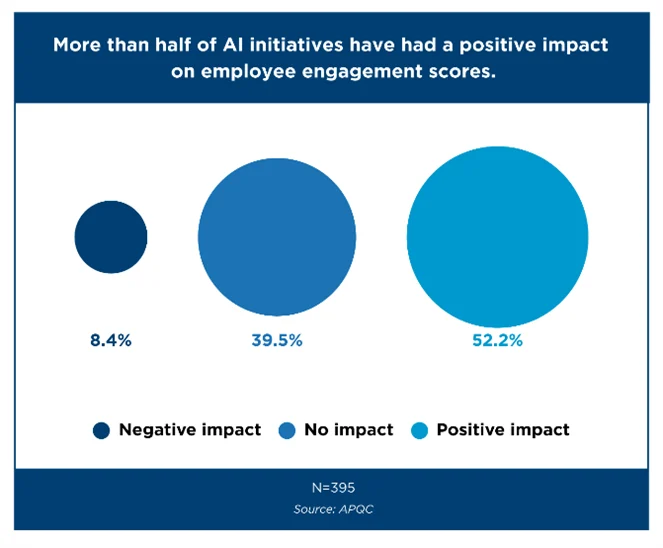
Recent findings from APQC, a global authority in benchmarking and process and performance improvement, shed critical light on this complex dynamic. Their comprehensive study, which surveyed numerous business leaders, reveals a stark divergence in how AI is affecting employee engagement. Contrary to widespread concerns that AI might broadly disengage workers, the data suggests a more optimistic, albeit conditional, outcome. Nearly half of the surveyed leaders reported that AI has demonstrably improved employee engagement, a vital metric for overall workplace satisfaction and productivity. Conversely, a significantly smaller proportion, fewer than one in ten, indicated that AI has had a detrimental effect on engagement. This pronounced difference between the two groups is not attributed to the inherent nature of AI, but rather to the distinct approaches organizations are taking in its deployment.
"The conversation around AI has often been framed by its disruptive potential, leading many to fear widespread disengagement," noted a spokesperson for APQC, speaking on condition of anonymity due to ongoing research dissemination protocols. "However, our findings underscore that AI is a tool, and like any tool, its impact is dictated by the hand that wields it. The key differentiator lies in the intentionality and strategic integration of AI into the fabric of an organization’s operations and culture."
The research highlights a critical challenge: while AI adoption is accelerating, a substantial segment of organizations are failing to translate these investments into tangible improvements in employee engagement. Approximately 40% of surveyed organizations reported experiencing no discernible impact on engagement from their AI initiatives, and slightly over 8% witnessed a negative impact. This data, while reassuring in that it does not indicate a wholesale erosion of engagement, points to a significant opportunity being missed. The core question emerging from this research is: why is the same transformative technology yielding such disparate outcomes across different corporate environments?
APQC’s analysis pinpoints that organizations reporting positive engagement outcomes tend to view AI not as an isolated tool, but as a catalyst for a comprehensive transformation of how work is accomplished. In these forward-thinking companies, the introduction of AI is a coordinated effort, involving the simultaneous evolution of AI tools, the necessary employee skillsets, and existing workflows. This holistic approach ensures that employees can readily understand how AI integrates into their specific roles, leading to palpable improvements in their daily work experience. The technology becomes an enabler, augmenting their capabilities and making their contributions more impactful.
In contrast, organizations experiencing minimal or no engagement benefits often implement AI in a more fragmented and piecemeal fashion. This can manifest as isolated use cases that lack broader integration, disconnected AI tools that operate independently of core business processes, or training programs that are divorced from the day-to-day realities of employee tasks. While employees in these environments might experiment with AI, they frequently lack the clarity needed to understand how it fundamentally alters their roles or enhances their effectiveness. This ambiguity can lead to a sense of detachment, where AI becomes an interesting experiment rather than an integral part of their professional lives.
A Call to Pause and Strategize Before Scaling AI
For many organizations that have already embarked on their AI journey, the current phase involves strategic decisions about scaling these initiatives. APQC’s research strongly advises a moment of reflection before further expansion. Leaders are urged to critically assess whether they are actively cultivating the necessary conditions that enable AI to genuinely improve how work is executed. The absence of these foundational elements, the research suggests, is a direct impediment to both successful AI adoption and meaningful employee engagement.
The implications of this are significant. Without a clear strategy that fosters understanding and integration, AI investments risk becoming costly exercises that fail to deliver on their promised returns, both in terms of operational efficiency and human capital development. The "build it and they will come" mentality, often applied to new technologies, proves insufficient when it comes to AI and its impact on the human element of business.
The Anatomy of Intentional AI Implementation
The APQC study delves into the consistent patterns observed in organizations where AI demonstrably enhances employee engagement. These patterns revolve around the deliberate prioritization, design, and execution of work. By understanding and implementing these principles, organizations can proactively assess their current AI integration and identify areas for improvement.
Aligning AI with Business-Critical Work
AI achieves its most profound impact when it is strategically applied to tasks that are directly aligned with an organization’s core business objectives. This necessitates a laser focus on use cases where improvements in speed, quality, or decision-making can demonstrably influence key business outcomes. When AI’s purpose is clearly linked to the organization’s most important work, employees can intuitively grasp its utility and recognize how it contributes to achieving superior results. Conversely, a weak or ambiguous connection between AI applications and overarching business priorities can leave employees feeling that the technology is detached from the fundamental drivers of success within their roles.
To gauge this alignment, organizations should pose critical questions: Does AI support the achievement of our most critical business goals? Are AI use cases directly linked to measurable improvements in key performance indicators? Is there a clear understanding across the workforce of how AI contributes to our competitive advantage? The clarity of these answers directly correlates with the potential for AI to drive engagement.

Redesigning Work Processes Before AI Integration
A crucial insight from the research is that AI tends to amplify existing work structures. When business processes are well-defined, consistent, and meticulously documented, AI can serve to reinforce these strengths, making them even more efficient and effective. However, if existing processes are fragmented, loosely defined, or reliant on inconsistent data, AI can inadvertently highlight these deficiencies, making them more apparent and more challenging to navigate.
These underlying process issues can directly translate into a negative employee experience. Instead of simplifying tasks, AI might introduce additional, convoluted steps, generate conflicting outputs, or force employees into a position where they must constantly interpret when and how to rely on the AI’s recommendations. When staff are compelled to spend more time resolving exceptions or rectifying inconsistencies stemming from poorly designed processes, their work becomes more tedious and less fulfilling, ultimately undermining engagement over time.
Organizations must therefore conduct thorough self-assessments to understand this dynamic. Key questions include: Are our core business processes clearly defined and optimized for efficiency? Have we mapped out potential AI interventions against existing workflows to identify friction points? Are we proactively addressing process inconsistencies before deploying AI solutions? A commitment to process optimization prior to AI deployment is paramount to avoid amplifying existing inefficiencies and negatively impacting employee morale.
Connecting AI to Specific Roles and Tasks
Employee engagement is significantly boosted when individuals have clear, actionable opportunities to apply AI to real tasks, decisions, and workflows within their specific roles. When this direct connection is absent, AI can remain an abstract concept, divorced from the tangible realities of daily work. Employees might possess a general understanding of AI’s capabilities, but this theoretical knowledge often fails to translate into tangible improvements in their performance, increased productivity, or a stronger sense of confidence in their professional capacity.
To foster this essential connection, organizations should ask: Are AI tools and capabilities directly integrated into the workflows of specific roles? Do employees receive training that clearly demonstrates how AI can be applied to their day-to-day responsibilities? Are there clear examples and use cases that illustrate the practical benefits of AI for individual employees? Making AI tangible and role-specific is key to unlocking its engagement potential.
Establishing Clear Ownership and Guardrails for AI
As AI adoption proliferates across an organization, employees require a rollout experience that feels coherent and well-supported. This necessitates the establishment of clear ownership for the introduction and ongoing support of AI initiatives. Furthermore, comprehensive guidance on how to effectively and responsibly use AI is indispensable. Without such a structured framework, employees are often left to their own devices, attempting to interpret what constitutes acceptable use and where to seek assistance when issues arise.
Crucially, organizations must also implement shared guardrails addressing critical areas such as AI ethics, data security, and responsible usage. A robust system for measuring the effectiveness of AI initiatives and a mechanism for refining strategies based on performance data are equally vital. When these elements are in place, AI is perceived as a deliberate and well-managed capability that the business is actively cultivating. In their absence, the AI rollout can feel disjointed, fostering distrust and apprehension among employees.
A critical self-evaluation for organizations involves assessing: Is there a single point of ownership for AI strategy and implementation? Are clear guidelines and policies for AI usage readily available? Have ethical considerations and security protocols been thoroughly addressed? Is there a feedback loop for continuous improvement of AI deployment? A coordinated and consistent approach to AI rollout builds confidence and facilitates smoother integration.
The Genesis of AI’s Return on Investment: Engagement and Beyond
The research from APQC unequivocally demonstrates that when employees can clearly perceive how AI integrates into their roles, understand what is expected of them, and know where to turn for guidance, AI evolves from a novel technology into a truly valuable component of their work. Conversely, when this clarity is lacking, individuals are forced to make assumptions about AI’s role, leading to inconsistent usage, experimentation without clear objectives, or outright disuse. The fundamental missing element in these scenarios is a clear articulation of how AI can empower employees to become more effective, boost their confidence, and deepen their connection to the value they are creating.
This divergence in understanding and application is precisely where the differing engagement outcomes begin to manifest. To bridge this gap, organizations must prioritize making AI’s role in the workplace more visible, accessible, and actionable. When employees can readily see how AI enhances their individual contributions and elevates their professional impact, deeper and more sustainable engagement is the inevitable consequence.
The implications of this research extend beyond mere employee satisfaction. Organizations that successfully foster AI-driven engagement are likely to benefit from increased innovation, improved problem-solving capabilities, and a more agile workforce, all of which are critical for sustained success in the rapidly evolving business landscape. The strategic implementation of AI is not just about technological advancement; it is about cultivating a future of work where humans and intelligent machines collaborate effectively to achieve shared goals.
The data presented in this article was accurate at the time of its publication. For the most current information and comprehensive findings, readers are encouraged to visit the official website of APQC at www.apqc.org. The ongoing evolution of AI necessitates continuous learning and adaptation, making such resources invaluable for organizations navigating this transformative era.