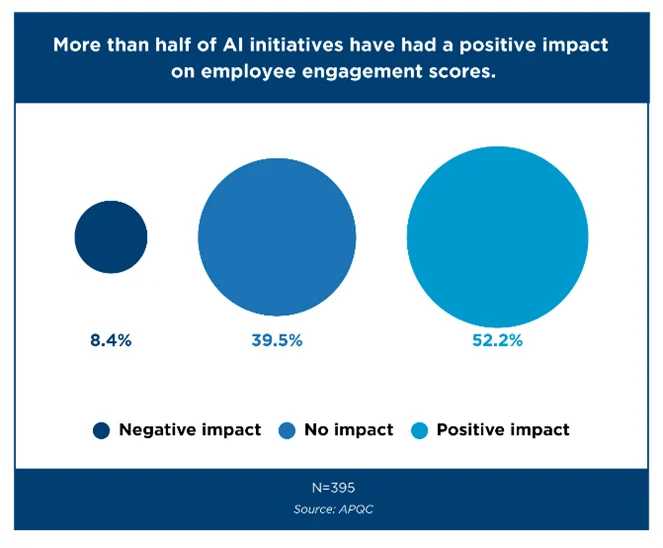
Organizations across the globe are channeling significant resources into the adoption of Artificial Intelligence (AI), driven by a dual expectation: to elevate business performance and, crucially, to enhance the employee experience. This investment surge is manifesting in a rapid proliferation of new AI tools and pilot programs deployed across diverse business functions. While the public discourse surrounding AI has often been dominated by concerns about potential job displacement and employee disengagement, emerging research from APQC, a leading process improvement association, suggests a more nuanced reality. Contrary to widespread apprehension, a substantial proportion of business leaders are reporting that AI is, in fact, improving employee engagement, a critical metric for overall job satisfaction and organizational health. Conversely, only a small fraction of these leaders indicate that AI has negatively impacted engagement levels. The divergence in outcomes, APQC’s findings reveal, is not inherent to the technology itself, but rather hinges on the strategic and intentional manner of its implementation.
The APQC research, which surveyed a broad spectrum of organizational leaders, paints a compelling picture: approximately 40% of participating organizations observed no discernible impact on employee engagement following AI integration. More concerningly, slightly over 8% reported a negative effect. This data, while reassuring in that it debunks the notion of AI as a universal engagement disruptor, simultaneously highlights a significant challenge. The stark reality is that nearly half of organizations are failing to realize any substantial engagement benefits from their substantial AI investments. This disparity begs a crucial question: why does the same technology yield such vastly different results in terms of employee morale and commitment?
APQC’s analysis points to a fundamental difference in approach. Organizations that report enhanced employee engagement typically view AI not as an isolated technological upgrade, but as an integral component of a broader, coordinated transformation of how work is accomplished. In these forward-thinking environments, the introduction of AI is intrinsically linked to the evolution of employee skill sets and the streamlining of existing workflows. This holistic integration ensures that employees can readily perceive AI’s relevance to their roles and experience tangible improvements in their daily tasks and overall productivity.
In contrast, organizations experiencing little to no positive impact often adopt AI in a more fragmented and piecemeal fashion. This can involve the deployment of isolated AI use cases, the integration of disconnected tools, or training initiatives that are divorced from the practical realities of daily work. While employees in these settings might engage with AI tools, they often lack the clarity needed to understand how these technologies fundamentally alter their responsibilities or contribute to their effectiveness. This disconnect can lead to a perception of AI as an ancillary or even superfluous addition, rather than a transformative force.
A Crucial Juncture: Re-evaluating AI Scaling Strategies
Many organizations that have already embraced AI are now contemplating further expansion of its use. However, before embarking on widespread scaling, it is imperative for leaders to critically assess whether the foundational conditions are in place to truly leverage AI for work enhancement. When these essential prerequisites are absent, the potential for both AI adoption and employee engagement to falter becomes significantly amplified. This moment calls for a deliberate pause and a strategic recalibration, ensuring that AI implementation is a catalyst for genuine improvement rather than a source of confusion or frustration.
The Pillars of Intentional AI Implementation
Organizations that successfully leverage AI to foster stronger employee engagement consistently demonstrate a shared set of characteristics in how they prioritize, design, and execute their work processes. These discernible patterns offer a roadmap for other organizations seeking to maximize the positive impact of AI. By understanding and emulating these principles, businesses can cultivate an environment where AI becomes a powerful ally in driving both performance and employee satisfaction.
Aligning AI with Business-Critical Operations
The most profound impact of AI is realized when it is strategically applied to tasks and processes that are central to an organization’s success. This necessitates a deliberate focus on use cases where improvements in speed, accuracy, or decision-making capabilities translate into measurable gains in business outcomes. When AI is clearly tethered to the core objectives of the business, employees can readily grasp its utility in achieving superior results. Conversely, a weak or ambiguous connection between AI initiatives and business priorities can render the technology abstract and disconnected from the very metrics that define success within their roles.
To ascertain the clarity of this alignment within your organization, consider the following reflective questions:
- Are AI initiatives directly addressing key performance indicators (KPIs) that drive business growth and profitability?
- Can employees articulate, with confidence, how their use of AI contributes to achieving overarching organizational goals?
- Is there a clear line of sight between the problems AI is intended to solve and the tangible benefits it is expected to deliver to the business?
- Are AI pilot programs and ongoing deployments prioritized based on their potential to deliver significant business value, rather than simply on technological novelty?
Redesigning Workflows Prior to AI Integration
A common pitfall in AI adoption is the tendency to overlay new technology onto existing, often suboptimal, work processes. AI possesses a remarkable capacity to amplify existing operational dynamics. When workflows are already well-defined, standardized, and robust, AI can serve to reinforce these strengths, leading to enhanced efficiency and effectiveness. However, if processes are fragmented, loosely structured, or reliant on inconsistent data, AI integration can exacerbate these underlying issues, making them more conspicuous and challenging to navigate.
The ramifications of this oversight are directly felt by employees in their day-to-day work. Instead of simplifying tasks, poorly integrated AI can introduce extraneous steps, generate conflicting outputs, or necessitate complex decisions regarding when and how to trust its results. When employees are compelled to dedicate more time to resolving exceptions or rectifying inconsistencies, their work can become more arduous rather than more productive, ultimately eroding engagement over time.

To assess whether these challenges are manifesting within your organization, reflect on these critical questions:
- Have existing business processes been thoroughly reviewed and optimized before the introduction of AI tools?
- Are current workflows documented, standardized, and understood by all relevant stakeholders?
- Is the data feeding AI systems clean, accurate, and consistently formatted?
- Are employees reporting an increase in tasks related to data cleansing, exception handling, or reconciling AI-generated outputs, rather than a reduction?
Establishing a Direct Link Between AI and Specific Roles and Tasks
Employee engagement with AI is significantly boosted when individuals are provided with clear and practical opportunities to apply these technologies to concrete tasks, decisions, and workflows within their specific roles. When this direct connection is absent, AI can remain an abstract concept, detached from the practicalities of daily work. Employees might possess a general understanding of AI’s capabilities, but this knowledge often fails to translate into tangible improvements in performance, enhanced productivity, or a greater sense of confidence in their professional capacity.
A few targeted questions can illuminate the strength of this connection within your organization and identify potential breakdowns:
- Are AI tools and functionalities directly mapped to specific job responsibilities and daily tasks?
- Do employees receive targeted training and support that demonstrates how to leverage AI within their immediate work context?
- Are there clear examples and use cases that showcase how AI can directly assist employees in making better decisions, completing tasks more efficiently, or improving the quality of their output?
- Do employees feel empowered and equipped to utilize AI as a tool to enhance their personal productivity and professional growth?
Defining Clear Ownership and Implementing Robust Guardrails for AI
As AI technologies become more pervasive across an organization, employees require a sense of coherence and predictability in their rollout and integration. This necessitates clear accountability for the introduction, ongoing support, and strategic evolution of AI tools. Furthermore, comprehensive guidance on how to effectively and responsibly utilize these technologies is essential. In the absence of such structure, employees are often left to independently interpret acceptable usage parameters and to navigate the complex landscape of where to seek assistance.
Equally critical is the establishment of shared ethical frameworks and operational guardrails concerning AI’s application, encompassing areas such as data privacy, security, and responsible use. A mechanism for measuring the efficacy of AI initiatives and for iteratively refining strategies based on performance data is also indispensable. When these elements are firmly in place, AI is perceived as a deliberately developed and well-managed organizational capability. Conversely, their absence can lead to a disjointed and potentially untrustworthy AI deployment, undermining employee confidence.
Consider the following questions to assess your organization’s approach to AI governance and rollout:
- Is there a designated individual or team responsible for overseeing the strategic direction and implementation of AI across the organization?
- Are clear guidelines and policies established regarding the ethical, secure, and responsible use of AI technologies?
- Do employees know where to turn for support, training, and clarification regarding AI tools and their application?
- Is there a transparent process for monitoring AI performance, gathering feedback, and making necessary adjustments to implementation strategies?
- Are employees actively involved in the feedback loop, contributing to the continuous improvement of AI integration and usage?
The Unfolding Payoff: Where AI Efforts Begin to Yield Returns
When employees can clearly perceive the direct correlation between AI and their individual roles, when their responsibilities and expectations are well-defined, and when they possess reliable channels for guidance and support, AI seamlessly integrates into their work processes, becoming a valuable asset. In scenarios where this clarity is lacking, individuals are often left to conjecture about AI’s relevance to their work. This can result in inconsistent usage, experimentation without clear objectives, or even the complete abandonment of AI tools. The fundamental missing element in these situations is a palpable understanding of how AI can demonstrably enhance their effectiveness, bolster their confidence, and deepen their connection to the value they generate.
This is precisely where the divergence in engagement outcomes begins to manifest. Bridging this gap requires a concerted effort to make AI’s role in the workplace more visible and actionable. When employees can readily see how AI amplifies their personal contributions and empowers them to achieve better results, a more profound and sustainable level of engagement will inevitably follow. The journey of AI integration is not merely about deploying technology; it is about fostering a symbiotic relationship between human ingenuity and artificial intelligence, one that ultimately elevates the work experience and drives organizational success.
The insights gleaned from APQC’s research underscore a critical takeaway for leaders navigating the rapidly evolving landscape of AI: the technology’s potential to foster employee engagement is not an inherent characteristic, but a direct consequence of strategic foresight and meticulous execution. By embracing a holistic, employee-centric approach to AI implementation, organizations can move beyond the hype and unlock the true potential of these transformative tools, cultivating a more productive, engaged, and future-ready workforce. The ongoing evolution of AI necessitates a continuous dialogue between technological advancement and human-centric design, ensuring that innovation serves to empower rather than alienate the people at the heart of every organization.
Data referenced in this article was considered accurate at the time of publication. For the most up-to-date information, readers are encouraged to consult www.apqc.org.