
As the United States approaches its 250th anniversary, a pivotal moment in its history coincides with the advent of artificial intelligence (AI), the most transformative technology of a generation. This technological shift is fundamentally reshaping the nature of work, prompting urgent questions from corporate boards, employees, and policymakers alike. While many focus on job displacement and potential blame, a deeper historical perspective reveals a recurring pattern: each wave of disruption, from the agricultural revolution to the digital age, has ultimately propelled America toward a more prosperous and dynamic economic future. The leaders who have historically grasped this fundamental truth have consistently defined and won the future.
The enduring narrative of the American economy is one of continuous evolution, a testament to its "operating system" of free enterprise and the adaptability of its workforce. Since its inception, the nation has undergone profound economic transformations, each one discarding old forms of labor while simultaneously birthing entirely new industries and employment categories. This article examines this 250-year pattern of disruption and renewal, placing the current AI revolution within its historical context and exploring the implications for CEOs and the broader economy.
From Agrarian Roots to a Service-Dominated Landscape
In 1776, when the Declaration of Independence was signed, the American economy was overwhelmingly agrarian. Approximately nine out of every ten working individuals were engaged in farming, cultivating a diverse range of regional crops like tobacco, rice, wheat, corn, fish, and timber. This agricultural output was facilitated by a nascent merchant class and a limited number of artisans. The national economic infrastructure was rudimentary, lacking a central treasury, a unified currency, or significant industrial manufacturing. The nation’s balance sheet, on that momentous July 4th, was largely composed of agricultural produce, maritime assets, and a powerful, unifying idea.
Fast forward to the present day, and the landscape is dramatically different. The U.S. Bureau of Labor Statistics reports approximately 170 million Americans in the workforce. Agriculture now accounts for less than two percent of this labor force. Another 19 percent are involved in building, manufacturing, mining, or transporting physical goods. The overwhelming majority, nearly 79 percent, are engaged in producing services – a sector that barely existed as a discernible category in 1776. This includes fields such as healthcare, software development, finance, education, logistics, entertainment, and professional consulting, all of which now form the bedrock of our daily economic lives.
To contextualize this shift, consider the reaction of a Pennsylvania farmer in 1776 if told that his descendants would earn a living by writing computer code, treating complex diseases, or managing global investment portfolios. The concept would have been utterly alien, as the productivity and technological advancements necessary to support such professions had not yet materialized. Yet, the American economy, driven by innovation and entrepreneurship, consistently expanded its productive capacity, enabling these new forms of work to emerge and flourish.
Three Eras of Transformation: A Recurring Pattern
The transition from an agrarian society to the service-based economy of today was not a single, smooth evolution but rather a series of transformative waves, each initiated by entrepreneurial visionaries who identified and addressed inefficiencies that had become accepted norms.
The Age of Steel: Andrew Carnegie and Industrial Might (Late 19th Century)
In 1875, when Andrew Carnegie established his first steel mill, the United States was a net importer of steel rails, relying heavily on Britain. Within a quarter-century, American steel production surged, becoming the world’s cheapest and most productive. Steel became the fundamental building material for an industrial revolution, enabling the construction of towering skyscrapers, expansive railroad networks, and robust bridges, which in turn supported a burgeoning industrial workforce. Carnegie’s enterprise did more than just produce steel; it laid the groundwork for urban vertical growth and the integration of a continental economy. Millions of agricultural workers displaced by mechanized farming found new employment opportunities in the mills, rail yards, construction projects, and supporting industries that fueled this industrial expansion. The nation’s economic output and complexity grew exponentially, fundamentally altering its character.
The Democratization of Mobility: Henry Ford and the Automobile (Early 20th Century)
Henry Ford is renowned not for inventing the automobile, but for making it accessible to the average working American. His pioneering use of the moving assembly line dramatically reduced the production time of a Model T from 12 hours to a mere 90 minutes, consequently slashing the price from over $800 to under $300. In a revolutionary move, Ford doubled his workers’ wages to $5 a day, empowering them to purchase the very vehicles they were producing. Despite initial criticism of this strategy as financially reckless, Ford’s innovations effectively created the American middle class. While blacksmiths, livery stable operators, and harness makers saw their livelihoods diminish, their children transitioned into roles as machinists, mechanics, automobile dealers, road construction workers, and, within a generation, suburban homeowners. Entire industries, inconceivable in 1908 – from auto insurance and roadside motels to fast-food restaurants – owe their existence to the innovation originating from Ford’s Highland Park plant.
The Rise of the Knowledge Economy: Jobs, Gates, and the Digital Revolution (Late 20th Century)
By 1976, as Steve Jobs and Steve Wozniak were assembling the first Apple computers in a garage and Bill Gates was developing the operating system that would define the personal computer era, the industrial economy forged by Carnegie and Ford was already facing challenges from automation and global competition. The anxieties of this period resonate with today’s discourse: factory closures, the hollowing out of industrial communities, and widespread concern that a generation would struggle to match their parents’ standard of living. However, what followed was an unprecedented expansion of high-skill, high-wage employment. Sectors such as software, biotechnology, financial services, telecommunications, and the vast ecosystem of professional services that support them now employ more Americans, at higher real wages, than the manufacturing sector ever did at its peak.
The Compounding Miracle of American Productivity
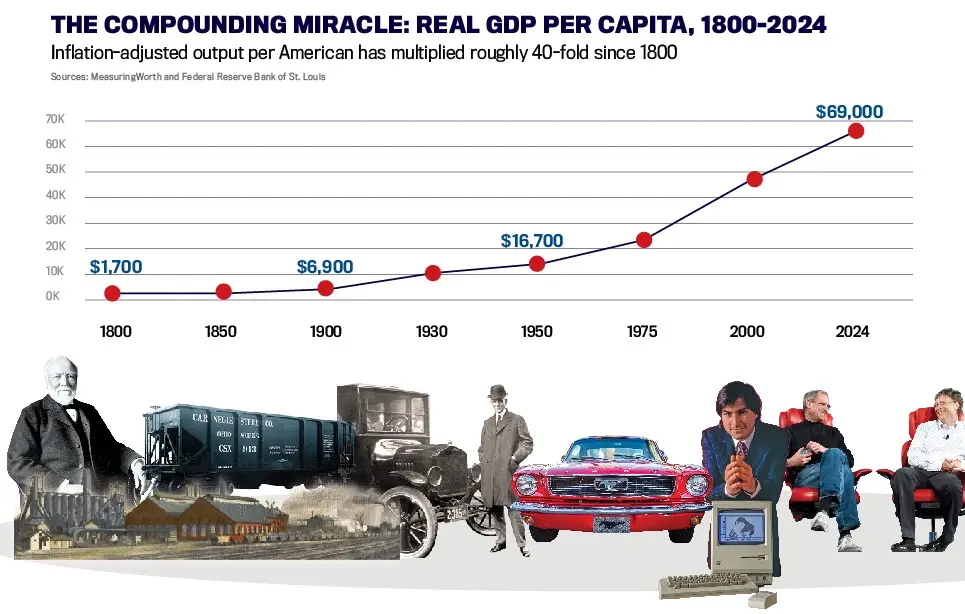
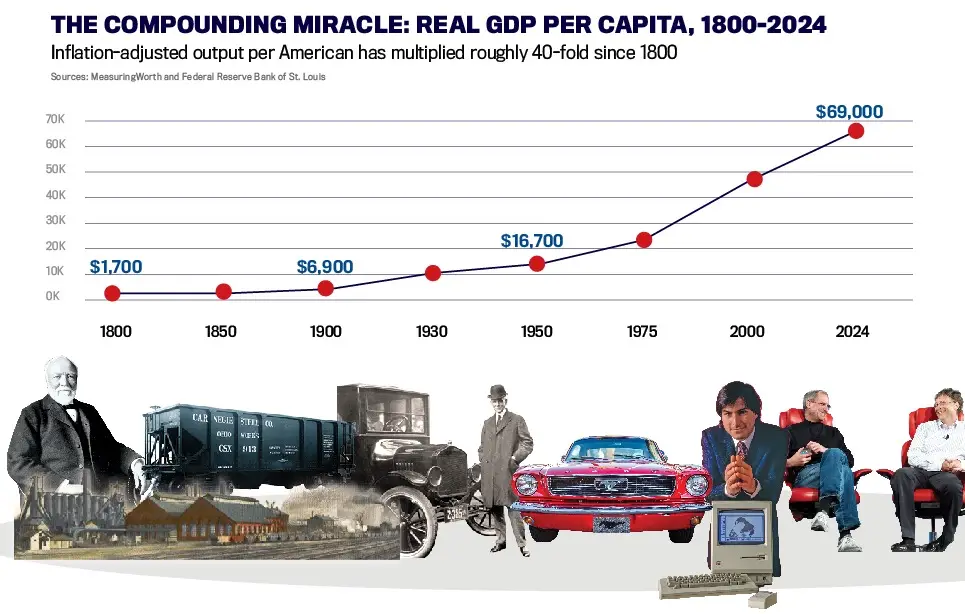
The common thread across these transformative eras is clear: each began with a significant productivity breakthrough that disrupted established employment patterns. Each was met with dire predictions of mass unemployment, yet each concluded with an economy that was materially larger, more diverse, and more prosperous than its predecessor. The cumulative effect of this relentless innovation is profoundly evident in economic output. Inflation-adjusted output per American, estimated at roughly $1,600 in 1800, surged past $8,000 by the turn of the 20th century, reached $18,000 by mid-century, and now stands near $70,000 – a remarkable forty-fold increase. Each doubling of this output was catalyzed by a wave of disruption, necessitating a generation of leaders willing to embrace the future.
AI: The Latest Chapter in a Long History of Disruption
Artificial intelligence represents the most consequential general-purpose technology since electricity. Its impact on the labor market is undeniable; it will, and already has, rendered certain categories of work obsolete. The critical question is not if jobs will be lost to AI, just as jobs were lost to the cotton gin, the steam engine, the assembly line, the container ship, and the personal computer. The true question is whether fear of this transition will prevent us from seizing the far greater opportunities that lie beyond it.
Historical precedent is unambiguous on this matter. Every preceding technology that displaced jobs ultimately created more employment opportunities, at higher wages, in sectors that the most pessimistic observers of the time could not have conceived. Current projections from the Bureau of Labor Statistics, for instance, forecast the creation of 5.2 million net new American jobs over the next decade. The fastest growth is anticipated in healthcare, professional and technical services, and, notably, in occupations directly enabled by AI itself. This optimistic projection, however, hinges on the nation’s ability to navigate the transition without succumbing to paralysis.
Pessimism, throughout history, has often held greater immediate credibility than optimism. In 1900, the dominant fear was the inability of immigrant labor to assimilate. By 1950, concerns centered on automation leading to permanent unemployment. In 1980, the anxiety was that Japan would dominate American manufacturing. In 2000, the internet was widely viewed as a speculative bubble devoid of a tangible economic foundation. While each of these fears was rooted in observable disruptions, they all misjudged the ultimate trajectory of the American economy. The nation has consistently lost specific jobs over decades, but it has never lost its fundamental capacity to create new ones.
The Imperative for Today’s CEOs
The 250th anniversary of the United States offers a critical juncture not only for celebration but also for a sober assessment of our responsibilities to the economic system that has fostered such remarkable growth. Three core commitments are paramount for contemporary business leaders:
1. Embrace Technology as a Catalyst for Innovation, Not Just Efficiency
Companies that view AI solely as a tool for cost reduction will achieve only fleeting efficiency gains. They will inevitably be outmaneuvered by competitors who leverage AI to pioneer entirely new products, services, and business models. The 19th-century textile mills that invested in the most efficient looms did not necessarily win; the true victors were those who asked what entirely new possibilities an industrial economy could unlock. This forward-thinking question must be applied to every business strategy today, not deferred to some distant future. For example, AI-powered predictive analytics can move beyond simple cost savings to forecast emerging market needs, optimize complex supply chains for resilience and sustainability, and personalize customer experiences in ways previously unimaginable, leading to new revenue streams and competitive advantages.
2. Invest in the Existing Workforce’s Adaptability
The American worker has consistently demonstrated an extraordinary capacity to adapt to technological change. This resilience is not merely an inherent national trait but is also a product of employers who invest in retraining, upskilling, and fostering an environment where employees can grow into roles that may not have existed at the time of their hiring. AI presents every CEO with an unprecedented opportunity to embody this commitment to workforce development at a scale and speed never before possible. This requires proactive initiatives, such as implementing AI-driven personalized learning platforms for employees, offering tuition reimbursement for AI-related certifications, and creating internal mobility programs that allow workers to transition into new AI-augmented roles. The potential for enhanced productivity and employee loyalty through such investments is immense.
3. Defend the Foundational Pillars of Economic Prosperity
The extraordinary economic progress of the United States has been built upon a specific set of conditions: robust free markets, the rule of law, secure property rights, open capital flows, and a culture that embraces entrepreneurship. These are not immutable natural laws but rather an inherited legacy that can be eroded. CEOs, possessing significant public platforms, have a crucial role to play in defending these principles. This involves advocating for policies that support innovation, fair competition, and responsible immigration that attracts global talent. It also means fostering a corporate culture that champions long-term investment and ethical business practices, thereby reinforcing the very foundations upon which America’s economic miracle was built. For instance, advocating for clear and consistent regulatory frameworks for AI development and deployment, supporting educational reforms that emphasize STEM skills, and participating in public discourse on the importance of intellectual property protection are vital actions.
Charting the Next 250 Years
The Pennsylvania farmer of 1776 could not have envisioned the complexities and conveniences of our modern world. Similarly, we cannot fully predict the economic landscape our great-grandchildren will inhabit. However, 250 years of evidence strongly suggest that this future will be characterized by greater wealth, higher productivity, and a dynamism fueled by work we cannot yet imagine. This optimistic outlook is contingent upon our continued commitment to the principles that have driven America’s success.
America’s economic prosperity has never been an inevitability. It has been meticulously constructed, decision by decision, by individuals and leaders who chose to embrace the future, even when faced with uncertainty and the temptation to retreat. This willingness to bet on what lies ahead, to innovate and adapt, has been, and remains, the enduring job description of the American CEO. The current AI revolution represents not an endpoint, but the commencement of another chapter in this ongoing saga of American economic transformation.








