Ascent Programs, a leading corporate organization overseeing a vital network of residential and wilderness treatment programs for teens and young adults across Utah, has undergone a profound transformation in its human resources and talent acquisition functions. Faced with the inherent complexities of managing hiring across six distinct sites for a workforce exceeding 600 employees, the organization successfully implemented Workable, an advanced applicant tracking system (ATS), to centralize, standardize, and streamline its recruitment efforts. This strategic shift has not only yielded significant operational efficiencies, including an estimated three to five hours saved per hire, but has also fundamentally elevated HR to a data-driven, strategic contributor, directly impacting the quality of care provided to its vulnerable client population.
Ascent Programs: A Mission-Critical Enterprise in Youth Treatment
At its core, Ascent Programs operates at the forefront of mental health and behavioral treatment for adolescents and young adults. The network comprises specialized residential and wilderness programs, such as Three Peaks Ascent, each dedicated to providing intensive therapeutic environments designed to foster healing, growth, and long-term recovery. The nature of this work demands an exceptionally high standard of care, requiring a diverse and highly qualified workforce. This includes licensed therapists, certified teachers, admissions specialists, and a substantial contingent of residential staff who provide continuous, direct supervision and support to clients.
The organizational structure of Ascent Programs adds another layer of complexity. While corporate HR, led by Jodi Levie, manages overarching strategy and corporate office hiring, each of the six program sites features its own embedded HR director. This setup necessitates a delicate balance between local operational flexibility and enterprise-wide consistency—a challenge that, prior to the adoption of Workable, proved increasingly difficult to reconcile. The roles Ascent recruits for range from highly specialized clinical positions requiring specific credentials and extensive vetting, to high-volume residential staff roles often experiencing higher turnover due to the demanding nature of the work. Ensuring a consistent supply of qualified, compassionate, and compliant personnel is not merely an HR task; it is a direct determinant of client capacity, program efficacy, and the overall mission success of Ascent Programs.
The Decentralized Quagmire: Hiring Before Workable
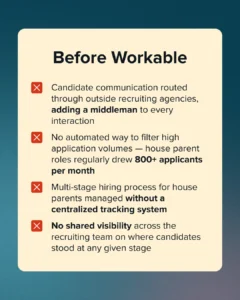
Before the advent of a unified solution, Ascent Programs’ hiring landscape was a fragmented and inefficient ecosystem. Each of the six program sites operated autonomously, with individual HR directors independently managing their entire recruitment lifecycle. This meant disparate job postings, primarily through separate Indeed accounts, with each site handling its own payment, ad placement, interview coordination, and candidate management. The absence of shared infrastructure meant there was no single source of truth for candidate data, no consolidated reporting, and critically, no visibility at the corporate level into the broader hiring performance of the organization.
The consequences of this decentralized approach were predictable and increasingly detrimental to Ascent’s ability to scale and maintain consistent quality. The process was inherently slow, as the entire burden of recruitment for a site often fell upon a single individual, leading to bottlenecks and extended time-to-hire metrics. Interview questions and evaluation criteria varied significantly from one program to another, raising concerns about fairness, equity, and compliance. Collaboration between HR and the clinical or operational teams, essential for effective hiring in a therapeutic environment, was limited by the lack of a common platform.
Most critically, the absence of centralized data rendered strategic decision-making impossible. As Jodi Levie, Ascent’s corporate HR lead, succinctly noted, “There was no visibility at the corporate level. We weren’t able to report on anything.” When a particular site encountered hiring difficulties, Ascent’s leadership had no means to discern whether the challenge stemmed from an internal process inefficiency or external market dynamics. This fundamental lack of insight prevented the organization from developing the data-driven strategies necessary for sustainable growth and consistent service delivery, leaving them reliant on anecdotal evidence rather than actionable intelligence.
The Strategic Imperative: Driving Change Through Data and Consistency
The impetus to seek a unified hiring solution for Ascent Programs was driven by two overarching strategic priorities: enhanced visibility and robust accountability. Leadership recognized the urgent need to present hiring performance to the board of directors not as a collection of isolated stories, but as compelling, verifiable data. Furthermore, with multiple independent sites, the organization desperately required a platform capable of injecting much-needed consistency into a hiring process that, by its very nature, demanded both local autonomy and enterprise-wide alignment.
The journey towards a centralized system began with a pilot implementation of Workable at Three Peaks Ascent, one of the network’s wilderness programs. The success of this initial phase, marked by immediate and tangible benefits, served as a catalyst for broader adoption. For Jodi Levie and her team, the critical evaluation criteria for any new system revolved around ease of implementation and demonstrable organizational impact. Workable met both these benchmarks, proving to be intuitive for users and delivering significant improvements almost immediately.
Early adopters within the HR team quickly grasped the platform’s potential for substantial time savings. As these efficiencies became apparent and were communicated across the different sites, adoption of Workable spread organically, driven by its inherent value rather than a top-down mandate. "Some people get set in their ways, and they don’t like change," Levie observed. "But as we talked about how much easier it was making our lives, it grew. Within a year, everyone was saying this is so much better." This rapid and widespread adoption underscored the platform’s user-friendliness and its ability to address immediate pain points for HR professionals. A key factor in accelerating this successful transition was the deliberate decision to extend hiring team access beyond just HR personnel. By empowering more employees—including clinical and operational managers—with visibility into candidates for their respective teams and a voice in the hiring process, Ascent fostered a sense of ownership. This made platform adoption feel less like a new policy and more like a direct benefit, enhancing collaboration and engagement across the organization.
Transforming Hiring: Pillars of Efficiency, Equity, and Intelligence
The implementation of Workable ushered in a new era for Ascent Programs’ talent acquisition, built upon several critical pillars:
-
Operational Efficiency and Significant Time Savings: Workable’s multi-board job distribution feature alone eliminated the tedious, manual process of posting roles individually across various job boards, ensuring wider reach with minimal effort. The platform’s self-scheduling capabilities for candidates and integrated texting features streamlined communication, reducing administrative back-and-forth. These efficiencies collectively translate into an estimated three to five hours saved per hire. For an organization with over 600 employees and the inherent turnover challenges of the care sector, this amounts to potentially thousands of administrative hours reclaimed annually, freeing HR staff to focus on more strategic initiatives. This newfound speed is particularly crucial for an organization where staffing levels directly correspond to client capacity; Ascent can now rapidly scale its hiring to match new client intake without compromising process quality.
-
Standardization for Enhanced Compliance and Equity: Perhaps one of the most impactful shifts was the move towards structured, consistent hiring across all six programs. Prior to Workable, there was no guarantee that a therapist candidate at one program was evaluated against the same criteria as a therapist at another. With Workable, Ascent developed role-specific workflows and standardized interview question sets for every position type, from high-volume residential staff to complex clinical roles requiring multi-stage evaluations. Every candidate for the same role now navigates an identical process, answers the same questions, and is assessed against uniform criteria. This "apples to apples" comparison, as Levie described, is instrumental in mitigating compliance risks and ensuring that all hiring decisions are made on a defensible, equitable, and non-discriminatory basis—a paramount concern in an industry serving vulnerable populations. The flexibility to customize workflows, adding steps for specialized clinical hires while streamlining for high-volume roles, allowed Ascent to achieve standardization without stifling the nuanced requirements of different positions.
-
Unprecedented Visibility and Strategic Reporting: The transformation in reporting capabilities has been truly revolutionary for Ascent. From a state of "no data" whatsoever, the corporate HR team now systematically tracks key performance indicators such as time to hire, qualified candidate volume, and candidate source across all six programs. This rich dataset informs decisions at both operational and strategic levels. The platform’s user-friendly reporting features, coupled with its predictive analytics functionality, enable Ascent to identify patterns in application flow and diagnose hiring challenges more accurately. When a site struggles to fill a role, HR can now consult historical data to determine if it’s a temporary market fluctuation or a systemic issue requiring targeted intervention. This newfound ability to "report to our board of directors," demonstrating areas of improvement and explaining challenges with concrete data, represents a significant elevation of the HR function. It shifts HR from a purely administrative support role to a strategic contributor, capable of driving organizational strategy with evidence-based insights.
-
Improved Candidate Quality and Seamless Experience: The enhanced reach facilitated by multi-board distribution, combined with a more structured evaluation process, has led to a consistent improvement in candidate quality. Hiring teams across all six programs report seeing more qualified applicants, indicating that the system effectively filters for fit earlier in the recruitment funnel. On the candidate side, the experience is notably seamless. Regardless of whether an applicant originates from Indeed, Ascent’s direct careers page, or a referral, their information is routed directly into Workable. This eliminates the need for HR to manage multiple platforms or reconcile disparate data, consolidating everything into a single, accessible repository. The application process itself is intuitive and friction-free, ensuring a positive initial impression for prospective employees.
Broader Implications: Impact on Mission and Growth
The comprehensive transformation of Ascent Programs’ hiring function has profound implications that extend beyond HR efficiencies. For an organization whose mission revolves around the wellbeing of teens and young adults, the quality and consistency of every hire directly impacts client outcomes. By ensuring a robust pipeline of qualified, well-vetted staff—from residential caregivers to highly specialized therapists—Ascent is better positioned to deliver its critical therapeutic services consistently and effectively. The ability to scale its workforce rapidly in response to client demand ensures that the organization can maximize its capacity to serve those in need, without compromising on the rigorous standards of care.
Furthermore, in a competitive job market for specialized clinical roles, having a streamlined, professional, and equitable hiring process enhances Ascent’s employer brand, making it a more attractive destination for top talent. The unified infrastructure provided by Workable supports the entire organization of over 600 employees, ensuring that HR directors and hiring managers across all six sites operate from a single, reliable source of truth. This fosters better collaboration, reduces redundancies, and ultimately strengthens the organizational fabric. The strategic insights derived from Workable’s reporting capabilities empower Ascent’s leadership to make informed decisions about resource allocation, talent development, and expansion, laying a solid foundation for sustainable growth.
Looking Ahead: Continuous Improvement and Strategic Evolution
As Ascent Programs continues its trajectory of growth, the organization is committed to further expanding its utilization of Workable’s advanced capabilities. Plans are underway to deliberately leverage features such as automated messaging and AI screening to further refine existing workflows, making them even more intentional and efficient. This continuous commitment to improvement is not merely an operational nicety; for an organization managing clinical hiring at scale, where the quality of every hire directly influences the wellbeing of its vulnerable clients, it is a fundamental imperative tied directly to its mission.
Workable has provided Ascent Programs with an indispensable foundation: unparalleled visibility, crucial standardization, and vital operational speed. Upon this robust infrastructure, the Ascent team is actively constructing a hiring function that is not only genuinely strategic but also fully capable of serving both the organization’s ambitious growth objectives and its profound mission to provide life-changing treatment for teens and young adults. The journey from fragmented processes to a unified, data-driven talent acquisition strategy marks a significant milestone in Ascent Programs’ ongoing commitment to excellence.