The landscape of corporate training is undergoing a significant transformation as organizations move away from passive learning models toward immersive, decision-based environments. While traditional multiple-choice quizzes remain a staple for verifying rote memorization, they often fail to prepare employees for the nuance and unpredictability of real-world interactions. In high-stakes environments—such as customer service, crisis management, or medical triage—the challenge is not merely identifying a "correct" answer but navigating a sequence of choices where each decision influences the subsequent outcome. Branching scenarios, powered by advancements in Artificial Intelligence (AI) and specialized authoring tools like iSpring Suite AI, have emerged as a critical solution for bridging the gap between theoretical knowledge and practical application.
The Evolution of Immersive Learning Environments
Historically, the development of branching scenarios was a resource-intensive endeavor reserved for high-budget simulations. Instructional designers had to manually map out every possible path, write hundreds of lines of dialogue, and coordinate with developers to ensure the logic remained sound. However, the integration of AI into authoring platforms has democratized this process. By leveraging generative AI, training professionals can now produce complex, non-linear narratives that adapt to learner input in a fraction of the time previously required.
The core value of these scenarios lies in the relationship between choice and consequence. Unlike a linear presentation, a branching scenario places the learner at the center of a narrative. For example, if a support agent is confronted by an irate customer, the scenario does not simply ask the agent to name a de-escalation technique. Instead, it presents the agent with several dialogue options. Choosing a defensive response might cause the virtual customer to become more hostile, while an empathetic response might unlock a path toward resolution. This "safe failure" environment allows employees to witness the long-term impact of their professional judgment without risking actual company revenue or reputation.
Strategic Criteria: When to Deploy Branching Logic
Despite the benefits, branching scenarios require more strategic planning than standard eLearning modules. Industry experts suggest that the decision to use branching should be based on the complexity of the task rather than the novelty of the technology.

Standard instructional methods, such as checklists or short video demonstrations, remain the most efficient way to teach fixed processes—such as how to use a specific software interface or where to find a company policy. In contrast, branching scenarios are uniquely suited for "soft skills" and situational judgment. These include:
- Conflict Resolution: Handling internal grievances or hostile external stakeholders.
- Sales Strategy: Navigating objections and building rapport with skeptical prospects.
- Safety Compliance: Identifying hazards in a dynamic environment where one oversight leads to a chain reaction.
- Leadership Development: Providing constructive feedback to employees who may react with defensiveness or apathy.
The objective in these cases is not just to remember a rule, but to build the confidence necessary to apply that rule under pressure.
The Methodology of Decision-First Design
A common pitfall in scenario design is starting with a broad topic rather than a specific decision point. A topic like "Diversity and Inclusion" is too vague to drive a branching narrative. However, a decision point such as "An employee makes an insensitive comment during a team meeting; how do you respond?" provides immediate direction.
Effective scenarios place the learner close to the "moment of action." Professional instructional design principles suggest minimizing long introductions that can dissipate tension. By presenting the learner with immediate pressure—such as a prospect saying, "Your competitor is cheaper"—the scenario mirrors the fast-paced nature of the modern workplace.
The quality of the scenario depends heavily on the plausibility of the choices provided. In many legacy training modules, "distractor" answers were often absurd or obviously wrong, allowing learners to guess the correct path without truly engaging with the material. To combat this, AI-driven tools help designers craft "nuanced distractors." These are options that might seem logical to an inexperienced employee but lead to sub-optimal outcomes. For instance, in a sales scenario, one option might focus on technical specifications (correct but poorly timed), while another focuses on relationship building (correct but ignoring the client’s budget concerns).

Accelerating Production with iSpring Suite AI
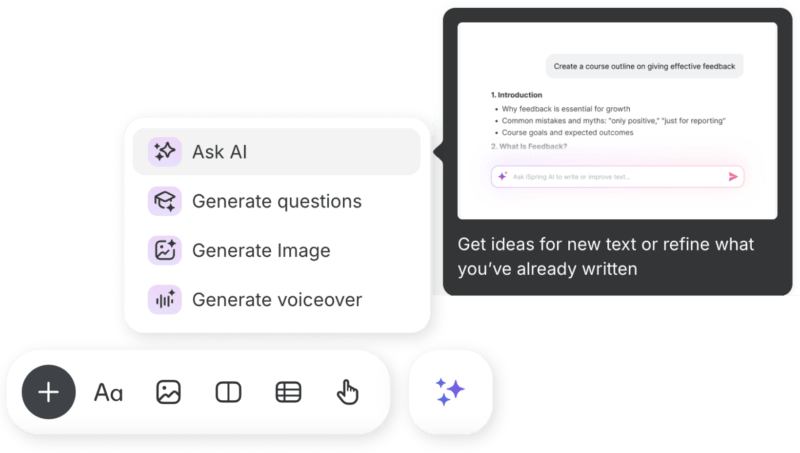
The technical implementation of these scenarios has been streamlined through the iSpring Suite AI, which operates within the familiar PowerPoint environment. This integration is particularly significant for corporate environments where staff are already proficient in slide-based presentations. The platform offers two primary pathways for building decision points:
1. Role-Play Simulations for Conversational Training
This module is designed for dialogue-heavy interactions. Designers can select characters from a vast library, assign them specific emotional states, and use AI to generate realistic dialogue. The AI can assist by drafting multiple variations of a response—such as a "calm," "skeptical," or "frustrated" reaction from a virtual customer—allowing the designer to refine the tone to match their specific organizational culture.
2. QuizMaker for Scored Assessment
For scenarios that require formal tracking and reporting, the QuizMaker tool allows for scored branches. This format is essential for compliance-heavy industries like healthcare or finance. Depending on the learner’s choice, they can be directed to a coaching slide, a remediation video, or an advanced stage of the simulation. This ensures that the training serves both as a learning tool and a diagnostic instrument for the organization.
The Role of Visual and Emotional Context
Data from the field of neuroeducation suggests that learners retain information more effectively when it is associated with emotional cues. Visual context plays a vital role in this process. The iSpring Content Library provides thousands of backgrounds—ranging from hospital wards and construction sites to corporate boardrooms—and characters with diverse facial expressions.
When a learner makes a poor choice and sees a virtual character’s expression shift from neutral to angry, it triggers a more profound psychological response than a simple text box saying "Incorrect." AI-powered character builders further allow organizations to customize clothing and appearance to reflect their specific workforce, increasing the relatability of the simulation.

Data-Driven Refinement and Testing
A critical phase in the lifecycle of a branching scenario is the testing of "all possible paths." Because these modules are non-linear, they require rigorous Quality Assurance (QA) to ensure there are no "dead ends" or logical inconsistencies.
Once published to a Learning Management System (LMS), the data generated by these scenarios provides invaluable insights for L&D managers. By analyzing "pathway data," organizations can identify specific areas where their workforce is struggling. If 70% of learners choose a specific "nuanced distractor" in a cybersecurity simulation, it indicates a widespread misunderstanding of a particular protocol, allowing the company to address the gap through targeted coaching or supplemental training.
Market Implications and the Future of Corporate Training
The shift toward AI-enhanced branching scenarios is reflected in broader market trends. According to industry reports from organizations like the Brandon Hall Group, companies that utilize simulation-based training report higher levels of employee engagement and a faster "time-to-productivity" for new hires. Furthermore, the global eLearning market is projected to continue its rapid expansion, with AI-driven content creation being a primary catalyst for growth.
The economic impact is also noteworthy. By reducing the time required to build complex simulations, companies can update their training materials more frequently in response to market changes or new regulations. What once took months of development can now be accomplished in days, allowing for a more agile approach to human capital development.
Conclusion: Turning Decisions into Safe Practice
The ultimate goal of any branching scenario is to turn workplace decisions into a form of "safe practice." By focusing on high-impact decisions, utilizing AI to generate plausible dialogue and consequences, and leveraging visual tools to create emotional resonance, organizations can prepare their employees for the complexities of the modern world.
As AI continues to evolve, the line between "training" and "experience" will continue to blur. The ability to simulate reality within a digital environment ensures that when employees face their most difficult professional moments, they have already practiced the solution a dozen times in a space where mistakes are not liabilities, but essential steps toward mastery. Through tools like iSpring Suite AI, the path from novice to expert is becoming shorter, more engaging, and more data-driven than ever before.