The question of how companies can effectively integrate artificial intelligence into their recruitment processes while preserving the indispensable human element has emerged as a paramount concern for employers and talent acquisition (TA) professionals. This critical inquiry demands practical, actionable insights, particularly as automated recruitment solutions become increasingly sophisticated and pervasive. As of early 2026, a significant portion of the corporate landscape, estimated between 35% and 45% of companies, has already embedded AI into core aspects of their hiring workflows, signaling a decisive shift in talent strategy. This article delves into the best practices for leveraging AI in recruitment for the year ahead, emphasizing how organizations can optimize hiring quality by strategically combining automated efficiencies with traditional human acumen.
The Evolving Landscape of AI in Recruitment: A 2026 Perspective
The trajectory of AI in recruitment suggests its enduring presence in the foreseeable future, primarily because the technology consistently delivers tangible results. Human Resources managers across various sectors have reported encouraging outcomes, particularly within larger enterprises tasked with processing thousands of candidate profiles and applications monthly. AI-driven recruitment solutions empower organizations to scale their hiring efforts, managing vast data volumes with unprecedented speed and precision. This efficiency is a key driver behind market experts’ projections for the enterprise sector of AI recruitment, which is expected to witness a Compound Annual Growth Rate (CAGR) of 6.8% between 2020 and 2032. This sustained growth underscores AI’s transition from a novel tool to a fundamental component of modern TA infrastructure.
Historically, AI’s journey in recruitment began with basic Applicant Tracking Systems (ATS) that automated administrative tasks like resume parsing and keyword matching. Over the past decade, however, advancements in machine learning, natural language processing (NLP), and predictive analytics have transformed AI into a strategic asset. Today, AI can analyze complex candidate data, predict job performance, and even identify potential flight risks, moving beyond mere administrative support to become a "gatekeeper to employment," as observed by Noelle London, CEO and founder of employee data platform Illoominus. This evolution means AI is no longer operating quietly in the background but actively shaping who gains access to career opportunities.
A significant development in 2026 is the rise of "agentic AI"—autonomous AI systems capable of performing complex tasks with minimal human intervention. Global HR technology studies indicate that an impressive 87% of enterprise organizations have already integrated agentic AI tools into their TA pipelines, leveraging them for tasks such as drafting job descriptions, initiating candidate outreach, and even conducting initial screening conversations. This represents a monumental leap from earlier AI applications, pushing the boundaries of what non-human team members can achieve in recruitment.
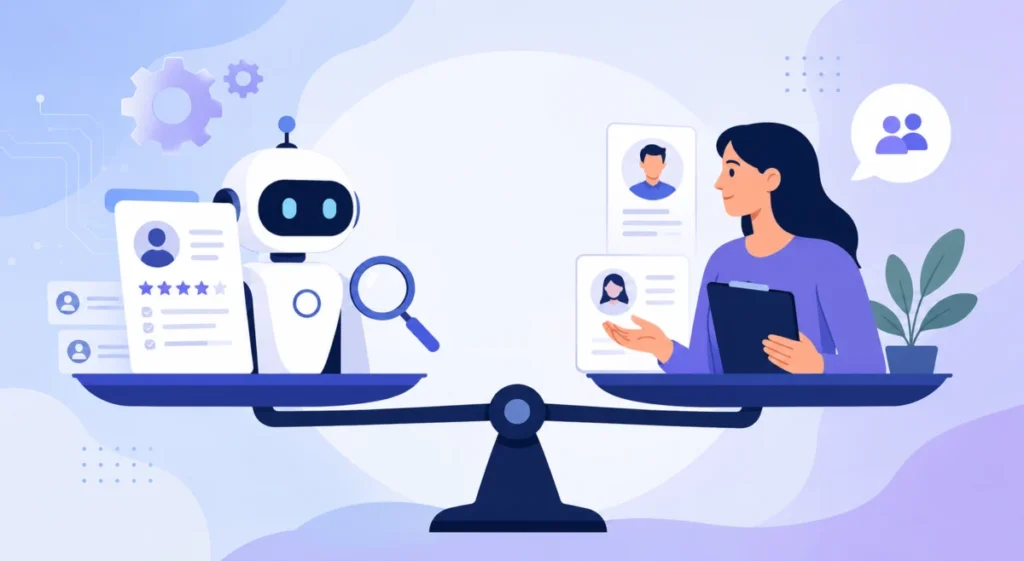
Despite these advancements, the critical message for TA professionals remains constant: the importance of moderating automated recruitment with a "human-in-the-loop (HITL)" approach cannot be overstated. This philosophy dictates that while AI streamlines processes and offers data-driven insights, active human participation remains essential for making strategic TA decisions, particularly those requiring empathy, nuanced judgment, and an understanding of organizational culture. Industry analysts frequently underscore the necessity of this hybrid model, asserting that "augmented intelligence," where AI enhances human capabilities rather than replaces them, will define the next era of talent acquisition.
Strategic Applications of AI in Recruitment: A Hybrid Approach
The following sections highlight key areas where AI can be strategically deployed in recruitment, alongside practical tips for balancing these technological capabilities with indispensable human intervention.
AI in Candidate Sourcing: Expanding Reach and Precision
One of the persistent challenges for recruiters is effectively sourcing top talent; approximately 46% of recruiters report difficulties in this area, a figure that fluctuates with shifting industry norms and job market expectations. AI offers a powerful solution, replacing error-prone manual data inputs and generalized engagements with sophisticated automated analytics. AI candidate sourcing solutions can instantly qualify and shortlist talent based on objective search criteria, ensuring a perfect job fit by accessing continuously refreshed job seeker data. This capability allows organizations to proactively identify and engage talent, offering suitable roles at every stage of their career, including the elusive 70% of the workforce categorized as passive job seekers. Furthermore, forward-thinking employers are leveraging AI sourcing for predictive workforce planning, anticipating and addressing future skill gaps before they emerge, thereby ensuring long-term organizational resilience. AI tools in this domain can sift through millions of profiles across diverse platforms, identify niche skills, and even predict cultural fit based on linguistic analysis of candidate profiles, significantly reducing the time-to-hire by an average of 15-20% for early-stage screening.
- The Human Advantage: While AI provides an invaluable first-round of talent scouting, it should not be viewed as a standalone decision-maker. TA teams must exercise their expert judgment by delving deeper into talent profiles. This involves evaluating the nuances of soft skills, critically assessing testimonials, and determining a candidate’s cultural alignment with the organization. A human recruiter can interpret the subtleties of a candidate’s career trajectory, understand their motivations beyond keywords, and build the initial rapport that AI cannot replicate, ensuring a truly holistic assessment before a final hiring decision. Recruiters are essential for complex problem-solving, like identifying transferable skills in candidates from unconventional backgrounds, a task that often eludes even advanced AI.
Optimizing Interview Scheduling: Enhancing Candidate Experience
Interview scheduling is often cited as a pain point for both recruiters and candidates, with poor practices significantly detracting from the overall candidate experience. The lengthy, multi-round processes can be particularly frustrating; data indicates that 42% of candidates have withdrawn from a hiring process solely due to scheduling complexities. Automated scheduling powered by AI transforms this experience, fostering enhanced candidate engagement through a transparent and accurate approach. These solutions provide self-scheduling links, timely reminders, and prompt status updates, granting job seekers the flexibility to manage their applications while remaining fully informed. In 2026, AI technology sets new benchmarks for interviewee expectations: while candidates typically anticipate a first response within seven days, AI-driven systems can achieve this within 48 hours. Similarly, the expectation of a scheduled interview within 2-6 days of contact is dramatically surpassed, with AI providing a self-scheduling link within a single day. This efficiency frees up an estimated 10-15 hours per recruiter per week, allowing them to focus on more strategic tasks.
- The Human Advantage: Despite AI’s systematic precision in scheduling complex, multi-round interviews, human intervention remains crucial for maintaining trust and personalization. Studies show that 25% of hires trust employers less when AI is used to evaluate their information, a sentiment that can extend to automated scheduling if not managed carefully. Human teams can mitigate these trust issues by vetting automated messages for tone, ensuring they are empathetic and professional, and avoiding impersonal phrases like "Do not reply to this automated email." Furthermore, recruiters can intervene to address any scheduling anomalies or provide personalized support, transforming a potentially sterile automated interaction into a positive touchpoint that reinforces the company’s commitment to candidate well-being. A human touch is also vital for handling rescheduling requests due to unforeseen circumstances, demonstrating flexibility and care.
AI in Resume Screening: Precision at Scale
Resume screening is fundamentally about identifying the precise skills, certifications, and experience required for a given role. For large enterprises handling thousands of applications for a single vacancy, manual reviews are an insurmountable, Herculean task. Automated resume screening solutions efficiently scan CVs for data points that align with an employer’s criteria. High-quality AI screening solutions analyze a CV’s format and content quality in mere seconds, assigning scores to prioritize candidate engagement and flag potential issues such as keyword stuffing—a common tactic in exaggerated resumes. Leveraging advanced Natural Language Processing (NLP) and Large Language Models (LLMs), these systems can understand context, infer transferable skills, and provide a comprehensive initial assessment that far exceeds manual capabilities. This process can reduce screening time by up to 80%, allowing recruiters to focus on a highly qualified shortlist.
- The Human Advantage: Empathy and contextual understanding remain indispensable in the talent selection process. While AI excels at summarizing the "what" of a candidate’s profile, it often lacks the contextual analytics to understand the "whys." TA teams should continue to manually review resumes for "points of note," such as career gaps, to gain a deeper understanding of prospective hires’ unique journeys and circumstances. A human recruiter can interpret why a candidate might have shifted careers, taken time off for personal reasons, or developed skills through unconventional paths. This empathetic review ensures that valuable talent isn’t overlooked due to rigid algorithmic interpretations, enabling organizations to tap into the full potential of a diverse workforce. This human review is also crucial for mitigating algorithmic bias that might inadvertently penalize non-traditional career paths or diverse backgrounds.
Enhancing Job Description Vetting and Career Sites with AI
The task of crafting thousands of job descriptions (JDs) and disseminating them across various job boards and career sites carries inherent risks, potentially costing valuable hires. Each JD, if not meticulously vetted, poses risks of readability issues and subconscious bias. Suboptimal JDs can bore or repel candidates, significantly tarnishing employer branding and compromising hiring Return on Investment (ROI). An AI-powered JD-vetting solution meticulously analyzes and corrects biases related to gender, age, education, and ableism, improves readability, and rectifies formatting inconsistencies (e.g., ensuring the inclusion of key sections like benefits and salary). These AI-driven platforms also provide enterprise TA teams with organized JD libraries, enabling consistent, compliant, and optimized job postings at scale. This ensures that every JD is not just legally compliant but also appealing and inclusive, improving application rates by up to 30%.
- The Human Advantage: While AI excels at refining the grammar, vocabulary, and syntax of JDs, human creativity and strategic thinking are essential for promoting a unique employee value proposition (EVP) and workplace culture. AI cannot reliably capture or articulate the nuanced cultural elements of a company, which are constantly influenced by leadership decisions, industry shifts, and economic conditions. This is where human teams must step in to enhance AI-polished JDs with authentic storytelling that resonates emotionally with candidates. For instance, articulating specific inclusion strategies based on the company’s goals, such as championing intersectionality among underrepresented groups, adds a layer of genuine commitment that AI alone cannot convey. Human oversight ensures that JDs reflect the true spirit and values of the organization, attracting candidates who are not just skilled but also culturally aligned.
AI’s Impact on Recruitment Jobs: Transformation, Not Replacement
The prevailing concern that AI will entirely replace recruitment jobs is largely unfounded. The short answer is no, and likely never. However, the technology undeniably reshapes the rules of the recruitment game. AI fundamentally acts as a transformative tool, dramatically reducing human error and effort when managing vast, complex mountains of candidate data. As long as companies continue to hire people, there will always be an intrinsic and vital need for the human touch throughout the talent acquisition pipeline—for empathy, negotiation, relationship building, and strategic decision-making.
That said, AI has instigated significant changes within recruitment and the broader world of work. Beyond merely adopting AI tools, hiring teams are actively redefining their TA priorities. Data from the first half of 2026 reveals a remarkable 95% rise in AI-related job postings in the US, indicating a profound shift. This trend reflects recruiters and employers pivoting their hiring agendas towards a smaller pool of high-value, in-demand skills centered around AI development, deployment, and management. Recruiters are evolving into "AI-augmented talent strategists," focusing less on administrative tasks and more on understanding complex talent markets, building strategic relationships, and leveraging AI insights for competitive advantage. The future recruiter will be a skilled interpreter of data, a master of candidate experience, and a strategic partner to the business.
Ethical Considerations and Governance in AI Recruitment
The ethical deployment of AI in recruitment is not only possible but imperative, provided it adheres to stringent safeguards and compliance frameworks. The rise of Explainable AI (XAI) is central to this. XAI provides transparency by elucidating how an AI system or algorithm arrives at a particular decision—for example, why one candidate was prioritized over another in an automated Applicant Tracking System (ATS). This transparency is crucial for fostering ethical and logical decision-making, moving away from opaque "black box" solutions that can perpetuate biases or lead to unfair outcomes. Regulatory bodies globally, including the European