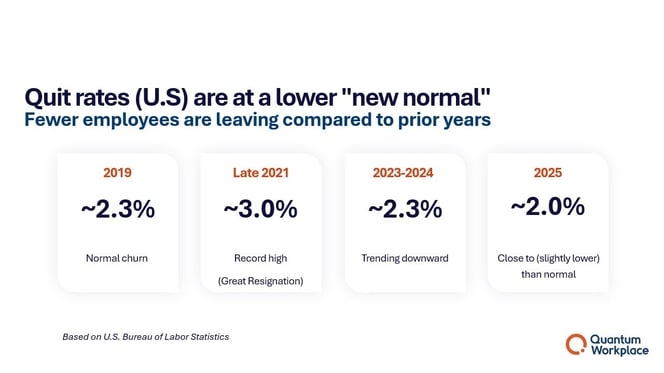
Employee engagement remained largely stable through 2025, and U.S. quit rates hit a historic low of approximately 2.0% in the same year. On the surface, these statistics suggest a period of organizational health and employee contentment. However, a deeper examination of workplace dynamics in 2026 reveals a more complex narrative, where apparent stability may mask underlying challenges and untapped potential. The current environment, characterized by constant change, evolving work models, and the integration of new technologies, necessitates a more nuanced understanding of employee sentiment beyond traditional HR metrics.
The illusion of stability can be misleading. While low turnover rates might indicate that employees are staying put, this does not automatically translate to high levels of motivation, alignment, or a clear vision for growth. According to Aaron Brown, Senior Manager of People Insights at Quantum Workplace, "Steady employee engagement may reflect resilience, not progress. Many organizations mistake stability for strength and miss opportunities to move forward." This sentiment is echoed by Anne Maltese, VP of People Insights, who describes this phenomenon as "latent risk"—a workforce that appears engaged but is not fully equipped or motivated for future challenges.
This shift in perspective underscores the need for HR leaders to look beyond headline figures and delve into the granular trends shaping employee experiences. The following four key employee engagement trends in 2026 offer critical insights into what high-level metrics might miss, providing a roadmap for organizations to foster genuine thriving rather than mere stability.
Managers Under Mounting Pressure: The Frontline of Organizational Strain
One of the most immediate indicators of internal pressure within organizations is the experience of middle managers. In 2026, these individuals are increasingly burdened with the dual responsibilities of driving results and supporting their teams amidst a landscape of continuous transformation. They are tasked with implementing strategic shifts, coaching employees through evolving workflows, and often serving as the primary conduit for organizational communication, all while contending with their own workload and the inherent uncertainties of constant change.
.png)
The data indicates that when organizational expectations outpace the clarity, resources, and support provided, managers are often the first group to exhibit declining engagement, reduced recognition, and diminished confidence. This initial dip in managerial well-being can rapidly cascade, impacting team morale and productivity. Across many organizations, managers consistently score lower than both senior executives and frontline employees on key engagement indicators, including recognition and clarity regarding expectations. This disparity highlights a critical vulnerability: managerial experience is emerging as a leading indicator of organizational alignment. When communication and strategic direction falter at this managerial level, the resulting misalignment can scale swiftly, often outpacing the detection capabilities of broader engagement or turnover metrics.
The implication for 2026 is clear: HR leaders must move beyond simply tracking the frequency of manager-led activities, such as one-on-one meetings. Instead, the focus must shift to evaluating the effectiveness of these interactions in fostering clarity, alignment, and a shared sense of purpose. A case study involving a large enterprise revealed a significant "feedback gap." While senior leadership received ample developmental input, managers deeper within the organization were not afforded the same level of constructive feedback. This deficiency quietly limited performance growth across the workforce. The organization’s response was to implement a "coach the coaches" program, equipping leaders with enhanced skills for delivering growth-oriented feedback. This initiative demonstrated that the quality, rather than just the quantity, of communication at the managerial level is paramount to strengthening employee connection, enhancing performance, and building resilience for change.
Top Talent’s Quiet Signals: Identifying Retention Risk Before It’s Too Late
While overall employee turnover remains low, the experience of top performers warrants specific attention. In 2026, high-achieving employees are actively signaling their needs and expectations through a variety of channels, including feedback surveys, informal conversations, and formal talent reviews. Even when headline engagement and turnover metrics appear robust, these signals from top talent can offer early warnings of potential attrition.
The failure to heed these indicators from critical employees can have profound consequences. Top performers are often the linchpins of productivity, continuity, and future leadership development. Overlooking their experiences means missing crucial opportunities to address issues that could lead to their departure. Data analysis consistently shows that while top performers generally maintain strong scores in areas related to development and coaching, indicators such as advancement opportunities, fairness in processes, and accountability frequently lag. This creates a quiet retention risk; employees may not be actively seeking new roles, but a growing sense of stagnation or unmet expectations can build over time.
For 2026, the challenge lies in detecting this subtler form of attrition risk. HR leaders are advised to segment engagement and feedback data by performance level or talent status. This granular approach allows for a deeper understanding of how high performers are truly experiencing their work, moving beyond a general assessment of whether they are staying. For instance, analysis might reveal that while top performers feel supported in their immediate roles, they perceive a lack of clear pathways for career progression or feel that equitable opportunities are not consistently applied. Such insights are crucial for proactive talent management, ensuring that the organization’s most valuable assets remain engaged and motivated for the long term.
Urgency Without Focus: The Productivity Paradox
The modern workplace often operates under a sense of urgency, driven by rapid market changes, technological advancements, and evolving business demands. However, in 2026, this pervasive urgency is frequently not matched by strategic focus, leading to a paradox where employees are working hard but struggling to achieve meaningful impact. When organizational priorities are unclear or constantly shifting, and when goals are not clearly defined or communicated, the effort invested by individuals and teams can become diluted.
This lack of clear direction can breed fatigue and confusion. If priorities change more rapidly than communication can keep pace, employees may lose sight of what truly drives business results. Collaboration can suffer as individuals struggle to align their efforts with overarching objectives. The data reflects this widespread misalignment, with a significant portion of employees, even top performers, reporting a lack of clear understanding regarding organizational priorities. Furthermore, the prevalence of written goals is often more common among high performers, suggesting that formalizing objectives is a key driver of clarity and productivity.
The implication for 2026 is the risk of sustained effort yielding diminishing returns. Organizations may find themselves engaged in more activity but achieving less impactful outcomes. To counter this, HR leaders must prioritize strengthening goal clarity. This involves ensuring that priorities are not only clearly articulated but also demonstrably connected to the broader organizational strategy. Reinforcing these goals through regular one-on-one discussions, consistent feedback mechanisms, and targeted recognition is essential. A deeper dive into customer data often reveals that productivity challenges are less about a lack of employee effort and more about the absence of clear alignment, undefined priorities, and a lack of focused direction. For example, the introduction of AI technologies, while promising, can exacerbate this issue if not accompanied by clear strategic objectives and employee support, leading to a sense of urgency without a defined purpose.
Future-Readiness: Bridging the Gap Between Intent and Execution
In 2026, many organizations have made strides in identifying critical roles and potential successors. However, the actual execution of development, readiness-building, and retention strategies is often lagging, creating a disconnect between the intention to prepare for the future and the tangible reality of workforce preparedness. This gap can leave organizations vulnerable, even when overall engagement and retention metrics appear healthy.
When future leaders and long-tenured employees feel stalled in their career progression, experience burnout, or perceive a lack of value, the organization’s long-term resilience is compromised. Data consistently shows that succession candidates, senior leaders, and long-tenured employees often exhibit early warning signs of burnout, uneven development, and readiness gaps that are not captured by broad engagement metrics. This can manifest as a feeling of being undervalued or overlooked, despite their tenure and potential contributions.

The implication for 2026 is that true future readiness hinges not solely on identifying potential successors, but on actively and intentionally developing them, supporting their well-being, and mitigating the risk of over-reliance on a select few individuals. Connecting data from succession planning, employee development programs, engagement surveys, and tenure information is crucial. This holistic approach enables organizations to identify readiness gaps proactively, address potential burnout among key personnel, and ensure that future leaders are not only capable but also willing to step into their roles.
A compelling case study illustrated how high engagement scores could mask underlying leadership burnout. One client’s survey results initially suggested a thriving culture with connected, motivated, and loyal employees. However, a more in-depth analysis revealed that the executive team was experiencing significant strain, leading to declining morale and a stagnation of innovation. This scenario underscores the critical insight that robust engagement metrics do not always equate to organizational health. When performance expectations escalate beyond the capacity or perceived support of employees, energy levels can inevitably erode. Consequently, HR and leadership teams must look beyond top-line engagement figures to uncover early indicators of fatigue, potential turnover, and unrealized potential within their workforce.
Turning Data into Action: The Path from Steady to Thriving
The overarching message from these 2026 employee engagement trends is that data only generates value when it informs clearer decisions and prompts earlier action. The objective for organizations in the current landscape is not merely to maintain stable metrics, but to cultivate informed insights that drive tangible improvements. To transition from a state of perceived stability to one of sustained thriving, HR leaders must integrate engagement data with critical indicators of performance, development, growth, recognition, and retention. These integrated insights will then serve as the foundation for strategic interventions at every organizational level.
Practical steps for acting on these insights include:
- Enhancing Managerial Effectiveness: Focus on equipping managers with the skills and resources to foster clarity, alignment, and effective communication. This involves providing targeted training on feedback delivery, coaching, and strategic goal setting.
- Proactive Talent Management: Implement strategies to identify and nurture high-potential employees, ensuring clear pathways for career advancement and addressing any perceived inequities in development or recognition.
- Clarifying Strategic Priorities: Ensure that organizational goals are well-defined, communicated effectively, and consistently reinforced through all levels of leadership.
- Developing Future Leaders: Create robust succession planning programs that extend beyond identification to encompass intentional development, well-being support, and proactive risk mitigation for potential leaders.
Organizations that adopt this integrated approach are demonstrating a clear advantage. Quantum Workplace customers who successfully connect engagement insights with performance and talent data are better positioned to retain their most valuable employees, strengthen the effectiveness of their leadership cadre, and maintain momentum through periods of organizational change.

The Journey from Steady Engagement to Thriving Teams
Building truly thriving teams necessitates a perspective that extends beyond individual engagement scores. Thriving is not a matter of chance; it is the product of a deliberate strategy where connection and performance are viewed as inseparable elements. This approach empowers leaders with the critical insights needed to act proactively and with confidence.
When connection exists in isolation from performance, teams may drift without clear direction or measurable impact. Conversely, when performance is pursued without adequate connection, teams can experience strain, burnout, and disengagement. When both are weak, teams inevitably struggle to achieve their objectives.
However, when both connection and performance are strong, organizations enter a powerful virtuous cycle. Improved results lead to enhanced retention, which in turn strengthens organizational capability. This heightened capability then fuels even better performance, creating a sustainable upward trajectory. To foster this cycle, organizations must cultivate four key conditions: alignment, empowerment, growth, and a sense of being valued. HR professionals play a pivotal role in interpreting the signals across these areas and empowering managers to translate insights into actionable strategies.
Final Thoughts: Engagement Trends as a Starting Point
Healthy employee engagement metrics should not be viewed as the ultimate destination, but rather as the foundational starting point for strategic organizational growth. The objective is not to undertake radical overhauls of talent strategies overnight, but rather to systematically act upon the opportunities that are often present but overlooked. In the current era, organizations must:
- Focus on Knowns: Prioritize developing existing talent, nurturing identified successors, and preparing employees for future challenges, rather than attempting to control every external variable.
- Leverage Data Intelligently: Move beyond superficial metrics to analyze deeper signals that reveal employee sentiment, developmental needs, and potential risks.
- Integrate Insights: Connect engagement data with performance, development, and retention data to build a comprehensive understanding of workforce dynamics.
- Empower Managers: Equip managers with the tools and training necessary to interpret data and implement effective strategies at the team level.
As Anne Maltese aptly states, "You can’t control everything, but you can develop your top performers, nurture your successors, and prepare people now for what’s next." By embracing this proactive and insightful approach, organizations can effectively navigate the complexities of the modern workplace and build teams that are not just engaged, but truly thriving.