Employee engagement trends in 2026 paint a deceptively calm picture, with steady engagement scores and historically low turnover rates suggesting organizational health. However, beneath this surface stability lies a more complex reality, marked by high internal pressure, constant organizational flux, and the pervasive influence of emerging technologies. This environment has created an "illusion of stability," where low quit rates and stable engagement metrics may be masking deeper issues of unmet needs and unrealized potential.
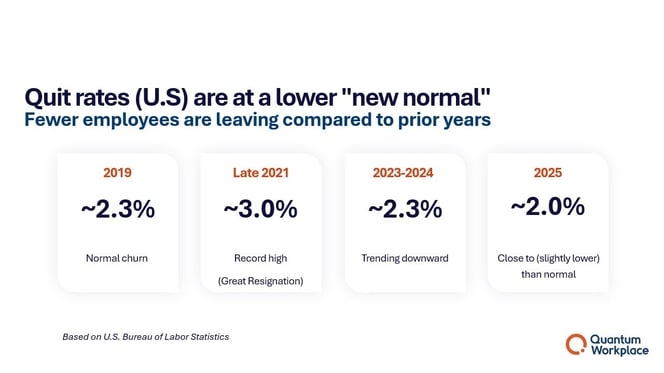
The year 2025 saw U.S. quit rates fall to approximately 2.0%, the lowest in recent memory. This significant decline, coupled with consistently stable employee engagement scores across various industries, has led many organizations to believe they are in a robust position. However, experts caution against mistaking this equilibrium for progress. Aaron Brown, Senior Manager of People Insights at Quantum Workplace, states, "Steady employee engagement may reflect resilience, not progress. Many organizations mistake stability for strength and miss opportunities to move forward."
Further analysis of employee sentiment reveals that while employees are staying, the drivers of this retention may not be rooted in genuine enthusiasm or alignment. Quantum Workplace data indicates that "intent to stay" is increasing at a faster rate than other engagement indicators. This suggests a workforce that is choosing to remain due to a perceived lack of opportune alternatives rather than a deep-seated connection to their roles and organizations. Anne Maltese, VP of People Insights, describes this phenomenon as "latent risk"—a workforce that appears engaged on the surface but may not be fully equipped or motivated for future challenges.
Consequently, relying solely on high-level engagement and turnover metrics is no longer sufficient. HR leaders must delve deeper into nuanced engagement trends to truly understand whether their teams are thriving or being subtly held back. This article explores four critical employee engagement trends in 2026 that offer a more comprehensive view of organizational health and provide actionable insights for sustained performance.
Trend 1: Managers are the First Line of Pressure
The modern managerial role has become increasingly demanding, with leaders expected to drive results, foster team development, and navigate constant organizational change, often with limited resources, clarity, or support. This multifaceted pressure cooker environment means that managers are frequently the first cohort to exhibit declining engagement, recognition, and confidence. When the expectations placed upon them outstrip their capacity or the support they receive, these issues can rapidly cascade to their direct reports, creating early warning signs of broader organizational strain.
.webp)
Data consistently shows that managers often score lower than both executives and frontline employees on key engagement, recognition, and clarity-of-expectations metrics. This disparity highlights a critical vulnerability: the manager experience is emerging as a leading indicator of overall organizational alignment. When communication and clarity break down at the managerial level, the resulting misalignment can escalate far more quickly than broad engagement or turnover figures might suggest.
The implication for 2026 is clear: the experience of managers is a crucial barometer for organizational health. Organizations must move beyond simply tracking whether managers are conducting one-on-one meetings. The focus needs to shift towards evaluating the effectiveness of these interactions in fostering clarity, ensuring alignment, and maintaining focus.
A poignant case study illustrating this challenge comes from a large enterprise that examined its leadership coaching data. They discovered a significant disparity: higher-ranking executives received more developmental feedback than managers deeper within the organizational hierarchy. This "feedback gap" was subtly hindering performance growth across the organization. The company’s solution was to "coach the coaches," empowering leaders to deliver more constructive, growth-oriented feedback. This initiative shifted the organizational focus from the frequency of one-on-one meetings to the quality and impact of those conversations, ultimately strengthening connections, improving performance, and enhancing change readiness at all levels.
Trend 2: Top Talent Signals Their Needs Amidst Stability
While overall employee engagement and retention metrics may appear stable, top-performing employees are actively communicating their experiences and outlining their needs, even if they aren’t actively seeking new roles. Their feedback, often embedded within surveys, talent reviews, and informal conversations, serves as an early indicator of potential retention risks among the organization’s most critical assets. Overlooking these signals from high performers—those vital for performance, continuity, and future leadership—can lead to significant vulnerabilities.
Data analysis reveals that while top performers often maintain strong scores in development and coaching, indicators related to advancement, fairness, and accountability consistently lag. This suggests a growing disconnect: these high-achievers may feel supported in their immediate development but are experiencing frustration due to a perceived lack of career progression, equitable treatment, or clear accountability structures. In 2026, retention risk among top talent is becoming subtler and more difficult to detect. Dissatisfaction can simmer beneath the surface, even when employees express no immediate intention to leave.
The key action insight for HR leaders is to segment engagement and feedback data by performance level or talent status. This granular approach allows for a deeper understanding of how high performers are truly experiencing their work, moving beyond the general assessment of whether they are staying. Anne Maltese, VP of People Insights, emphasizes this point: "The first thing I want to know is: how do my top performers feel? You can use surveys, one-on-ones, focus groups—it’s not necessarily more data. It’s being intentional about how you look at the data you already have."
By intentionally examining feedback from these critical employee segments, organizations can identify and address growing frustrations before they lead to attrition, ensuring the continued strength and stability of their most valuable talent pool.
Trend 3: Urgency Without Focus Hinders Productivity
In the current business landscape, many teams are working harder than ever, but the efficacy of their efforts is being hampered by unclear priorities and competing goals. This lack of clear direction means that intense effort doesn’t always translate into meaningful organizational impact. When urgency becomes a constant state without clear strategic focus, it can lead to employee fatigue, confusion, and a breakdown in collaboration. As priorities shift rapidly without adequate communication or clarity, employees can lose sight of what truly drives business results.
Data indicates that misalignment is a widespread issue, affecting even top performers. Approximately 25% of employees report not having a clear understanding of organizational priorities. Furthermore, the prevalence of written goals is significantly higher among high performers, suggesting that formalizing and communicating objectives is a critical factor in driving productivity.
The implication for 2026 is a risk of sustained effort yielding diminishing returns—more activity, but less tangible impact. To counteract this, organizations must enhance goal clarity by ensuring that priorities are clearly articulated, directly linked to overarching strategy, and consistently reinforced through regular one-on-one discussions, feedback mechanisms, and recognition programs.
Aaron Brown, Senior Manager of Insights, provides a stark example of this misalignment, particularly in the context of emerging technologies like AI: "It starts with good intentions, but that’s usually where misalignment starts to show up. The clearest example is how organizations have approached AI. It’s wonderful. It’s an amazing tool. But we’re hearing from customers and employee feedback that they’re being told, ‘Just try it out, see what you can do.’ Now add: ‘Learn a new technology.’ Combine that with ‘do more with less,’ and it shows up as good intention but no clear, defined goal—what are we trying to accomplish, and how are we going to support people to accomplish it? If we can solve that, people will feel more excited to try new ventures.” This highlights that productivity challenges are rarely about a lack of effort but rather stem from misalignment, unclear objectives, and a deficit in focused direction.
Trend 4: Future-Ready in Intent, Uneven in Execution
Many organizations have made strides in identifying potential successors and critical roles within their structures. However, the actual preparation, readiness, and retention of these individuals are not consistently keeping pace, creating a gap between who is designated and who is truly prepared to step forward. This is particularly concerning when future leaders and long-tenured employees begin to experience burnout, feel stalled in their development, or perceive themselves as undervalued. In such scenarios, organizations can become surprisingly fragile, even if headline engagement and retention metrics appear robust.

Data suggests that succession candidates, senior leaders, and long-tenured employees are often the first to exhibit early risk signals. These can include burnout, uneven development trajectories, and readiness gaps that remain hidden from broader engagement metrics. The implication for 2026 is that future organizational readiness depends not only on identifying potential leaders but also on intentionally developing them, supporting their well-being, and mitigating over-reliance on a small group of individuals.
The actionable insight here is to integrate data from succession planning, employee development, engagement surveys, and tenure records. This holistic approach allows organizations to proactively identify readiness gaps, address burnout risks, and ensure that future leaders are not only prepared but also willing to assume greater responsibilities. A compelling case study from a Quantum Workplace client illustrated this point: despite high overall engagement scores, the executive team was experiencing significant burnout. While surveys suggested a connected and motivated workforce, a deeper analysis revealed leaders were stretched thin, morale was declining, and innovation had stagnated. As Aaron Brown noted, "High engagement at the surface can mask burnout underneath." This underscores the critical need for HR and leadership teams to look beyond top-line engagement scores and uncover the early signals of fatigue, turnover risk, and untapped potential.
Turning Employee Engagement Data into Informed Decisions
The four trends highlighted above converge on a critical realization: employee engagement data only generates true value when it translates into clearer decisions and earlier, more decisive action. In 2026, the objective is not merely to maintain stable metrics but to achieve informed insight that drives meaningful change. To transition from a state of stability to one of sustained thriving, HR leaders must connect engagement data with performance, development, growth, recognition, and retention signals. These connections then become the foundation for guiding strategic actions at every level of the organization.
Practical steps to leverage these insights include:
- Segmenting Data: Analyze engagement metrics by role, tenure, performance level, and department to uncover specific pain points and opportunities.
- Linking Engagement to Outcomes: Correlate engagement data with key business metrics such as productivity, customer satisfaction, and innovation to demonstrate ROI and inform strategic priorities.
- Empowering Managers: Equip managers with the insights and tools necessary to have effective development conversations, provide targeted feedback, and foster alignment within their teams.
- Prioritizing Feedback Loops: Establish continuous feedback mechanisms that go beyond annual surveys, enabling real-time adjustments and fostering a culture of open communication.
Organizations that adopt this integrated approach are already demonstrating tangible improvements. Quantum Workplace customers who effectively connect engagement insights with performance and talent data are better positioned to retain top talent, enhance manager effectiveness, and maintain momentum through periods of change.
The Step from Steady Engagement to Thriving Teams
Building truly thriving teams requires a vision that extends beyond mere engagement scores. Thriving is not an accidental outcome; it is cultivated when connection and performance are recognized as inextricably linked. Leaders need the foresight to act proactively, driven by robust data and confident in their decisions.

When connection exists without performance, teams can drift, lacking direction and impact. Conversely, when performance exists without genuine connection, teams often strain and experience burnout. When both elements are weak, teams inevitably struggle. However, when both connection and performance are strong, organizations enter a powerful virtuous cycle: improved results enhance retention, greater retention strengthens organizational capability, and this enhanced capability fuels even better performance.
To foster this dynamic cycle, organizations must cultivate four key conditions: alignment, empowerment, growth, and feeling valued. HR plays a pivotal role in interpreting the signals across these areas and empowering managers to translate these insights into concrete actions that drive organizational success.
Final Thoughts: Employee Engagement Trends as the Starting Line
Achieving healthy employee engagement metrics should not be viewed as the ultimate destination but rather as the crucial starting line for strategic growth and organizational development. The objective in this era is not to undertake a wholesale overhaul of talent strategies overnight. Instead, it is about acting on the opportunities that are often present but overlooked. Organizations must prioritize:
- Proactive Identification: Continuously identifying potential leaders and critical talent pools.
- Intentional Development: Creating structured development pathways that prepare individuals for future roles and responsibilities.
- Well-being Support: Actively addressing burnout and ensuring the sustainable well-being of all employees, especially those in leadership positions.
- Data-Driven Action: Moving beyond theoretical understanding to implement concrete, data-informed interventions.
As Anne Maltese aptly puts it, "Focus on your knowns. You can’t control everything, but you can develop your top performers, nurture your successors, and prepare people now for what’s next.” By embracing these nuanced engagement trends and acting on the insights they reveal, organizations can move beyond a superficial sense of stability to cultivate truly thriving, future-ready workforces.