
Artificial intelligence is currently reshaping the landscape of global industry at a velocity that exceeds the internal processing capacity of many organizations. As Chief Learning Officers (CLOs), human resources partners, and corporate leaders face mounting pressure to deploy generative AI tools and demonstrate immediate returns on investment, a counter-current of "AI fatigue" has emerged among the workforce. While the promise of AI centers on unprecedented productivity gains, the reality for many employees is a landscape of unclear expectations, constant tool churn, and a sense of psychological exhaustion. This tension suggests that the primary barrier to AI integration is no longer the technology itself, but rather the design of the human systems intended to support it.
The Anatomy of the AI Fatigue Crisis
The current state of AI adoption is characterized by a significant disconnect between executive ambition and employee experience. According to research from The Upwork Research Institute, which surveyed 2,500 global workers including C-suite executives, 96 percent of senior leaders expect AI to significantly boost worker productivity. However, the data reveals a starkly different reality for those on the front lines: 77 percent of employees report that AI tools have actually increased their workload.
This discrepancy has led to a burnout crisis, with 71 percent of full-time employees reporting symptoms of exhaustion related to digital transformation. Furthermore, nearly half of the global workforce—approximately 47 percent—admits to having no clear understanding of how to achieve the productivity gains their employers expect. This phenomenon is rooted in what researchers call "technostress," a psychological strain caused by the demands of using information systems when job demands rise faster than an individual’s autonomy, clarity, and skill development.
The "confidence gap" further exacerbates this issue. Executives, who often have more autonomy and resources to experiment with new technologies, adopt AI tools at significantly higher rates than frontline staff. When leadership mandates "experimentation" without providing a structured framework or dedicated time, it often results in cognitive overload rather than innovation.
A Chronology of the AI Transition: From Hype to Fatigue
To understand the current state of AI fatigue, it is necessary to examine the rapid timeline of generative AI’s entry into the corporate sphere:
- Late 2022 – Early 2023: The Awareness Phase. The public release of advanced large language models (LLMs) triggered a global "AI arms race." Organizations rushed to procure licenses for various tools, fearing obsolescence.
- Mid-2023: The Implementation Phase. Companies began rolling out "pilot programs." Training during this period focused heavily on "tool mastery"—teaching employees which buttons to click and how to write basic prompts.
- Late 2023 – Early 2024: The Productivity Paradox. As tools became ubiquitous, the expected "productivity miracle" failed to materialize for many. Instead, employees found themselves managing more data, more communications, and more complex workflows without a reduction in their traditional responsibilities.
- Present Day: The Fatigue Phase. Organizations are now seeing the fallout of rapid adoption: high burnout rates, "pilot purgatory" where projects fail to scale, and a workforce that is increasingly skeptical of new technological mandates.
Defining AI Fusion Skills: The New Paradigm
The solution to this fatigue lies in a shift from "tool fluency" to what experts Paul R. Daugherty and H. James Wilson of Accenture term "fusion skills." In their research, fusion skills are defined as the specific human capabilities required to collaborate effectively with generative AI, prioritizing judgment and problem-framing over technical proficiency.
There are three core fusion skills that serve as the foundation for this new way of working:
- Intelligent Interrogation: This involves the ability to probe AI models with sophisticated, iterative questioning. It moves beyond "prompt engineering" to a deeper understanding of how to frame complex problems so that an AI can provide meaningful assistance.
- Judgment Integration: This is the critical human capacity to evaluate, vet, and refine AI-generated outputs. It requires a high degree of domain expertise to identify hallucinations, biases, or logical inconsistencies that an AI might produce.
- Reciprocal Apprenticing: This describes a two-way learning relationship where humans learn to augment their capabilities through AI, while simultaneously "teaching" the AI systems through feedback loops and specialized data, effectively acting as a mentor to the machine.
By focusing on these skills, organizations reframe AI as a "thinking partner" rather than a replacement for human effort. This shift is essential for restoring employee agency and reducing the anxiety associated with automation.
Supporting Data and Industry Analysis
The necessity of fusion skills is backed by research from Harvard Business Publishing Corporate Learning and Degreed. Their global survey of 2,739 employees found that "AI-fluent" individuals—those who report the lowest levels of fatigue and highest levels of productivity—differentiate themselves through hands-on experimentation embedded in their daily workflow. These high-performing individuals are twice as likely to learn through practical application compared to their peers who rely on passive training videos or manuals.
Furthermore, economic analysis suggests that the "productivity gap" is often a result of organizational lag. While an AI tool can perform a task in seconds, the human process of reviewing, integrating, and approving that task often remains tied to legacy workflows. Without fusion skills, the human becomes the bottleneck, leading to the increased workload reported in the Upwork study.

Strategic Priorities for Learning and Development Leaders
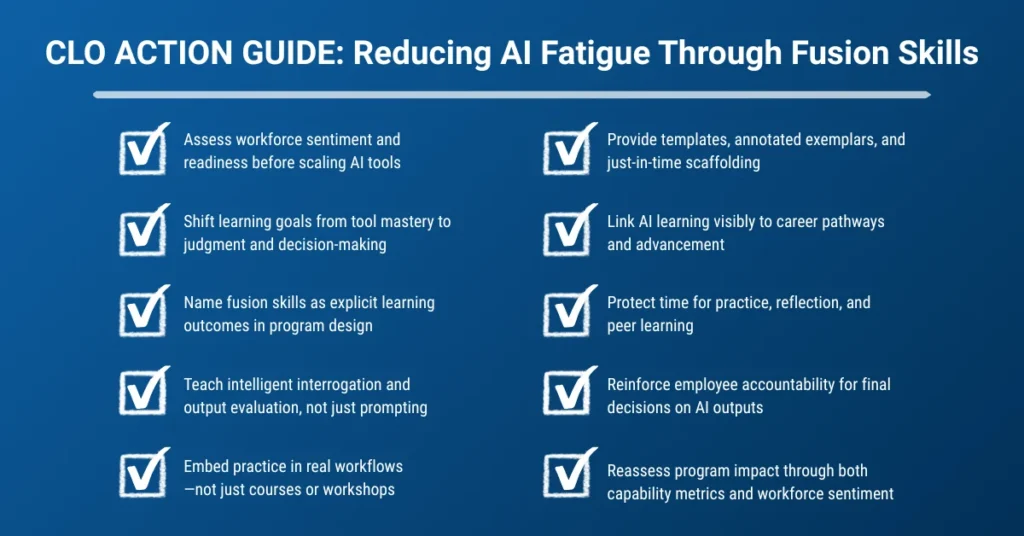
To combat AI fatigue and foster a culture of durable capability, Chief Learning Officers and HR leaders must move beyond traditional training models. The following strategic priorities are essential for a sustainable AI transition:
1. Assessing Workforce Sentiment and Readiness
Before deploying new tools, organizations must conduct deep-dive assessments of employee confidence and concerns. SHRM’s analysis indicates that tailoring adoption strategies to specific departmental needs—rather than a "one size fits all" corporate mandate—significantly reduces resistance. Pulse surveys and focus groups can identify where the "adoption liabilities" exist before they turn into burnout.
2. Making Fusion Skills Explicit Outcomes
L&D programs should be redesigned to offer assessable outcomes in intelligent interrogation and judgment integration. When employees see that they are building transferable skills that will remain valuable even if a specific software becomes obsolete, their engagement increases. This transforms the perception of AI training from a "compliance chore" to a "career investment."
3. Embedding Learning in the Workflow
The primary barrier to AI fluency is not a lack of motivation, but a lack of time. Organizations must create "learning labs" or AI-assisted project sprints where experimentation is part of the billable hour. Providing "protected time" for reflection and peer critique of AI outputs allows employees to develop the necessary judgment without the pressure of immediate production deadlines.
4. Supporting Capacity, Not Just Capability
AI fatigue is often a matter of "cognitive load." L&D leaders should provide practical scaffolding, such as prompt templates, annotated exemplars, and decision frameworks. By reducing the mental effort required to start using a tool, organizations can help employees move past the "frustration phase" of the learning curve more quickly.
Official Responses and Organizational Shifts
While many companies are still struggling, early adopters in the professional services and technology sectors are already shifting their narratives. Statements from leading HR consultancy firms suggest a move toward "Human-Centric AI." The consensus among industry thought leaders is that the next phase of the digital revolution will be won not by the companies with the best algorithms, but by those with the most adaptable workforces.
"We are moving from a period of ‘technological awe’ to a period of ‘operational reality,’" says one industry analyst. "The organizations that succeed will be those that treat AI as a social system as much as a technical one."
Broader Impact and Long-Term Implications
The transition to an AI-augmented economy carries significant implications for the future of work. If organizations fail to address AI fatigue, they risk creating a "two-tier" workforce: a small group of highly fluent experts and a larger group of overwhelmed, disengaged employees. This divide could lead to increased turnover, decreased morale, and a failure to realize the economic benefits of AI investments.
Conversely, by investing in fusion skills, organizations can build "career resilience." These skills—judgment, interrogation, and apprenticing—are inherently human and highly transferable. They represent the "durable skills" of the 21st century.
In the final analysis, AI fatigue is not a failure of the workforce; it is a signal that the current methods of corporate learning are insufficient for the pace of modern change. The most resilient organizations of the future will not be those that deploy AI the fastest, but those that invest most deeply in the human capacity to think, judge, and decide alongside it. For the Chief Learning Officer, the mandate is clear: the goal of AI integration is not to make the machine smarter, but to empower the human to be more effective.






