The rapid integration of generative artificial intelligence into the modern workplace has triggered a profound shift in organizational dynamics, outpacing the ability of many institutions to adapt their human systems. While the promise of AI centers on unprecedented productivity gains and the automation of mundane tasks, a growing disconnect has emerged between executive expectations and the lived experience of the workforce. Chief Learning Officers (CLOs), human resources partners, and organizational development leaders now find themselves at a critical juncture, facing intense pressure to deploy AI-enabled tools while simultaneously addressing a rising tide of employee burnout, uncertainty, and what experts are now terming "AI fatigue."
This phenomenon is not characterized by a fundamental resistance to technology itself, but rather by the friction created by unclear expectations, constant tool churn, and learning strategies that prioritize the speed of adoption over human readiness. As organizations move deeper into the age of generative AI, the focus is shifting from simple tool proficiency toward the cultivation of "fusion skills"—the unique capabilities required for effective human-machine collaboration.
The Anatomy of the AI Fatigue Crisis
The current state of AI adoption is defined by a significant "productivity paradox." According to research conducted by The Upwork Research Institute, which surveyed 2,500 global workers including C-suite executives and full-time staff, 96 percent of senior leaders expect AI to significantly boost worker productivity. However, the reality for employees is starkly different: 77 percent of workers report that AI tools have actually increased their workload. This disconnect has led to 71 percent of full-time employees experiencing symptoms of burnout, with nearly half (47 percent) stating they have no clear understanding of how to achieve the productivity gains demanded by their employers.
This crisis is rooted in "technostress," a psychological strain resulting from the demands of using information systems that exceed an individual’s coping mechanisms. Decades of research by scholars such as Tarafdar, Cooper, and Stich indicate that technological change drives burnout when job demands rise faster than an employee’s sense of autonomy, clarity, and skill development. When organizations urge employees to "experiment" with AI without providing a structured framework or dedicated time, they often inadvertently accelerate fatigue rather than innovation.
Furthermore, a widening "confidence gap" has emerged. Executives, who often have more control over their schedules and greater access to high-level strategic contexts, are adopting AI tools at significantly higher rates than frontline staff. This creates a top-down pressure that overlooks the logistical and cognitive hurdles faced by employees who must integrate these tools into rigid, high-volume daily workflows.
A Chronology of the Generative AI Integration Wave
To understand the current state of fatigue, it is essential to trace the timeline of how generative AI entered the corporate sphere:
- The Catalyst Phase (Late 2022 – Early 2023): The public release of ChatGPT and subsequent Large Language Models (LLMs) sparked a global frenzy. Organizations felt an immediate "fear of missing out" (FOMO), leading to rapid, often uncoordinated pilot programs.
- The Proliferation Phase (Mid 2023 – Early 2024): Enterprise-grade tools, such as Microsoft 365 Copilot and Google Workspace AI, were integrated into standard software suites. Companies began mandating AI usage across departments, often before establishing clear governance or training protocols.
- The Friction Phase (Mid 2024 – Present): The initial novelty has worn off, replaced by the realization that AI outputs require significant human oversight (the "human-in-the-loop" necessity). This period is marked by the realization that AI is not a "set-it-and-forget-it" solution, leading to the current state of fatigue and the search for more sustainable integration models.
The Framework of AI Fusion Skills
In response to this exhaustion, organizational theorists are advocating for a shift toward "fusion skills." The concept, popularized by Paul R. Daugherty and H. James Wilson of Accenture in their 2024 research for the Harvard Business Review, suggests that the value of AI lies not in the machine alone, but in the interface between human judgment and machine processing.
Fusion skills are defined by three core pillars that move beyond technical "prompt engineering":
1. Intelligent Interrogation
This skill involves the ability to frame problems in a way that AI can effectively process. It requires a deep understanding of the underlying subject matter to ask the right questions and, more importantly, to recognize when the AI is providing a superficial or "hallucinated" answer. It is the transition from being a passive user to an active, critical director of the technology.
2. Judgment Integration
While AI can synthesize vast amounts of data, it lacks the contextual, ethical, and organizational nuance that humans possess. Judgment integration is the capability to evaluate AI-generated outputs against real-world constraints, ethical standards, and long-term strategic goals. It ensures that the final output is not just "technically correct" but "organizationally sound."
3. Reciprocal Apprenticing
This represents a bidirectional learning process. Humans must learn how the AI functions to improve its performance, while simultaneously "learning from the machine" by observing the patterns and connections the AI identifies. This creates a feedback loop where both the human’s expertise and the machine’s utility grow in tandem.
Data-Driven Insights into AI Fluency
Research from Harvard Business Publishing Corporate Learning and Degreed, based on a survey of over 2,700 employees globally, highlights the importance of how these skills are acquired. The study found that "AI-fluent" individuals—those who report high levels of comfort and productivity with the technology—are twice as likely to have learned through hands-on experimentation embedded in their daily workflow compared to their peers.

Crucially, the study noted that the primary barrier to scaling AI fluency is not a lack of employee motivation, but a lack of organizational support. When employees are expected to learn these complex skills "on the side" while maintaining their usual output, the result is inevitably burnout.
Strategic Imperatives for Learning Leaders
To combat AI fatigue and foster the development of fusion skills, Chief Learning Officers and HR leaders are being urged to adopt a more intentional, human-centric design for their learning programs.
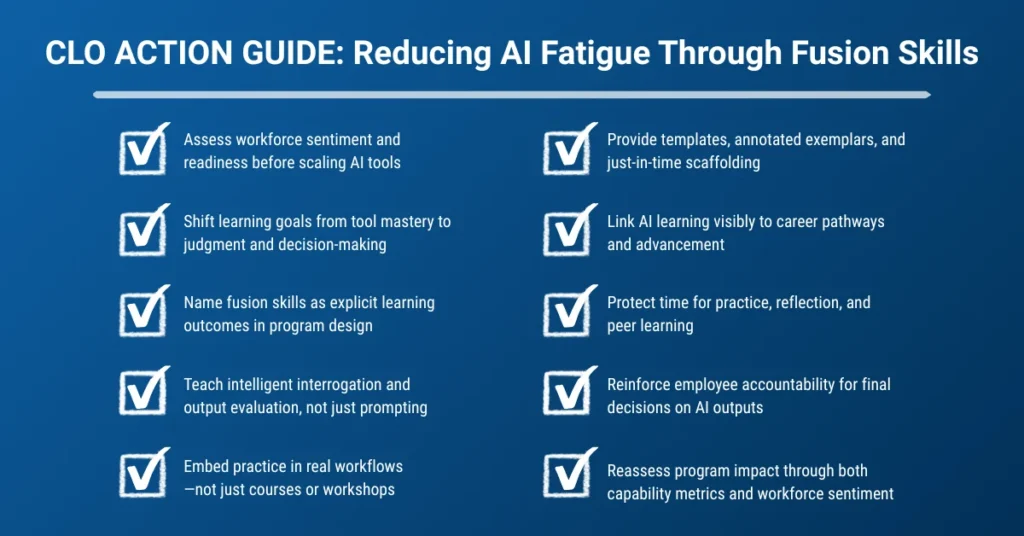
Assessing Sentiment and Readiness
Before deploying new tools, organizations must conduct pulse surveys and focus groups to gauge workforce sentiment. Tailoring adoption strategies to specific departmental needs—rather than applying a one-size-fits-all mandate—has been shown by organizations like SHRM to significantly reduce resistance.
Redefining Learning Outcomes
Training must move beyond the "how-to" of software interfaces. Learning outcomes should be framed around durable, transferable skills like "critical evaluation of automated outputs" or "algorithmic bias detection." By focusing on judgment rather than specific tool mastery, organizations build a workforce that remains capable even as the specific AI platforms evolve.
Embedding Learning in the Workflow
The most effective AI training occurs during the performance of actual tasks. Learning leaders are increasingly implementing "AI-assisted project sprints" and "learning labs" where employees are given protected time to experiment with AI on real-world problems. This reduces the cognitive load of having to learn a new system in a vacuum.
Connecting Skills to Career Pathways
AI fatigue is often exacerbated by the fear of obsolescence. To counter this, L&D leaders must clearly demonstrate how fusion skills enhance an individual’s career resilience. Framing AI as a collaborator that amplifies human creativity and decision-making—rather than a replacement for it—is essential for maintaining long-term engagement.
Official Responses and Industry Perspectives
Industry leaders are beginning to acknowledge that the "productivity at all costs" mentality is unsustainable. Statements from HR tech summits and leadership forums indicate a growing consensus that "human-centric AI" is the only path forward.
"We are seeing a shift in the conversation," notes one industry analyst. "In 2023, the question was ‘How fast can we implement AI?’ In 2025, the question is ‘How can we implement AI without breaking our people?’"
Many organizations are now appointing "AI Ethics Officers" and "Human-AI Integration Leads" to bridge the gap between IT and HR. These roles are tasked with ensuring that the deployment of AI aligns with the psychological well-being of the workforce and the long-term health of the organizational culture.
Broader Impact and Implications for the Future of Work
The long-term implications of AI fatigue extend beyond individual burnout. If left unaddressed, it can lead to increased turnover of high-value talent, a decline in the quality of work due to over-reliance on unvetted AI outputs, and a total breakdown of trust between leadership and staff.
Conversely, organizations that successfully pivot to a fusion-skills model stand to gain a significant competitive advantage. These organizations will not only see the productivity gains they desire but will also foster a culture of continuous, sustainable innovation.
The move toward fusion skills signals a broader evolution in the definition of professional expertise. In the pre-AI era, expertise was often defined by the accumulation of knowledge. In the AI era, expertise is increasingly defined by the ability to direct, judge, and refine the outputs of intelligent systems.
At its core, the challenge of AI fatigue is a design problem. It is a signal that the traditional methods of corporate training and technological deployment are no longer sufficient for the pace of modern disruption. By placing human judgment and agency at the center of the AI strategy, organizations can move from a state of exhaustion to one of empowered fluency. The most resilient organizations will be those that recognize that their greatest asset is not the AI they deploy, but the people who have the skills to master it.