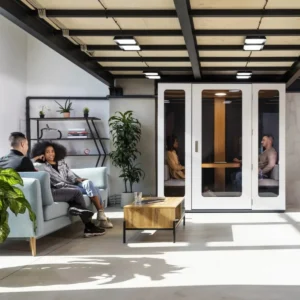
Coworking operators may already have another revenue stream sitting inside their existing spaces: meeting rooms. Data from Cobot, a coworking management software platform, reveals that meeting rooms across German coworking spaces within its dataset are utilized for approximately 12% of their available capacity, calculated on an eight-hour workday and a five-day week. Crucially, external bookings made through Cobot’s booking tools account for a mere 0.6% of this overall utilization, highlighting a significant underperformance in capturing external demand.
This analysis, which encompasses coworking spaces in both major German cities with over 100,000 residents and smaller urban areas, indicates a consistent pattern across diverse geographical locations. Cobot has further indicated that similar trends are observable in other European markets, suggesting this is not an isolated issue but a widespread opportunity for the coworking sector.
The Visibility Gap: External Customers Remain Largely Unaware
A primary factor contributing to this underutilization of meeting room resources by external clients is a fundamental visibility problem. Existing members of a coworking space are inherently aware of the amenities and services offered, including meeting room availability and booking procedures. In contrast, potential external customers actively searching for meeting room rentals in a specific locale may never encounter a coworking space’s offerings online or through local business directories. This lack of discoverability means that valuable inventory remains unseen by a significant segment of the market.

To address this, Cobot suggests that coworking operators can enhance the discoverability of their meeting rooms through several strategic improvements. This includes the development of more detailed and compelling online listings that go beyond basic room dimensions. Such listings should prominently feature high-quality photography showcasing the meeting spaces, along with practical, actionable information about the equipment available (e.g., projectors, whiteboards, video conferencing systems), catering options, and any additional services that can enhance a client’s meeting experience. Furthermore, actively listing meeting rooms on external booking platforms and online directories can significantly expand their reach, placing them directly in front of potential customers who are not already familiar with the specific coworking brand or location. This proactive approach to marketing can transform underutilized assets into a substantial revenue driver.
Friction in the Booking Process Hinders External Sales
Beyond visibility, the booking process itself presents another significant barrier to securing external clients. In many coworking spaces, individuals or businesses seeking to book a meeting room for a single event or on an ad-hoc basis are still required to engage directly with the coworking staff. This often involves contacting the team, articulating specific needs, and then waiting for staff members to check availability, confirm details, and manually process the reservation. This multi-step, often time-consuming, process can be a deterrent for external customers who are accustomed to more streamlined, self-service booking experiences.
The inefficiency of a manual booking system can directly translate into lost revenue. Cobot advocates for a more transactional approach, enabling prospective clients to view real-time pricing and availability, understand precisely what is included in the rental fee, and complete their booking directly online. While additional arrangements, such as catering or specific AV equipment needs, can be handled subsequently by the coworking team, the initial reservation should be as frictionless as possible. This modern approach aligns with customer expectations in the digital age and significantly reduces the likelihood of a potential booking being abandoned due to procedural hurdles.
Pricing Strategies: Balancing Member Value with External Profitability
Pricing strategies also play a critical role in the profitability of external meeting room bookings. The data from Cobot’s German market analysis reveals a noteworthy trend: the median price for external meeting room rentals in cities was approximately 1.5 times the rate charged to coworking members. Even more striking is that the top 10% of coworking spaces with the highest external pricing charged more than double the member rate.
While this data does not establish a direct causal link between higher prices and increased demand, it strongly suggests that popular and well-equipped meeting rooms can indeed command a premium in the market. Spaces that offer superior amenities, prime locations, or a more refined ambiance may find that external customers are willing to pay a higher price for these benefits. This presents an opportunity for operators to strategically differentiate their meeting room offerings and implement tiered pricing structures that reflect the value and demand for different types of spaces. The key lies in finding a balance that is attractive to external clients while maximizing revenue potential, ensuring that internal member needs are also met without compromise.
The Untapped Potential: Expanding External Bookings
A common concern among coworking operators is that opening up meeting room access to external clients might inadvertently reduce availability for their existing members. However, the current utilization data, showing an average of only 12% capacity usage, suggests that there is substantial room for growth before this becomes a significant issue. In fact, the data indicates that coworking spaces with meeting rooms that are already popular among their members tend to attract a higher volume of external bookings as well. This suggests a positive correlation: a well-regarded and frequently used meeting room facility within a coworking space can serve as a strong draw for outside customers.
For coworking operators looking to diversify and enhance their revenue streams, the opportunity may lie not in developing entirely new product lines, but rather in optimizing the sales and marketing of their existing meeting room capacity. By implementing more effective visibility strategies and streamlining the booking process, operators can tap into a much larger pool of potential customers. This involves a strategic shift from viewing meeting rooms primarily as an amenity for members to recognizing them as a valuable, monetizable asset with significant revenue-generating potential.
Strategic Implications and Future Outlook
The findings from Cobot’s analysis offer a clear roadmap for coworking businesses seeking to bolster their financial performance. The underutilization of meeting rooms by external clients is not a reflection of a lack of demand, but rather a consequence of operational and marketing inefficiencies. By addressing these shortcomings, coworking spaces can unlock a significant and relatively untapped revenue stream.

Key takeaways for operators include:
- Enhanced Online Presence: Investing in professional photography, detailed descriptions, and transparent pricing for meeting rooms is crucial. Listing on multiple online platforms, including those specifically for venue hire, can dramatically increase discoverability.
- Streamlined Booking Systems: Implementing an online, self-service booking system that mirrors the ease of use found on popular e-commerce or travel sites is essential for capturing external demand. This should include instant confirmation and secure payment processing.
- Strategic Pricing: Analyzing market rates and member usage to establish competitive yet profitable pricing for external bookings. Tiered pricing based on room size, amenities, and duration can cater to a wider range of client needs and budgets.
- Leveraging Member Popularity: Recognizing that well-loved member spaces can be marketed effectively to external clients. Testimonials and case studies from satisfied external users can further build trust and attract new business.
- Operational Efficiency: Ensuring that staff are trained to handle any ancillary services or inquiries efficiently once a booking is confirmed, providing a seamless experience from initial contact to post-event follow-up.
The coworking industry has experienced significant growth and evolution, particularly in the post-pandemic era, with a greater emphasis on flexible work solutions. While many operators have focused on membership models and community building, the potential of ancillary services like meeting room rentals to external clients presents a compelling avenue for increased profitability and market penetration. By strategically optimizing their meeting room offerings, coworking spaces can transform these underutilized assets into a robust source of additional revenue, solidifying their position as comprehensive hubs for flexible work and business needs. This strategic imperative not only enhances financial performance but also broadens the appeal and utility of coworking spaces within the wider business ecosystem.