The U.S. Equal Employment Opportunity Commission (EEOC) concluded its 2025 fiscal year on September 30, marking a period of profound institutional transformation and a historic decline in litigation volume. According to data analyzed by legal experts, the Commission filed a total of 93 merit lawsuits throughout the year, the lowest number recorded in a decade and one of the lowest totals in the agency’s 60-year history. This decline reflects a dramatic shift in enforcement strategy and administrative stability following the transition between the Biden and Trump administrations. While the early months of the fiscal year suggested a continuation of the aggressive enforcement seen in 2023, the subsequent dismissal of key leadership and a pivot in ideological priorities led to a significant deceleration of court-bound activity.
For employers and legal practitioners, the FY 2025 data reveals an agency in a state of flux. Despite the drop in overall filings, the EEOC has not retreated entirely; rather, it has reallocated its remaining resources toward specific categories of discrimination, including religious freedom and pregnancy-related protections, while backing away from LGBTQ+ advocacy and broad systemic litigation. The year was defined by a "roller-coaster" effect for field staff and corporate defendants alike, as the agency navigated budget constraints, leadership vacancies, and a controversial restructuring of its governing board.
A Chronology of Transition and Institutional Turbulence
The 2025 fiscal year began under the momentum of the Biden administration’s labor-centric agenda. In the first quarter of the fiscal year (October through December 2024), the EEOC maintained a relatively steady pace, filing 24 lawsuits. This early activity was largely driven by a Democratic majority of Commissioners and a General Counsel, Karla Gilbride, who had prioritized aggressive litigation against systemic workplace inequities.
However, the landscape shifted abruptly following the presidential inauguration in January 2025. President Donald Trump moved quickly to reshape the Commission’s leadership, an effort that included several unprecedented administrative actions. In late January, the President elevated Andrea Lucas to the position of Acting Chair. Simultaneously, he terminated General Counsel Karla Gilbride, a move that echoed President Biden’s earlier termination of a Trump-appointed General Counsel but signaled a total reversal of the agency’s litigation philosophy.
The most significant disruption occurred when President Trump fired Commissioners Charlotte Burrows and Jocelyn Samuels. Because EEOC Commissioners are typically appointed to fixed terms to ensure the agency’s independence, the firing of Burrows and Samuels—both of whom had years remaining on their terms—was viewed by many legal scholars as an unprecedented test of executive power over independent federal agencies. These dismissals left the Commission without a quorum, as only Acting Chair Lucas and Commissioner Kalpana Kotagal remained. The loss of a quorum has had lasting impacts on the agency’s ability to authorize high-stakes litigation, contributing heavily to the year-end totals.
Analyzing the Data: Monthly Trends and Regional Disparities
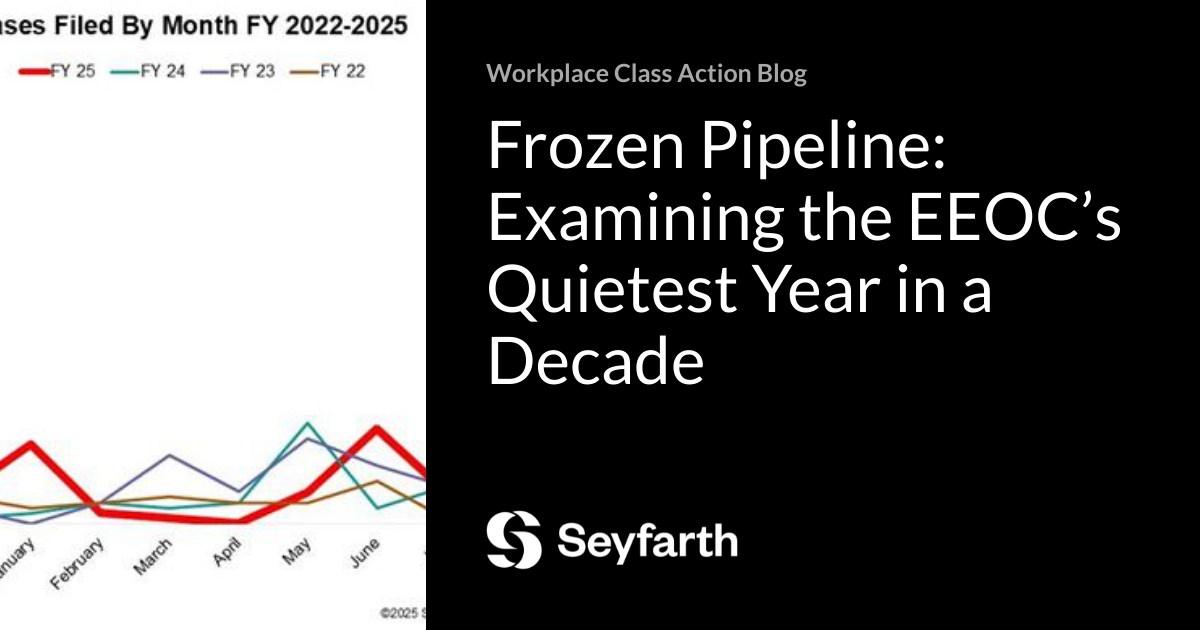
The timing of EEOC filings in FY 2025 provides a window into the agency’s internal pressures. January 2025 saw a spike of 15 lawsuits, a figure that analysts suggest was a "last-minute" effort by outgoing enforcement personnel to move cases into the court system before the change in administration. Following this surge, activity slowed as the new leadership took hold.
A second, unexpected spike occurred in June 2025, with 18 filings—a five-year high for that specific month. However, the traditional "September Surge," in which the EEOC typically files a massive volume of cases to meet end-of-year quotas, was notably muted. In September 2025, the Commission filed only 35 lawsuits. To put this in perspective, the EEOC filed 71 lawsuits in September 2023 and 56 in September 2024. The 2025 figure represents a nearly 50% decrease from the peak activity seen just two years prior.

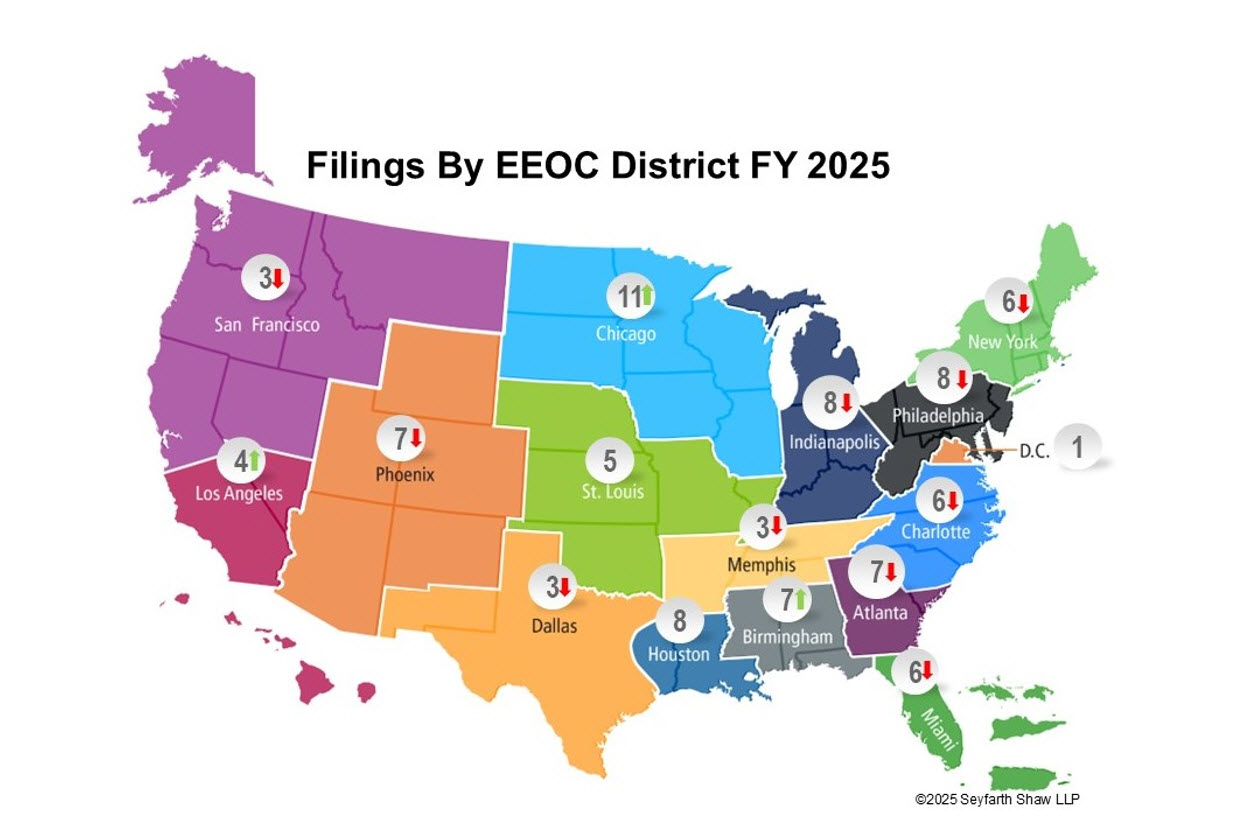
Geographically, the activity was concentrated in a few key District Offices. The Chicago District Office led the nation with 11 merit filings, reclaiming its status as one of the most litigious branches of the agency. Other active regions included Philadelphia, Indianapolis, and Houston, each recording eight filings. Notably absent from the top tier were the West Coast offices. Districts in Los Angeles, San Francisco, and New York—which were historically the most active during the Obama administration—filed only four, three, and six lawsuits, respectively. This geographic retreat suggests that the current administration is focusing its limited resources on the industrial Midwest and the South, rather than the more traditionally progressive coastal corridors.
Shift in Statutory Priorities: The Rise of Religious and Pregnancy Claims
While the volume of cases decreased, the type of cases filed in FY 2025 highlights a clear shift in the EEOC’s strategic focus. Under Acting Chair Andrea Lucas, the agency has pivoted toward a "back to basics" approach that emphasizes certain protected classes while de-emphasizing others.
The Americans with Disabilities Act (ADA)
The ADA remained the single most cited statute in EEOC litigation, accounting for 34 of the 93 filings. This indicates that disability discrimination remains a non-partisan priority for the agency. However, the focus within ADA litigation has evolved. The EEOC increasingly targeted cases involving "invisible" disabilities, such as mental health conditions (PTSD, anxiety, depression) and sensory impairments (vision and hearing). These cases often center on an employer’s alleged failure to provide reasonable accommodations or the use of discriminatory screening tools during the hiring process.
Pregnancy and the PWFA
The EEOC filed 10 lawsuits under the Pregnancy Discrimination Act and the newly enacted Pregnant Workers Fairness Act (PWFA). When combined with other sex-based discrimination claims, this category accounted for 37 cases. Acting Chair Lucas has been a vocal proponent of enforcing protections for pregnant workers, framing it as a fundamental component of protecting women in the workplace. This area of enforcement has remained robust despite the overall downturn in litigation.

Religious Freedom
One of the most striking developments of FY 2025 was the surge in religious discrimination lawsuits. The Commission filed 11 such cases, a significant increase from previous years. This trend is a direct response to a massive backlog of religious discrimination charges—which saw a 600% increase during the COVID-19 pandemic due to vaccine mandate disputes. In August 2025, the EEOC issued a public statement reaffirming its commitment to protecting religious liberty, with Acting Chair Lucas stating that workers should not have to choose between "their paycheck and their faith."
Race and National Origin
Conversely, litigation involving race and national origin discrimination plummeted to a decade-long low, with only three filings in FY 2025. Interestingly, two of these three cases involved theories of "reverse discrimination" or "anti-American bias." For example, in EEOC v. Seward and Son Planting Co., the Commission alleged that an employer gave preference to non-American workers over Black American citizens. This aligns with the administration’s broader "America First" policy framework.
The Retreat from LGBTQ+ Advocacy
Perhaps the most stark ideological shift in FY 2025 was the EEOC’s withdrawal from litigation involving gender identity and sexual orientation. Early in the fiscal year, during the Biden administration’s final months, the EEOC had filed two high-profile lawsuits concerning transgender workers. However, following a January 2025 Executive Order aimed at "restoring biological truth" in federal policy, the EEOC moved to dismiss its own actions in these cases.
Acting Chair Lucas issued a formal statement declaring that "biological sex is real" and that the agency would no longer view the use of biological pronouns as a form of workplace harassment. While private plaintiffs intervened to continue these lawsuits, the EEOC’s official withdrawal marks the end of a multi-year period where the Commission was a primary engine for expanding LGBTQ+ protections under Title VII.
The Quorum Crisis and Its Legal Implications
The lack of a quorum at the Commission level has created a significant legal bottleneck. Under EEOC regulations, the General Counsel has delegated authority to file "routine" lawsuits. However, this authority does not extend to "systemic" cases—those involving large-scale patterns of discrimination, major expenditures of agency resources, or novel legal theories that could create new judicial precedents.
Because the Commission lacked a quorum for much of 2025, it was legally barred from authorizing the type of massive, multi-state class actions that characterized the agency during the Biden and Obama years. This "quorum crisis" essentially forced the EEOC to limit itself to smaller, individual-plaintiff cases. Legal experts suggest that if the EEOC attempts to pursue larger cases without a quorum, those cases could be vulnerable to procedural challenges in federal court, as defendants may argue the agency exceeded its delegated authority.
Implications for the Business Community
The findings from FY 2025 suggest a complicated landscape for employers. While the threat of a "headline-grabbing" systemic lawsuit from the EEOC has diminished in the short term, the risk of litigation remains high in specific sectors.
- Healthcare and Regional Focus: Employers in the healthcare industry and those operating in the Midwest (Chicago/Indianapolis) remain high-priority targets for the EEOC.
- The Private Bar Shadow: Historically, the private plaintiff’s bar follows the EEOC’s lead. Even if the EEOC files fewer cases, the "roadmap" provided by their investigations often leads to private class actions.
- Accommodation Compliance: With the ADA and PWFA remaining top priorities, employers must ensure their "interactive process" for accommodations is well-documented and consistently applied.
- Religious Expression: The rise in religious discrimination filings suggests that employers should revisit their policies regarding religious expression and exemptions, particularly as the legal threshold for "undue hardship" continues to be scrutinized by the courts.
In summary, FY 2025 was a year of retrenchment and redirection for the EEOC. By reaching a 10-year low in litigation activity, the Commission has signaled a departure from the aggressive, broad-scale enforcement of the previous era. However, the pivot toward religious liberty, pregnancy protections, and "American worker" advocacy indicates that the agency is merely sharpening its focus rather than retreating from the courtroom entirely. As the agency awaits the confirmation of new Commissioners to restore a quorum, the current "sluggish" pace may eventually give way to a new, differently-focused era of federal workplace oversight.