Enterprise talent acquisition teams are navigating an increasingly complex landscape, facing intense pressure to accelerate hiring timelines, optimize recruitment spend, and achieve greater output with existing resources. In this environment, Artificial Intelligence (AI) interview assistants have emerged as a pivotal investment, demonstrating one of the highest returns on investment (ROI) within the modern recruiting technology stack. This comprehensive guide delves into the tangible financial implications of deploying AI interview assistants across large-scale recruitment operations, examining the critical metrics that define success, providing a framework for calculating ROI, and highlighting the practical outcomes observed by organizations leveraging solutions like Eightfold AI Interviewer.
The core concept of AI interview assistant ROI in enterprise recruitment centers on the measurable financial benefits an organization realizes by integrating autonomous AI systems to augment or replace manual screening and initial interview processes. At the enterprise level, this return is amplified across three critical dimensions: efficiency gains, cost reduction, and quality of hire improvements. Unlike simpler automation tools that focus on scheduling or sending reminders, a true AI interview assistant engages candidates directly, conducts adaptive interviews with role-specific questioning, evaluates responses comprehensively, detects potential fraud, and delivers scored summaries to recruiters. This depth of functionality translates into a significantly more impactful ROI compared to traditional HR technology solutions.
The financial impact of AI interview automation at the enterprise scale is profound, addressing some of the most persistent challenges in large-volume hiring. Internal data and early adopter experiences with solutions like Eightfold AI Interviewer reveal headline metrics that underscore this transformation: significantly reduced time-to-fill, a substantial decrease in recruiter workload, and enhanced candidate experience. For organizations operating at enterprise scale, these improvements translate directly into seven-figure annual savings. The potential for financial optimization is so significant that interactive tools exist to model specific savings based on annual hire volume, recruiter costs, and current time-to-fill metrics.
Calculating the ROI for an AI interview assistant in enterprise recruitment involves a structured approach, typically encompassing four key components: the cost of the AI platform, savings realized from reduced recruiter time, the financial benefit of decreased vacancy periods, and improvements in the quality of hires leading to reduced turnover. Early adopters of advanced AI interviewing solutions have reported dramatic reductions in hiring cycles, compressing them from an average of 42 days to under a week, with the time to conduct the initial interview slashed by up to 90%. This acceleration is a direct driver of financial efficiency, ensuring that critical roles are filled more rapidly, minimizing lost productivity and revenue opportunities.
Several key drivers underpin the substantial financial impact of AI interview software at the enterprise level.
Faster Speed-to-Candidate: Winning the Talent Race
In high-volume and hourly hiring scenarios, the ability to connect with qualified candidates swiftly is paramount. Top talent in competitive markets often secures positions within days of applying. An AI interview assistant that engages candidates within minutes of their application submission, rather than days, provides enterprises with a crucial first-mover advantage. This rapid engagement ensures that organizations are presenting their opportunities to promising candidates before competitors even initiate contact, thereby increasing the likelihood of securing desired talent.
Reallocating Recruiter Time: From Busywork to Strategic Decisions
The most impactful activities for recruiters involve persuasion, assessment, and closing candidates. AI interview assistants effectively offload administrative burdens and initial evaluation tasks, such as scheduling coordination and basic screening interviews. This reallocation of recruiter time allows human talent acquisition professionals to focus on higher-leverage activities that demand human judgment and interpersonal skills. Consequently, existing recruitment teams can manage a greater volume of hires without experiencing burnout, optimizing head count utilization.
AI Elasticity: Navigating Hiring Surges Efficiently
One of the most significant, yet often underestimated, drivers of ROI from AI interview assistants is their inherent elasticity. During periods of peak demand—such as holiday seasons in retail, open enrollment in financial services, or manufacturing ramp-ups—AI interview assistants can simultaneously conduct interviews with hundreds or even thousands of candidates. As demand normalizes, the system scales back down accordingly. This capability eliminates the need for costly temporary recruiter hires, agency fees, or the productivity losses associated with hiring delays, providing a cost-effective solution for managing fluctuating recruitment needs.
Fraud Detection: Safeguarding Hiring Investments
Enterprise hiring fraud represents a growing concern, with the cost of a fraudulent hire—especially in sensitive or regulated roles—far exceeding the investment in preventative measures. Advanced AI interview assistants incorporate robust fraud detection systems, often including over a dozen distinct mechanisms. These can range from detecting tab switching and camera manipulation during remote interviews to sophisticated voice duplication analysis. Integrations with identity verification services like ID.me and CLEAR further bolster security, ensuring the integrity of the candidate pool and safeguarding the financial impact of every hire.
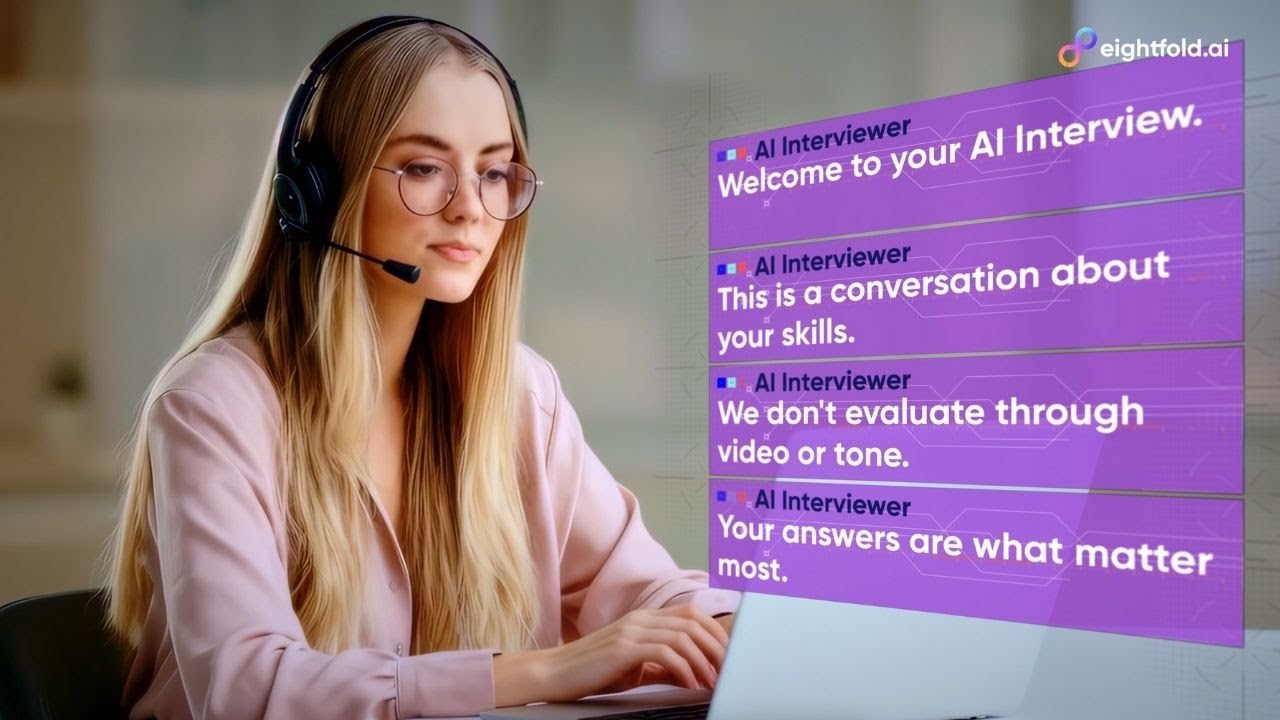
Eightfold AI Interviewer, for example, is positioned as an autonomous AI digital worker, distinct from simple chatbots or scheduling assistants. It conducts full, adaptive interviews at scale and has been recognized for its innovation, earning accolades such as being named a Top HR Product of the Year by HR Executive and the HR Tech Conference. Its key capabilities that drive ROI at the enterprise level include its ability to conduct fully adaptive interviews, its sophisticated fraud detection mechanisms, its multilingual capabilities to support global hiring efforts, and its seamless integration with existing Applicant Tracking Systems (ATS) and HR Information Systems (HRIS). Organizations such as STMicroelectronics and numerous Fortune 500 companies are leveraging this technology.
The financial impact of AI interview automation is particularly pronounced in high-volume and hourly hiring segments. The inherent challenges in these areas—overwhelming applicant volumes, recruiter burnout, lengthy time-to-first-interview, high candidate drop-off rates, and seasonal demand spikes—are directly addressed by AI interview automation. The reported metrics from high-volume use cases are stark: drastic reductions in time-to-first-interview, significant improvements in candidate engagement rates, and a marked decrease in recruiter time spent on initial screening. For enterprise operations teams responsible for hiring thousands of frontline, warehouse, retail, or service workers annually, these improvements translate into enhanced operational resilience, enabling efficient staffing for peak seasons without the burden of increasing permanent recruiting head count or incurring premium agency fees.
Comparing the ROI of AI interview assistants to traditional enterprise recruitment costs reveals a significant financial advantage. Traditional recruitment processes often incur substantial, albeit sometimes hidden, costs. These include the inefficiency of manual screening and initial interviews, the cost of prolonged vacancies due to slow hiring cycles, expenses associated with recruitment agencies, the financial burden of high recruiter turnover and burnout, and the significant, often overlooked, cost of fraudulent hires. AI interview assistants directly address and mitigate each of these cost categories simultaneously. The platform’s cost becomes a single, predictable line item, while the savings are distributed across enhanced recruiter efficiency, reduced vacancy periods, and improved hire quality, all of which are measurable.
Several key questions often arise regarding the implementation and impact of AI interview assistants on enterprise recruitment and recruiter roles.
Addressing Recruiter Concerns: Augmentation, Not Replacement
A primary concern is whether AI interview assistants will replace human recruiters. The consensus and design of leading solutions like AI Interviewer is that they augment, rather than replace, recruiters. The AI handles the initial screening and evaluation layer, providing recruiters with scored summaries and insights. Recruiters then review these outputs, make informed decisions, and lead the crucial offer and closing conversations. This model empowers recruiting teams to manage more hires with the same head count, focusing human effort on the aspects of hiring that truly require human judgment and relationship-building.
Ensuring Compliance and Mitigating Bias
Compliance and bias are critical considerations. AI Interviewer, and similar advanced systems, are designed to evaluate candidates based solely on demonstrated skills and responses to role-specific questions. They do not consider visual appearance, accent, or emotional expression, ensuring consistent and equitable evaluation against predefined criteria. This approach provides enterprises with the auditability and transparency needed for compliance purposes, as the evaluation logic is clearly defined and consistently applied.
Streamlined Implementation and Scalability
The implementation of AI interview assistants is typically designed for rapid deployment, often within one to two weeks. These solutions integrate seamlessly with existing ATS and HRIS platforms, minimizing the need for complex workflow rebuilds. The deployment is characterized by a high impact with a light operational lift. Furthermore, these systems are built for massive scale. AI Interviewer, for instance, has demonstrated the capacity to conduct over a million interviews in a single hour, operating 24/7 across multiple languages. Its elastic scalability ensures it can adeptly manage hiring surges without requiring additional head count or incurring per-interview cost increases.
Calculating the Financial Impact
To quantify the financial impact of AI recruitment automation, organizations can utilize dedicated ROI calculators. These tools allow users to input key variables such as annual hire volume, the fully loaded cost of recruiters, current time-to-fill metrics, average new hire salary, and the platform cost. The output typically provides an estimated three-year ROI, payback period, and the projected annual hours freed up for recruiters.
The Bottom Line: A Strategic Investment in Efficiency
Enterprise recruitment is one of the most operationally expensive functions within large organizations, yet it has historically been one of the least automated. AI interview assistants represent a category of investment where the ROI is not speculative; it is demonstrably realized through reductions in recruiter hours, improvements in time-to-fill metrics, and decreased vacancy costs, often within weeks of deployment. Organizations achieving the highest returns typically exhibit three key characteristics: a high volume of requisitions, a commitment to data-driven decision-making, and a strategic focus on talent acquisition as a critical business enabler. For such organizations, the question shifts from whether an AI interview assistant delivers ROI to how much value it can unlock and how quickly. Solutions like Eightfold AI Interviewer are available for trial, with performance metrics based on internal hiring results, acknowledging that individual results may vary based on hiring volume, role type, and specific deployment configurations.