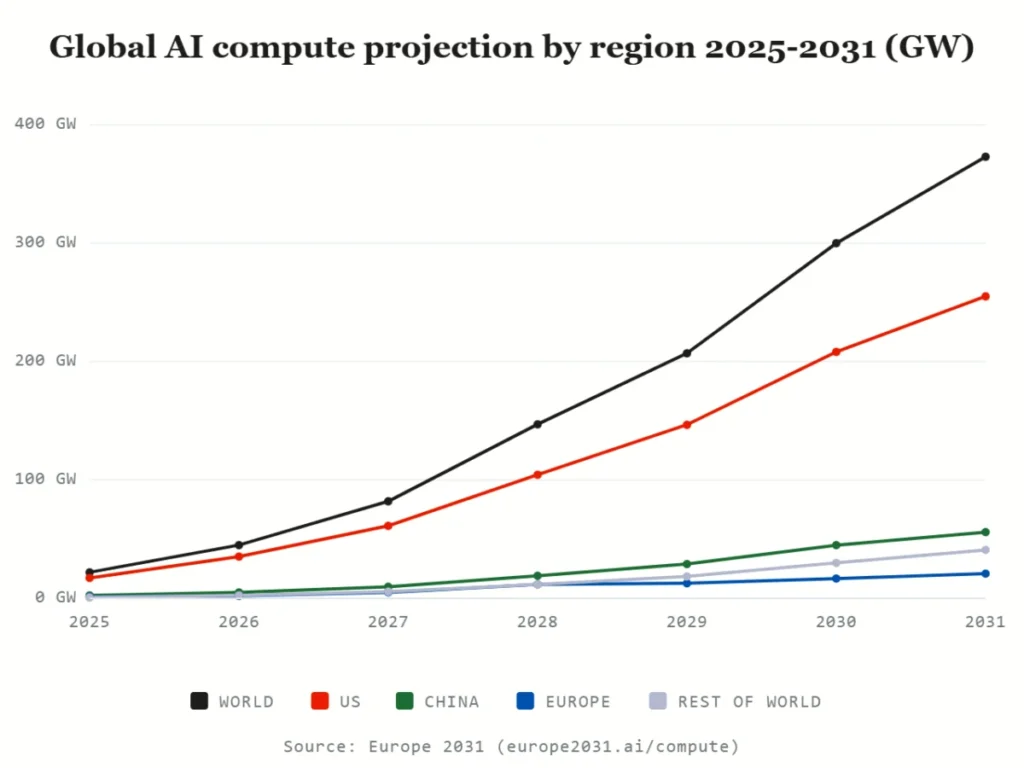
A sobering report published this summer by a group of European AI researchers paints a stark picture of the continent’s trajectory in the rapidly evolving artificial intelligence landscape. Titled Europe 2031, the scenario-forecasting document warns that without a significant course correction, Europe is on track to cede control over critical AI resources – including computational power, top-tier talent, and industrial leverage – by the year 2031. The authors propose an aggressive adoption of AI, coupled with robust retraining programs and income support for displaced workers, as a vital strategy to avert this projected decline.
The Europe 2031 report emerges from the collaborative efforts of Daan Juijn, Stan van Baarsen, Judith Dada, and a cohort of co-authors. It employs a scenario-forecasting methodology akin to that of the widely influential AI 2027 report, released in April 2025 by the AI Futures Project. While AI 2027 focused on the global growth of AI capabilities, Europe 2031 narrows its lens to the specific challenges and opportunities facing the European continent. The core of its analysis hinges on projecting the consequences of Europe’s current pace of investment in AI compute and its existing policy framework remaining unchanged over the next decade.
The Growing Compute Divide: A Geopolitical Imperative
A central tenet of the Europe 2031 report is the critical role of AI compute – the vast network of data centers and high-performance chips essential for training and operating cutting-edge AI systems. The researchers estimate that Europe currently commands a mere 5% of the global AI compute infrastructure. Under their baseline projection, this share is expected to see only marginal growth, inching towards 6% by 2031. In stark contrast, the United States is projected to maintain its dominant position, controlling close to 70% of global AI compute.
This substantial disparity is not merely an academic observation; it carries profound implications for geopolitical influence and economic competitiveness. The authors contend that compute power is increasingly becoming the gatekeeper to accessing the most advanced and capable AI models. Nations and corporations that possess superior compute resources are positioned to develop, refine, and deploy AI technologies at an accelerated pace, thereby shaping the global AI agenda and reaping its associated economic benefits. This could lead to a scenario where Europe becomes a consumer of AI technologies developed elsewhere, rather than a key architect and innovator.
Currently, the majority of Europe’s AI compute infrastructure is concentrated in the Nordic region. However, the Europe 2031 report forecasts a significant geographical redistribution of this capacity by 2031. France is projected to emerge as the largest holder of European AI compute, accounting for approximately 37% of the continent’s total. Norway and Germany are expected to follow, each holding around 9% of the European AI compute share. While this internal shift indicates some development within the continent, it does not fundamentally alter Europe’s modest global standing.
Authorship and Independence: Ensuring Unbiased Analysis
The eight individuals who contributed to the Europe 2031 report operated in their personal capacities. This deliberate choice underscores a commitment to providing an independent and objective assessment of Europe’s AI future. The researchers acknowledge that the bulk of the work was conducted in their own time, with the Arq Foundation providing limited financial support primarily for operational costs such as website development and translation services. Crucially, the authors report no funding from AI companies, thereby mitigating any potential conflicts of interest. They explicitly state that the views expressed in the report do not represent the official positions of their respective employers. This commitment to intellectual independence is vital for building trust and credibility around the report’s findings and recommendations.
A "Flexicurity" Approach to AI and Labor: Reimagining the Social Contract
Among the five key recommendations put forth in Europe 2031 to steer the continent away from its projected AI deficit, one stands out for its emphasis on labor market adaptation: the adoption of a "flexicurity" model. This approach, drawing inspiration from Denmark’s established system, advocates for a framework that allows employers to deeply integrate AI into their operations while simultaneously providing robust protections for workers. These protections are envisioned not through rigid job preservation, but through comprehensive retraining initiatives and income support mechanisms for individuals whose roles are impacted by AI-driven automation.
The rationale behind this recommendation is rooted in the authors’ assessment of the prevailing economic realities. They argue that attempts to artificially preserve existing job structures in the face of rapid technological advancement are ultimately futile and counterproductive. Companies and nations that resist or delay AI adoption risk being outmaneuvered by more agile competitors. Furthermore, without a proactive safety net, the inevitable disruption caused by AI could lead to widespread unemployment and social instability. The flexicurity model, by contrast, aims to foster a dynamic labor market where innovation can flourish, and workers are equipped with the skills and support necessary to navigate transitions and thrive in the evolving economy. This involves a fundamental shift from a mindset of "job protection" to one of "worker adaptability."
Bridging the Governance Gap: Empowering Policymakers and Workforces
The Europe 2031 report also highlights a significant governance gap, drawing a parallel between the challenges faced by public sector officials and those within private organizations. The authors observe that many European civil servants are currently barred from utilizing frontier AI systems due to data protection concerns. Compounding this issue is a perceived lack of technical expertise among these officials, hindering their ability to effectively evaluate and regulate the very technologies they are tasked with overseeing.
This dynamic is mirrored within companies. When organizational leaders implement strict restrictions on AI access without concurrently fostering AI literacy across their workforce, they risk making critical decisions about jobs and skills without a clear understanding of the technology’s capabilities and limitations. This can lead to suboptimal strategies, missed opportunities, and a disconnect between leadership vision and the practical realities faced by employees. The report implicitly calls for a dual approach: equipping public sector leaders with the knowledge and tools to govern AI effectively, and empowering both leaders and employees within organizations to leverage AI responsibly and strategically.
The Broader Implications: A Call for European Agency
The Europe 2031 report serves as a critical wake-up call for European policymakers, industry leaders, and the public. The projected concentration of global AI compute in the United States and the continent’s relatively small share underscore the urgent need for a coordinated and ambitious European strategy. Failure to act decisively could result in a future where Europe is not only a technological laggard but also economically dependent on external AI powerhouses.
The report’s emphasis on proactive labor market adaptation is particularly pertinent. As AI technologies become more sophisticated, their impact on employment will be profound and far-reaching. A flexicurity model, while requiring significant investment in education and social support systems, offers a pragmatic pathway to mitigate potential social upheaval and harness the benefits of AI for broader societal prosperity. This approach acknowledges that technological progress is inevitable and that the focus should be on managing its societal consequences rather than attempting to halt it.
Furthermore, the report’s critique of the governance gap points to a need for enhanced digital literacy and a more agile regulatory environment. empowering public servants and corporate leaders with the knowledge to understand and engage with AI is essential for informed decision-making and effective policy implementation. This involves not only providing access to AI tools but also investing in comprehensive training and educational programs.
A Timeline of Concern and Opportunity
The publication of Europe 2031 this summer arrives at a pivotal moment in the global AI race. The report’s authors, working largely in their personal capacities and with limited external funding, have provided a detailed, data-driven forecast that warrants serious consideration. Their methodology, mirroring that of the influential AI 2027 report from April 2025, grounds their projections in current trends.
The timeline presented is stark: if current investment and policy trajectories continue unchanged, Europe’s share of global AI compute will stagnate. This projection stands in stark contrast to the dominant position expected to be held by the United States. The internal redistribution of compute within Europe by 2031, with France leading, while a point of interest, does not alter the continent’s overall standing on the global stage.
The report’s recommendations, particularly the emphasis on "flexicurity," suggest a proactive approach to labor market transformation. This contrasts with potential reactions from other regions or entities that might favor more protectionist or slower-adoption strategies. The call for deeper AI adoption by employers, paired with worker support, implies a need for a societal consensus on the benefits and challenges of AI.
Reactions and Broader Impact
While the report itself is the primary source of analysis, the implications of its findings are likely to spark considerable debate among European policymakers, industry leaders, and labor unions. One might anticipate responses from:
- European Union Officials: Expected to engage with the report’s findings, potentially influencing future AI strategy documents and funding allocations for research and development. The report’s focus on compute and talent aligns with existing EU priorities, but its stark warning may necessitate a more aggressive stance.
- National Governments: Particularly those identified as future hubs of European AI compute (France, Norway, Germany), are likely to review their national AI strategies and investment plans in light of the report’s projections.
- Industry Leaders: Companies involved in AI development and deployment, as well as those in sectors heavily reliant on AI, will be keen to understand the competitive landscape and the implications for their workforce strategies.
- Labor Organizations: The report’s emphasis on retraining and income support will be a key area of focus for unions, who will likely advocate for strong worker protections and robust social safety nets.
- Academic and Research Institutions: The report’s scenario-forecasting methodology and its conclusions will undoubtedly be subject to academic scrutiny and further research.
The broader impact of the Europe 2031 report lies in its potential to galvanize a more unified and ambitious European response to the AI challenge. By clearly articulating the risks of inaction and proposing concrete, albeit challenging, solutions, the report provides a framework for a necessary continental dialogue. Its influence will depend on how effectively these findings are translated into tangible policy changes and strategic investments across member states and at the EU level. The next few years will be critical in determining whether Europe can indeed pivot from a trajectory of potential decline to one of AI leadership and sustained economic relevance.