In a significant ruling issued on September 15, 2026, the 2nd U.S. Circuit Court of Appeals has clarified the standard for proving religious discrimination under Title VII of the 1964 Civil Rights Act, particularly within the contentious context of COVID-19 vaccination mandates. The court held that plaintiffs alleging discrimination must now demonstrate that an employer’s adverse action was motivated by a specific desire to avoid granting a religious accommodation, rather than merely proving the employer’s knowledge of the employee’s need for such an accommodation. This decision, emerging from the case of Bergin v. New York State Unified Court System, effectively realigns the circuit’s jurisprudence with the U.S. Supreme Court’s 2015 precedent set in EEOC v. Abercrombie & Fitch, overturning a previous, more lenient standard within the 2nd Circuit.
The ruling has profound implications for both employers navigating complex accommodation requests and employees seeking religious exemptions from workplace policies. It underscores the critical importance of a meticulous, well-documented approach to handling religious accommodation issues, especially as the legal landscape continues to evolve in the wake of public health crises and increasingly diverse workplaces.
The Bergin Case: A Test of Accommodation and Mandates
The Bergin v. New York State Unified Court System case centered on a former court officer, identified as the plaintiff, who sought an exemption from the New York State Unified Court System’s (UCS) COVID-19 vaccination mandate. The plaintiff informed UCS that complying with the mandate conflicted with her sincerely held religious beliefs.
In response to her request, UCS initiated its standard process, asking the plaintiff to complete a questionnaire designed to elicit more detailed information regarding her religious beliefs and the nature of the requested accommodation. However, the plaintiff failed to submit the requested information in a timely manner. Consequently, having not complied with the vaccination mandate and not fully engaging in the accommodation process by providing the requested details, she was discharged from her position.
Following her termination, the plaintiff filed a lawsuit, alleging failure-to-accommodate religious discrimination under Title VII. A district court initially granted partial summary judgment in her favor. This decision was based on the existing 2nd Circuit precedent at the time, which only required plaintiffs to demonstrate that an employer knew an employee’s religious belief conflicted with an employment requirement to establish a prima facie case of discrimination. The previous standard placed a significant emphasis on employer knowledge, making it relatively easier for employees to meet the initial burden of proof.
Shifting Legal Sands: The Influence of Abercrombie & Fitch
The turning point in the Bergin case came during the appeal. UCS argued that the district court had erred by not applying the updated Title VII analysis articulated by the U.S. Supreme Court in EEOC v. Abercrombie & Fitch, decided in 2015. This landmark Supreme Court case fundamentally reshaped the understanding of discriminatory motive in failure-to-accommodate claims.
In Abercrombie, the case involved a Muslim job applicant who wore a headscarf, which violated Abercrombie’s "Look Policy" prohibiting headwear. While the employer’s hiring manager suspected the applicant wore the headscarf for religious reasons, they did not explicitly ask about it due to company policy against religious discrimination questions. The applicant was not hired, and the EEOC sued on her behalf. The Supreme Court ultimately ruled that an employer could be held liable for religious discrimination even if it did not have "actual knowledge" of the need for an accommodation, provided that the employer’s motive for the adverse action was to avoid accommodating a religious practice. The high court clarified that the employee must actually require an accommodation of their religious practice and must show that the employer’s desire to avoid granting that accommodation motivated an adverse employment decision. The focus shifted from mere knowledge to discriminatory intent related to the accommodation itself.
The 2nd Circuit, upon reviewing the Bergin appeal, concurred with UCS’s argument. It acknowledged that Abercrombie had indeed overturned its prior circuit precedent regarding the evidentiary standard for religious discrimination claims. As a result, the appeals court vacated the district court’s grant of summary judgment to the plaintiff in Bergin. Furthermore, it explicitly directed the district court to apply the Abercrombie standard during further proceedings.
Significantly, the 2nd Circuit also disagreed with the district court’s finding that UCS had made a "judicial admission" that the plaintiff had adequately communicated her conflicting religious belief. This detail underscores the importance of the interactive process and the employer’s right to seek sufficient information to assess an accommodation request.
The court also provided a crucial clarification in a footnote, stating that its decision was not meant to suggest that plaintiffs must meet a "new, heightened discriminatory motive requirement." Instead, the court explained that plaintiffs only need to demonstrate that the denial of an accommodation was due to the employee’s religion, as opposed to some other legitimate, non-discriminatory reason. This could include, for instance, an employee’s failure to timely provide requested information necessary for the employer to evaluate the accommodation. This nuance is vital, as it aims to prevent the ruling from being interpreted as an insurmountable barrier for employees while still reinforcing the need for clear links between religious belief, accommodation request, and employer’s discriminatory motive.
Timeline of Key Legal Developments
- 1964: Title VII of the Civil Rights Act is enacted, prohibiting discrimination based on religion, race, color, sex, and national origin, and requiring employers to reasonably accommodate employees’ religious practices unless doing so would cause undue hardship.
- 2015: U.S. Supreme Court issues its ruling in EEOC v. Abercrombie & Fitch, clarifying that an employer’s desire to avoid granting a religious accommodation must motivate an adverse employment decision for a Title VII claim to succeed.
- 2020-2022: The COVID-19 pandemic leads to widespread implementation of vaccine mandates across various sectors, triggering a surge in religious accommodation requests and subsequent litigation.
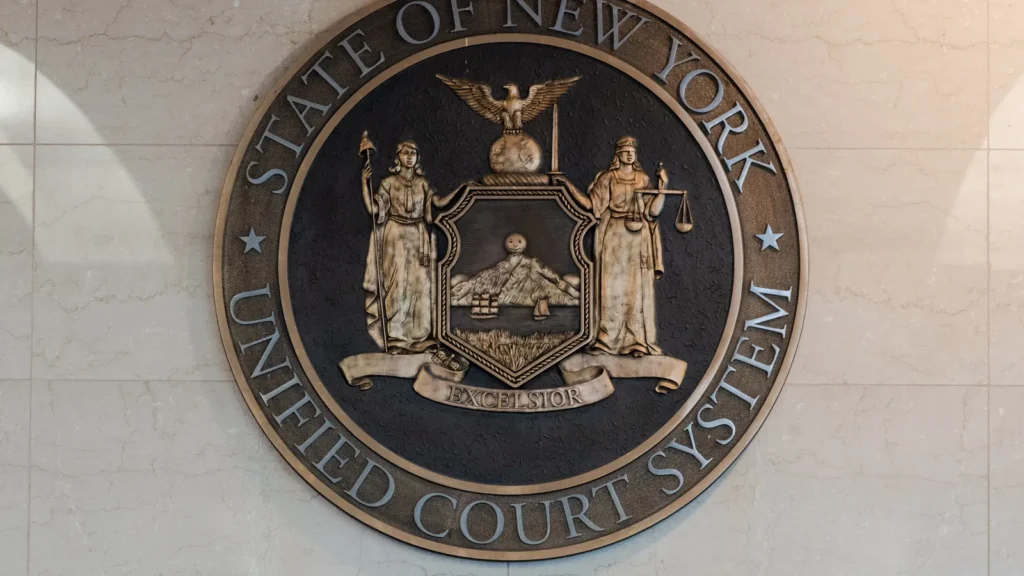
- July 29, 2020: (Contextual image date) The seal of the State of New York Unified Court System, relevant to the Bergin case, is photographed, reflecting the institutional setting.
- September 15, 2026: The 2nd U.S. Circuit Court of Appeals issues its decision in Bergin v. New York State Unified Court System, aligning its religious discrimination standard with Abercrombie.
The Broader Context of COVID-19 Vaccine Mandates and Litigation
The Bergin decision is not an isolated event but rather a significant development within a broader landscape of litigation stemming from COVID-19 vaccine mandates. The pandemic presented unprecedented challenges for employers, forcing them to balance public health directives, workplace safety, and individual rights, including religious freedom.

Across the United States, various federal and state courts have grappled with the legal intricacies of vaccine mandates and religious exemptions. The 9th Circuit, for example, has been particularly active in issuing notable decisions. In one such instance, the 9th Circuit sided with a former consultant, a Christian Jew, who cited Bible passages in her initial request for a vaccination mandate exemption. Her employer had initially approved her request but later revoked it, demanding further information that the plaintiff only partly provided. The employer then placed her on unpaid leave before ultimately terminating her. The 9th Circuit concluded that the plaintiff had provided sufficient notice of her beliefs, partly because the employer had initially approved her request, suggesting an understanding of her religious basis. This case highlights how the specific actions and responses of both employer and employee throughout the interactive accommodation process can heavily influence legal outcomes.
These cases underscore the complexities employers face. On one hand, they are obligated to maintain a safe working environment and adhere to public health guidelines. On the other, they must respect employees’ sincerely held religious beliefs and provide reasonable accommodations unless doing so poses an undue hardship. The varying outcomes in different circuits and cases emphasize the fact-specific nature of religious discrimination claims.
Expert Reactions and Implications for Employers
Legal experts have swiftly weighed in on the Bergin decision, recognizing its critical implications for human resources and legal departments. Emily Tortora and Hayley Klein, attorneys at Venable LLP, noted in their analysis that the Bergin decision "reinforces the importance of a thoughtful, consistent, and well-documented approach to spotting, assessing, and responding to potential religious accommodation issues."
For employers, the Bergin ruling provides a degree of clarity, albeit one that shifts the burden of proof in favor of employers in some respects. It means that simply knowing an employee holds a religious belief that conflicts with a workplace rule may not be enough for an employee to win a discrimination claim if the employer can demonstrate a non-discriminatory reason for the adverse action, such as the employee’s failure to engage in the interactive process or provide necessary information.
Key implications for employers include:
- Robust Accommodation Policies: Employers must have clear, well-defined policies and procedures for handling religious accommodation requests. These policies should outline the process for requesting an accommodation, the information required from employees, and the steps the employer will take to evaluate the request.
- Thorough Documentation: Meticulous documentation of every step in the accommodation process is more crucial than ever. This includes initial requests, follow-up communications, questionnaires, employee responses (or lack thereof), discussions about potential accommodations, and the rationale behind any decisions made.
- Effective Interactive Process: Employers must actively engage in an "interactive process" with employees seeking accommodation. This means communicating clearly, asking for necessary details (as long as they are related to the accommodation request), and considering alternative accommodations.
- Training and Education: HR professionals and managers must be adequately trained on Title VII requirements, the Abercrombie standard, and the nuances of religious accommodation law. They need to understand what constitutes a sincerely held religious belief and how to avoid actions that could be perceived as motivated by a desire to avoid accommodation.
- Risk Mitigation: The ruling suggests that employers who can demonstrate a legitimate, non-discriminatory reason for an adverse action—such as an employee’s non-compliance with information requests—will be in a stronger legal position. This incentivizes employers to ensure their processes are fair, transparent, and defensible.
Implications for Employees and Future Outlook
For employees, the Bergin decision highlights the importance of active participation and transparency when seeking religious accommodations. While their right to religious freedom remains protected under Title VII, the burden of proving discriminatory motive now requires more than just demonstrating the employer’s awareness of their religious conflict.

Key implications for employees include:
- Clear Communication: Employees must clearly articulate their sincerely held religious beliefs and the specific accommodation they are seeking. Vague or incomplete requests may not be sufficient.
- Timely Engagement: Responding promptly and thoroughly to employer requests for additional information is critical. Failure to do so could be interpreted as a non-religious reason for an adverse action, as highlighted by the Bergin ruling.
- Understanding Employer Process: Employees should familiarize themselves with their employer’s accommodation policies and be prepared to engage in the interactive process as required.
- Potential for Heightened Scrutiny: While the court clarified it’s not a "heightened discriminatory motive requirement," employees may find it more challenging to prove their case if employers have followed a robust, documented process and can point to legitimate, non-discriminatory reasons for their actions.
The Bergin decision will likely influence how other circuits interpret and apply the Abercrombie standard, potentially leading to greater uniformity in religious discrimination law across the country. However, questions remain about how "desire to avoid granting an accommodation" will be interpreted in various factual scenarios. The ongoing evolution of workplace norms, particularly regarding health and safety, coupled with the deeply personal nature of religious belief, ensures that this area of law will continue to be a subject of intense scrutiny and frequent litigation. The ultimate impact of Bergin will depend on how district courts apply the revised standard and how future appellate decisions further refine these complex legal principles.
In conclusion, the 2nd Circuit’s ruling in Bergin v. New York State Unified Court System marks a significant development in religious accommodation law under Title VII. By aligning its standard with the Supreme Court’s Abercrombie precedent, the court has emphasized the necessity of proving an employer’s discriminatory motive related to accommodation, rather than mere knowledge. This decision will undoubtedly shape HR practices, legal strategies, and the dialogue surrounding religious freedom in the workplace for years to come.