Singapore – Held from May 4-7, 2026, HR Tech Asia convened in Singapore, bringing together a dynamic assembly of leaders from across the Asia-Pacific region. The central imperative of this year’s summit was to equip individuals and organizations with the foresight and strategies necessary to navigate an era defined by the accelerating pace of artificial intelligence (AI)-driven change. The event served as a crucial nexus for discussion and innovation, underscoring the profound impact AI is poised to have on the future of work.
The expo, a flagship event for HR professionals in the region, featured a robust agenda designed to tackle the multifaceted challenges and opportunities presented by emerging technologies. From the initial moments, the tone was set for a deep dive into strategic transformation, moving beyond superficial adoption to a fundamental reimagining of how work is structured and executed.
Opening Keynote: Deconstructing Automation and Embracing Human Potential
The summit commenced with a high-octane opening keynote delivered by Jason Averbook, co-founder of Now to Next. Averbook’s address was a powerful call to action, challenging the conventional wisdom surrounding AI implementation. His central thesis was a stark warning against what he termed "automating dysfunction."
"Don’t take AI and put it on top of junk," Averbook emphatically stated. He elaborated on the concept of "work slop" – a byproduct of integrating advanced technology with outdated or inefficient processes. This "slop," he explained, manifests as flawed data, cumbersome workflows, and stifled creativity, ultimately undermining the very benefits AI promises.
Averbook’s provocative message urged HR professionals to confront a long-standing truth: despite technological advancements from mainframes to cloud computing, the core functions of HR have often remained remarkably consistent, merely repackaged in new technological wrappers. He argued that the current AI revolution demands a more radical departure – a genuine reevaluation and reimagining of the nature of work itself.
To illustrate this point, Averbook introduced a compelling framework for dissecting job roles into three distinct task categories: "hands work" (execution and operational tasks), "heads work" (strategic thinking, analysis, and problem-solving), and "hearts work" (cultivating relationships, fostering engagement, and amplifying human potential). He cited prevalent studies indicating that HR departments typically allocate approximately 70% of their time to "hands work." This segment of tasks, he highlighted, is precisely the most susceptible to automation.
However, Averbook reframed this statistic not as a threat, but as an unprecedented opportunity for liberation. "When 70% of your job goes away, it gives you more time to focus on the human side," he pospered, emphasizing the shift towards higher-value, uniquely human contributions.
He also critically examined the prevailing obsession with AI adoption metrics. Averbook posited that adoption, in isolation, cannot be the ultimate objective. Instead, he championed "embodiment" as the true goal – the seamless integration and natural utilization of AI within the organizational fabric. He painted a vivid picture of an evolving workplace where employees interact with HR systems through intuitive conversational interfaces, citing McDonald’s innovative use of WhatsApp as a front-end for its Workday platform. This example underscored his plea for attendees to look beyond mere technological tools and to cultivate a comprehensive cultural transformation in how work is conceived, designed, and experienced.
CHRO Panel: Charting the Course for Organizational Adaptation
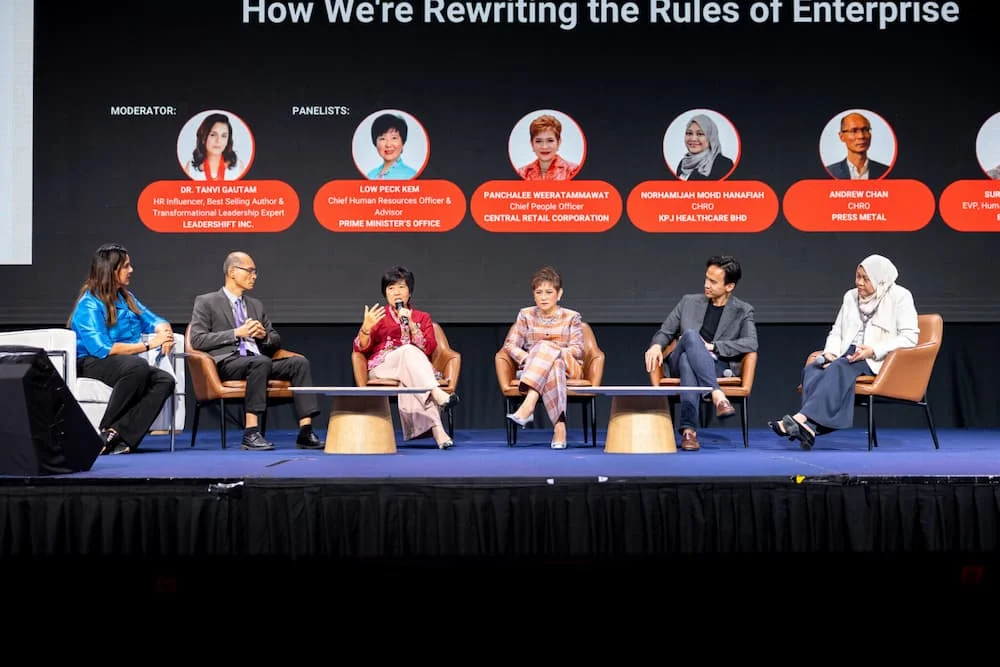
Following Averbook’s impactful keynote, the morning session featured one of the most eagerly anticipated segments of the conference: a panel discussion with Chief Human Resources Officers (CHROs) from some of Asia’s most forward-thinking organizations. The panel was expertly moderated by Dr. Tanvi Gautam, a distinguished HR influencer and transformational leadership expert from Leadershift Inc.
The distinguished panel comprised:
- Low Peck Kem, CHRO and Advisor (Workforce Development) at Singapore’s Public Service Division, Prime Minister’s Office.
- Panchalee Weeratammawat, Chief People Officer of Central Retail Corporation.
- Norhamijah Mohd Hanafiah, CHRO of KPJ Healthcare.
- Andrew Chan, CHRO for Press Metal.
- Suryo Sasono, Executive Vice-President of Human Capital Strategy and Talent Management at Bank BRI.
The discussion spanned a wide array of critical topics, including the intricacies of talent mobility, the strategic imperatives of succession planning, and the complex ethical considerations of delineating responsibility between AI-driven decisions and human accountability.
Suryo Sasono provided a compelling case study from Bank BRI, Indonesia’s largest and most profitable bank. He shared the bank’s decision not to fully automate credit decisions, despite possessing the necessary data. "When you start outsourcing decision-making purely to AI, it becomes no one’s responsibility," Sasono observed. "There needs to be one person accountable." This statement resonated deeply, highlighting the persistent need for human oversight and accountability in critical business functions, even in an era of advanced automation.

On the subject of succession planning, Andrew Chan outlined Press Metal’s multi-year transformation. The company successfully transitioned from a system based on familiarity and tenure-driven promotions to a sophisticated, transparent, and data-driven talent dashboard. This initiative garnered significant recognition, including a United Nations Global Compact Award, underscoring the power of strategic talent management.
Low Peck Kem emphasized the deliberate architecture required for effective talent flow. She noted the mandatory rotation policy within Singapore’s public service, where HR directors are expected to move between sectors every five years. "If you yourself don’t want to move, it’s very difficult to convince your business to allow their people to move," she remarked, illustrating how leadership’s willingness to embrace change is a critical catalyst for organizational mobility.
Cultivating Essential Leadership Qualities in the Age of AI
A dynamic rapid-fire segment of the panel focused on identifying the most challenging leadership quality to cultivate in the contemporary business landscape: curiosity, empathy, or systems thinking. The responses revealed a diverse yet insightful split among the panelists.
Panchalee Weeratammawat argued that empathy is the most neglected yet crucial trait. "Most people focus on delivering commercial targets rather than understanding that human is human," she stated, highlighting the enduring importance of human connection and understanding in driving organizational success.
Suryo Sasono championed curiosity as the paramount quality. He explained that at Bank BRI, the sheer scale and profitability of the institution present a unique danger of complacency. This mindset, he warned, has historically led to the downfall of industry giants like Kodak and Nokia, emphasizing that continuous learning and exploration are vital for sustained relevance and innovation.
Dr. Tanvi Gautam, moderating the discussion, concluded the panel with a poignant observation that encapsulated the core message of the day: "A right person with the wrong technology could work. But the wrong person, even with the right technology, is not going to work." This statement served as a powerful reminder that while technological advancements are critical, the human element – the competence, adaptability, and mindset of individuals – remains the ultimate determinant of success.
Broader Implications and the Path Forward
The insights shared at HR Tech Asia 2026 painted a clear picture of the transformative journey ahead for HR professionals and organizations across the Asia-Pacific. The event underscored that the AI revolution is not merely about adopting new tools, but about fundamentally rethinking organizational structures, talent strategies, and the very essence of leadership.
The discussions highlighted a growing consensus that true progress lies in leveraging AI to augment, rather than replace, human capabilities. By automating routine tasks, organizations can liberate their workforce to focus on higher-order cognitive functions, strategic thinking, and the cultivation of interpersonal relationships – areas where human ingenuity and emotional intelligence remain unparalleled.
The emphasis on "embodiment" over mere adoption signals a maturation of thinking within the HR community. It suggests a strategic shift towards integrating AI in ways that are intuitive, seamless, and deeply embedded within the organizational culture, ultimately enhancing employee experience and operational efficiency.
The candid exchanges on accountability, talent mobility, and leadership development provided actionable frameworks for organizations striving to build resilient and adaptive workforces. The experiences shared by leaders from diverse sectors, including public service, retail, healthcare, and finance, offered valuable lessons applicable across a broad spectrum of industries.
As organizations grapple with the unprecedented pace of technological change, HR Tech Asia 2026 served as a critical platform for fostering collaboration, sharing best practices, and collectively charting a course towards a future where technology and human potential converge to drive sustainable growth and innovation. The event’s success in convening thought leaders and practitioners underscores its pivotal role in shaping the future of human resources in Asia.
For those interested in participating in future discussions and gaining cutting-edge insights, registration for HR Tech Asia 2027 is now open. Interested parties can click here to register their interest. Further detailed reporting from the event can be accessed by visiting the HRM Asia reporter Josephine Tan’s comprehensive coverage, available by clicking here.