The global corporate training landscape is currently navigating a significant technological crossroads, characterized by a persistent tension between legacy infrastructure and the promise of AI-driven innovation. For several years, the central debate within Learning and Development (L&D) circles has focused on the perceived rivalry between the Learning Management System (LMS) and the Learning Experience Platform (LXP). While early industry forecasts suggested that the LXP would inevitably render the LMS obsolete, the reality on the ground in 2026 reveals a much more nuanced and integrated environment. According to the latest benchmark data, the expected mass migration to LXPs has not materialized as predicted; instead, organizations are opting for a hybrid approach that prioritizes operational stability over experimental features.
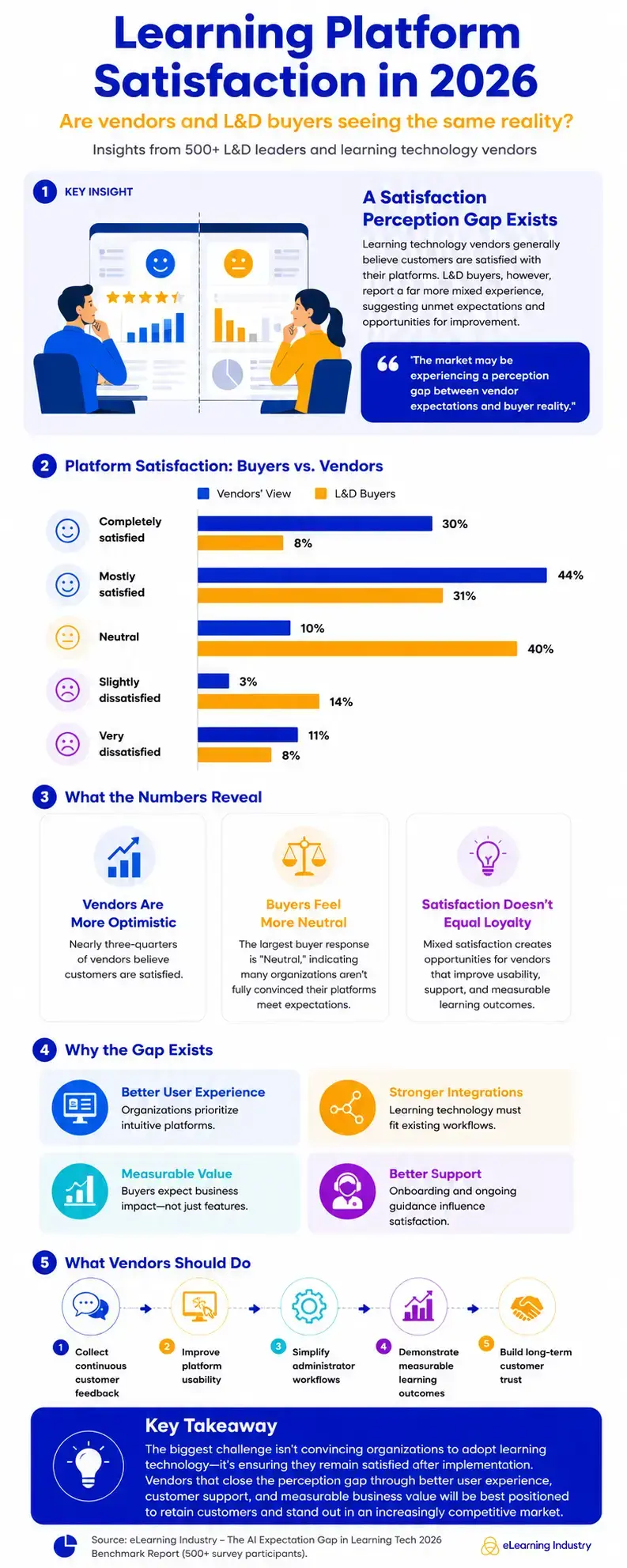
The 2026 benchmark report from eLearning Industry, which surveyed more than 500 L&D buyers and technology vendors, provides a comprehensive look at this evolution. The findings highlight a significant "expectation gap" between what technology providers are building and what corporate buyers are actually willing to implement. As organizations modernize their learning ecosystems, the decision-making process has shifted from chasing the latest trends to ensuring that new tools can demonstrate immediate business value and seamless integration with existing HR tech stacks.
Defining the Divide: Technical and Functional Differences
To understand why the market remains divided, it is essential to distinguish the fundamental architectures of the LMS and the LXP. Although both platforms facilitate employee development, they serve diametrically opposed philosophical and operational goals.
An LMS is primarily a top-down administrative tool. Designed for the delivery, management, and tracking of formal training, it serves as the "system of record" for an organization’s human capital development. Its core strengths lie in compliance, certification management, and structured onboarding. For industries such as healthcare, aviation, and financial services, where regulatory oversight is stringent, the LMS is an indispensable utility. It allows administrators to mandate specific content, set deadlines, and generate audit-ready reports that prove an employee has met legal or safety requirements.
Conversely, an LXP is a bottom-up, learner-centric environment. Often described as the "Netflix of learning," an LXP focuses on discovery and engagement. Rather than forcing a specific curriculum on a user, it employs artificial intelligence and machine learning to suggest content based on the individual’s role, past interests, and identified skill gaps. LXPs excel at supporting self-directed learning, social collaboration, and the curation of external resources, such as podcasts, articles, and third-party videos. The primary goal of an LXP is not compliance, but rather the continuous development of skills and the fostering of a "learning culture."
The 2026 Market Reality: Data-Driven Insights
The 2026 report offers a stark contrast to the marketing narratives prevalent in the early 2020s. Despite the aggressive promotion of LXPs as the future of work, the LMS remains the dominant force in corporate learning. The data shows that 70% of L&D buyers continue to utilize an LMS as their primary platform. In contrast, only 16% of organizations report using an LXP as their main learning tool.
This discrepancy highlights a major disconnect in the industry. While 31% of technology vendors now offer LXP capabilities—investing heavily in AI-enabled discovery and personalized interfaces—the actual adoption rate among buyers is trailing significantly. This "vendor-buyer gap" suggests that while providers are preparing for a future defined by autonomous learning, the majority of L&D departments are still grappling with the immediate, practical needs of business operations.

Market analysts suggest that this lag is not due to a lack of interest in innovation, but rather a reflection of "platform fatigue." Many organizations invested heavily in digital transformation during the remote-work surge of 2020-2022 and are now in a phase of consolidation. They are less likely to replace a functioning, albeit older, LMS with a new LXP if the latter cannot guarantee a clear return on investment (ROI) or if it requires a complete overhaul of their existing data structures.
Why the Learning Management System Retains Its Dominance
The continued supremacy of the LMS can be attributed to three primary factors: structure, integration, and purpose. In the modern enterprise, these elements are often more valuable than high-end user experiences.
1. Structured Workflows and Compliance
The primary reason the LMS remains the bedrock of corporate training is its ability to handle scale and complexity. For a multinational corporation with 50,000 employees, the priority is often ensuring that every staff member completes their annual anti-harassment or cybersecurity training. The LMS provides the "push" mechanism required for these mandatory tasks. The 2026 report confirms that compliance remains the top driver for platform usage, a need that the open-ended nature of an LXP is not designed to satisfy.
2. Deep Integration with HR Ecosystems
Modern LMS platforms have spent decades refining their ability to communicate with Human Capital Management (HCM) systems like Workday, SAP SuccessFactors, and Oracle. These integrations allow for automated user provisioning, where an employee’s training record is tied directly to their payroll, performance reviews, and promotion eligibility. Buyers in the 2026 survey ranked "integration" as a higher priority than "AI features," indicating that the ability of a tool to work within a pre-existing ecosystem is a non-negotiable requirement for L&D leaders.
3. Measurability and Business Alignment
While LXPs offer "engagement" metrics, such as time spent on the platform or content ratings, these are often viewed as "vanity metrics" by executive leadership. The LMS, however, provides hard data on completion rates and certification status—metrics that are easily translated into business readiness and risk mitigation. In a period of economic scrutiny, L&D leaders are choosing platforms that provide the most defensible data to justify their budgets.
The Vendor Strategy: Betting on the "Experience" Economy
While buyers remain cautious, vendors are doubling down on LXP development. This strategy is driven by the belief that the current LMS-heavy model is unsustainable in a rapidly changing labor market. As the "half-life" of skills continues to shrink, vendors argue that organizations cannot rely solely on administrator-assigned training to keep their workforce competitive.
The vendor push toward LXPs is heavily focused on AI-powered personalization. By integrating Large Language Models (LLMs) and advanced data analytics, vendors are creating platforms that can proactively identify a skills gap before the employee or manager even realizes it exists. For example, if an employee’s performance data suggests a struggle with project management software, an AI-driven LXP can automatically surface a five-minute "microlearning" video to address the specific issue.
Furthermore, vendors see the LXP as a way to solve the "content overload" problem. With thousands of courses available via providers like LinkedIn Learning or Coursera, employees often suffer from decision paralysis. The LXP acts as a filter, using algorithms to ensure that the most relevant, high-quality content reaches the right person at the right time.
The Rise of the Integrated Learning Ecosystem
The most significant trend identified in the 2026 report is the move away from "either/or" thinking. Instead of choosing between an LMS and an LXP, forward-thinking organizations are building "Integrated Learning Ecosystems."
In this model, the LMS serves as the back-end engine, managing the "must-have" training, data security, and compliance reporting. The LXP sits on top of the LMS as a front-end "experience layer," providing the intuitive interface and personalized recommendations that modern employees expect. This allows an organization to maintain the rigors of corporate governance while offering the flexibility of a modern digital experience.
Industry experts refer to this as the "headless LMS" approach, where the administrative power of the system is separated from the user interface. This allows companies to swap out the "experience" layer as technology evolves without having to migrate their entire historical database of training records.
Strategic Recommendations for L&D Leaders
For organizations currently evaluating their learning technology roadmap, the 2026 findings suggest a pragmatic approach. The report emphasizes that the "best" platform is entirely dependent on the specific maturity and goals of the business.
- Prioritize the LMS if: Your primary goals are compliance, safety, and operational consistency. If your industry is highly regulated or if you are focused on foundational onboarding, a robust LMS remains the most cost-effective and reliable choice.
- Prioritize the LXP if: You have already mastered compliance and are now focused on upskilling, reskilling, and leadership development. An LXP is the ideal tool for organizations that want to foster a culture of continuous improvement and employee-led growth.
- Adopt a Hybrid Model if: You are a large enterprise with diverse needs. By using an LMS for "push" learning and an LXP for "pull" learning, you can satisfy both the legal requirements of the company and the developmental desires of the workforce.
Conclusion: A Future of Convergence
The 2026 benchmark report serves as a reminder that technology adoption in the corporate world is rarely a linear path. While the LXP represents a significant leap forward in user experience and AI application, the LMS continues to provide the structural integrity that large-scale organizations require.
The "LMS vs. LXP" debate is effectively ending, replaced by a focus on "Interoperability." The future of workplace learning will not be defined by which platform "wins," but by how effectively different technologies can be woven together to support both the business’s need for compliance and the individual’s need for growth. As AI continues to mature, the lines between these platforms will likely blur further, eventually leading to a unified "Learning Intelligence Platform" that handles both management and experience with equal proficiency. For now, however, the 70% of buyers sticking with their LMS are not "behind the times"—they are simply prioritizing the practical realities of modern business.