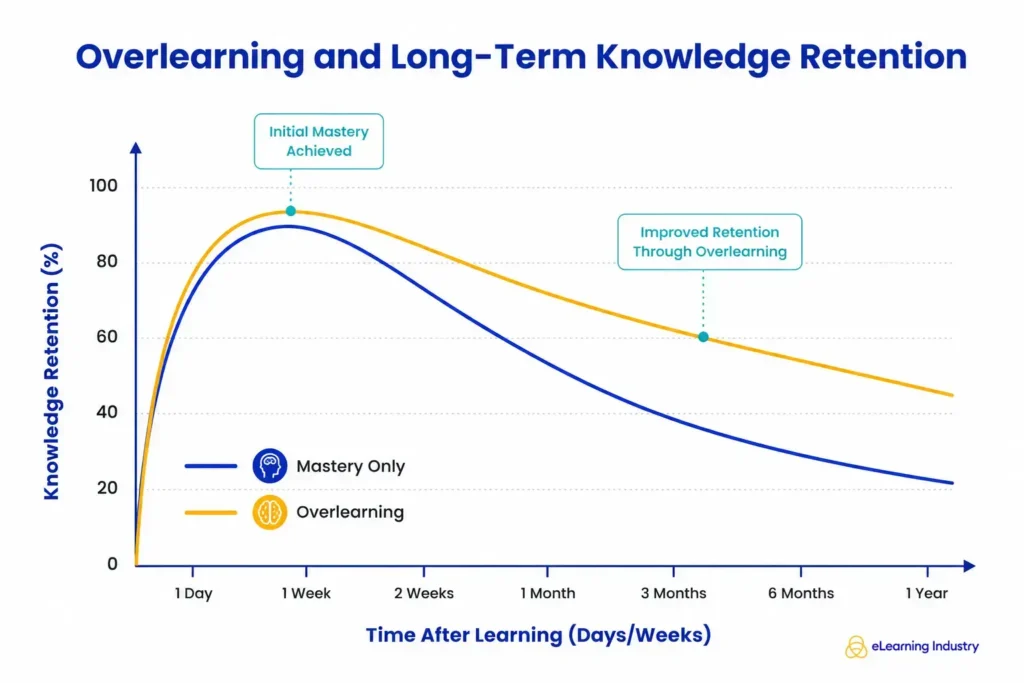
The traditional trajectory of workplace training has long been defined by a binary outcome: an employee is either "trained" or "untrained." However, a growing body of psychological research and instructional design theory suggests that reaching the threshold of competence is merely the beginning of true proficiency. This concept, known as overlearning, involves the deliberate practice of a skill or the continued study of information well after a learner has achieved initial mastery. By pushing beyond the point of "getting it right once," overlearning transforms fragile new knowledge into durable, automatic habits that withstand the pressures of time, stress, and cognitive load.
As corporate environments become increasingly complex and the cost of human error rises in sectors such as healthcare, aviation, and cybersecurity, the strategic application of overlearning is moving from a psychological curiosity to a fundamental requirement for high-performance organizational cultures.
The Evolution of Overlearning: From Behaviorism to Neuroscience
The roots of overlearning are deeply embedded in the history of experimental psychology, dating back to the late 19th century. Hermann Ebbinghaus, a pioneer in the study of memory, first quantified the "forgetting curve," which demonstrates how rapidly information is lost after the initial learning phase. Ebbinghaus discovered that the more times a person reviews material—even after they have memorized it perfectly—the slower the rate of decay becomes.
In the mid-20th century, the behaviorist movement further refined this concept. Researchers focused on the role of repetition and reinforcement in shaping behavior, suggesting that overlearning creates a "habit strength" that makes a response more resistant to extinction. As the field transitioned into cognitive psychology, the focus shifted to how the brain encodes and retrieves information. Modern cognitive science defines overlearning as a method to move tasks from "controlled processing," which requires significant mental effort and focus, to "automatic processing," which occurs with minimal conscious awareness.
Recent neurological studies have provided physical evidence for these theories. Research published in journals such as Nature Neuroscience indicates that overlearning hyper-stabilizes the brain’s neural circuits. Specifically, continued practice after mastery shifts the neurochemical balance in the visual cortex and other processing centers toward an "inhibitory-dominant" state. This stabilization prevents new learning from interfering with what has just been mastered, effectively "locking in" the skill and protecting it from being overwritten by subsequent information.
The Cognitive Mechanics of Automaticity
The primary benefit of overlearning is the development of automaticity. In a professional context, this refers to the ability to perform a task correctly without having to devote significant cognitive resources to the mechanics of the action. When a skill is overlearned, it requires less activation in the prefrontal cortex—the area of the brain responsible for complex decision-making and executive function—and relies more on the basal ganglia, which manage habits and procedural memory.
This shift is critical for performance under pressure. In high-stress situations, the "fight or flight" response can impair the prefrontal cortex, leading to what is commonly known as "choking" or cognitive paralysis. However, overlearned skills remain accessible because they are stored as deeply ingrained procedural habits. This is why emergency room physicians, elite athletes, and military personnel undergo rigorous, repetitive training; the goal is to ensure that life-saving protocols are executed flawlessly even when the individual is experiencing extreme physiological stress.
Strategic Implementation in Instructional Design
For instructional designers and Chief Learning Officers, the challenge lies in identifying which skills require overlearning and which do not. Implementing overlearning across an entire curriculum is often counterproductive, leading to "overtraining" where the time spent on repetition yields diminishing returns or causes learner burnout.
A fact-based analysis suggests that overlearning should be prioritized based on a "Risk and Frequency" matrix. Tasks that are performed infrequently but carry a high cost of failure are the prime candidates for overlearning.
High-Stakes Compliance and Safety
In industries governed by strict regulatory frameworks, such as finance or pharmaceuticals, "knowing" the rules is insufficient. Employees must be able to apply compliance protocols instinctively. Overlearning in these areas involves moving beyond multiple-choice assessments and into high-fidelity simulations where learners must navigate complex ethical and legal dilemmas repeatedly. Similarly, in safety-critical roles—such as manufacturing or construction—overlearning emergency shutdown procedures can mean the difference between a minor incident and a catastrophic failure.
Customer-Facing Proficiency
In sales and customer support, overlearning is used to refine "soft skills" into "hard habits." When a customer service representative has overlearned conflict resolution techniques, they can remain calm and professional even when faced with an aggressive client. For sales professionals, overlearning product knowledge and objection-handling allows them to focus on building rapport and reading the client’s body language rather than struggling to remember technical specifications.
Digital Literacy and Cybersecurity
As digital transformation accelerates, certain technical skills must become second nature to protect organizational integrity. Cybersecurity awareness is a prominent example. While an employee may pass a one-time test on identifying phishing emails, the skill must be overlearned through regular, unannounced simulations. This ensures that the "pause and verify" reflex is stronger than the impulse to click a suspicious link, regardless of how busy the employee is.

Practical Strategies for eLearning and Training
To effectively integrate overlearning into modern training programs, organizations are moving away from "one-and-done" workshops toward a model of continuous reinforcement.
-
Retrieval Practice: Unlike passive review (rereading or re-watching), retrieval practice requires the learner to actively pull information from their memory. Instructional designers are increasingly using "low-stakes" quizzes and flashcards throughout the learning journey to force this mental effort, which has been shown to double long-term retention compared to traditional study methods.
-
Spaced Reinforcement: The timing of practice is as important as the practice itself. Spaced repetition involves revisiting material at increasing intervals (e.g., one day, one week, one month). This approach combats the forgetting curve by re-engaging the memory just as it begins to fade, effectively strengthening the neural pathway each time.
-
Varied Practice Conditions: To ensure that overlearned skills are flexible and adaptable, learners should practice in diverse contexts. If a manager only practices giving feedback in a calm, simulated office setting, they may struggle to do so on a noisy factory floor. Varied practice builds "generalized" mastery that can be applied across different real-world scenarios.
-
Measuring Beyond Accuracy: Standard assessments often measure whether a learner can do something. Overlearning assessments measure how easily they can do it. Metrics such as "time-to-competence," "fluency," and "confidence scores" provide a more accurate picture of whether a skill has been overlearned to the point of automaticity.
The Economic and Organizational Impact
The shift toward overlearning represents a significant change in how organizations view the ROI of training. While the initial investment in overlearning is higher due to the extended time required for practice, the long-term costs of skill decay and retraining are significantly lower.
Christopher Pappas, CEO and founder of eLearning Industry, emphasizes the necessity of this approach in the current economic climate. "In eLearning Industry, our training approach goes beyond just completing training programs," Pappas noted. "We focus on helping employees remember and use important skills long after training ends, because consistent performance leads to real results."
Data from the L&D sector suggests that organizations utilizing overlearning strategies see a marked reduction in "on-the-job" errors and a faster "ramp-up" time for new hires. Furthermore, employees who feel they have truly mastered their skills report higher levels of job satisfaction and lower levels of performance-related anxiety.
Potential Pitfalls: When More Practice Is Too Much
Despite its benefits, overlearning is not a universal solution. It can become counterproductive if applied to tasks that are simple, frequently performed in the daily flow of work, or subject to rapid change. If a software interface changes every six months, overlearning the specific clicks required to navigate it is a waste of resources. In these instances, "just-in-time" learning aids or performance support tools are more efficient.
Moreover, excessive repetition of the same task can lead to "reactive inhibition"—a psychological state where the learner becomes bored and less attentive, actually increasing the likelihood of mistakes. Instructional designers must balance the need for repetition with the need for engagement, using gamification and interactive elements to maintain learner interest.
Conclusion: The Future of Mastery in the Workplace
As the global economy shifts toward a "skills-based" model, the definition of mastery is being rewritten. Competence is no longer the finish line; it is the baseline. Overlearning provides the framework for moving beyond that baseline, ensuring that critical knowledge is not just acquired, but owned.
By understanding the psychological origins of overlearning and applying its principles through modern instructional design, organizations can build a workforce that is not only capable but resilient. Whether it is a pilot navigating a crisis, a surgeon performing a delicate procedure, or a salesperson closing a high-stakes deal, the power of overlearning lies in the confidence that comes from knowing that, when it matters most, the right response will be automatic. The future of professional development lies in this pursuit of "over-mastery," where the goal is to make excellence a habit rather than an occasional achievement.