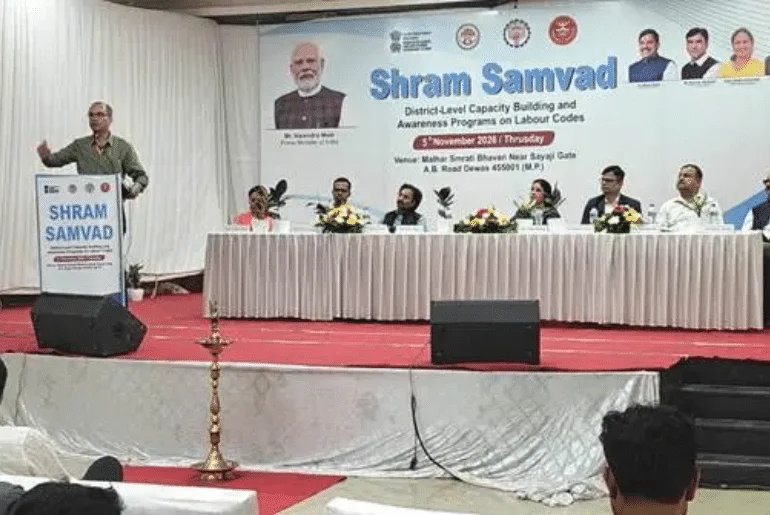
The Ministry of Labour and Employment (MoLE), Government of India, in a significant collaborative effort with the Labour Department, Government of Madhya Pradesh, successfully orchestrated a district-level capacity-building and awareness programme, "Shram Samvad," in Dewas, Madhya Pradesh, on November 5, 2026. This pivotal initiative, organised in association with the Association of Industries Madhya Pradesh and Sun Pharmaceutical Industries, marked a proactive step towards ensuring the seamless implementation of India’s transformative labour reforms. The programme’s core objective was to enhance awareness among a wide array of stakeholders, including employers, human resources (HR) professionals, legal experts, and finance specialists, regarding the intricacies of the new Labour Codes and the comprehensive rules framed thereunder. Beyond mere dissemination of information, "Shram Samvad" aimed to fortify institutional capacity concerning labour reforms, welfare provisions, and social protection mechanisms, simultaneously fostering enhanced coordination between the Central and state governments and encouraging deeper engagement with industry stakeholders.
A Crucial Dialogue for Labour Reform
The "Shram Samvad" programme served as a vital forum, convening senior officials from key governmental and statutory bodies alongside representatives from the industrial sector. Esteemed attendees included delegates from the Ministry of Labour and Employment, the Madhya Pradesh Labour Department, the Employees’ Provident Fund Organisation (EPFO), the Employees’ State Insurance Corporation (ESIC), the Chief Labour Commissioner (Central), and the Directorate General Labour Welfare (DGLW). The event witnessed the participation of over 100 individuals representing diverse facets of industry, encompassing employers, and professionals from HR, legal, and finance functions. This multi-stakeholder gathering underscored the collaborative spirit essential for navigating the complexities of modern labour legislation. The interactive nature of the programme was designed to bridge potential information gaps and foster a shared understanding of the operational aspects and compliance responsibilities inherent in the new labour framework.
Navigating India’s Labour Code Transformation: A Background
The genesis of India’s current labour reform agenda lies in the government’s ambitious vision to consolidate and streamline the country’s antiquated and fragmented labour laws. For decades, India operated under a labyrinthine system of over 40 central labour laws and numerous state-specific legislations, a structure often criticised for its complexity, rigidity, and administrative burden. This multi-layered regulatory environment was perceived as an impediment to industrial growth, ease of doing business, and often, inconsistent worker protection.
Recognising these challenges, the Government of India embarked on a comprehensive reform exercise, culminating in the parliamentary passage of four landmark Labour Codes between 2019 and 2020:
- The Code on Wages, 2019: Replaced four existing laws related to wages, bonuses, and equal remuneration, aiming to ensure universal minimum wage and timely payment.
- The Industrial Relations Code, 2020: Consolidated three major laws governing industrial disputes, trade unions, and standing orders, seeking to balance worker rights with employer flexibility.
- The Code on Social Security, 2020: Amalgamated nine laws related to provident fund, ESI, gratuity, maternity benefits, and other social security provisions, aspiring for universal social security coverage.
- The Occupational Safety, Health and Working Conditions Code, 2020: Replaced 13 existing laws concerning safety, health, and welfare standards in various establishments, focusing on a safe and healthy working environment.
These codes represent a monumental shift, designed to simplify compliance, enhance ease of doing business, promote formalisation of the workforce, protect workers’ rights, and adapt to the evolving dynamics of the global economy. While the codes have been passed by Parliament, their effective implementation hinges on the notification of corresponding rules by both the Central and State governments, and critically, a thorough understanding by all affected parties. The "Shram Samvad" programme in Dewas is a testament to the government’s sustained commitment to this final, crucial phase of implementation.
The Legislative Journey and Implementation Imperatives
The journey of India’s labour codes began with their initial introduction in Parliament, followed by extensive deliberations, committee reviews, and subsequent passage. The Code on Wages was the first to be enacted in 2019, followed by the remaining three codes in 2020. However, the operationalisation of these codes requires the notification of detailed rules, which provide the framework for their practical application. The Central Government has been progressively notifying these rules, and state governments are in the process of formulating and notifying their own state-specific rules, which must align with the central framework. This phased approach, while necessary for meticulous implementation, often creates a period of uncertainty and a significant learning curve for businesses and their compliance teams.
The delay between the enactment of the codes and their full implementation has underscored the imperative for robust capacity-building and awareness initiatives. Businesses, particularly Micro, Small, and Medium Enterprises (MSMEs) which constitute a substantial part of India’s industrial landscape, often lack the dedicated resources or legal expertise to fully comprehend and adapt to such sweeping legislative changes. Without adequate guidance, the risk of non-compliance increases, potentially leading to legal penalties, industrial unrest, and administrative inefficiencies. Therefore, programmes like "Shram Samvad" are not merely informative sessions but critical interventions aimed at de-risking the transition and ensuring a smooth paradigm shift in labour administration. The choice of Dewas, an industrial hub in Madhya Pradesh, highlights a strategic focus on regions with significant manufacturing and employment activities, where the impact of these reforms will be most acutely felt.
Shram Samvad: A Day of Intensive Engagement
The "Shram Samvad" programme on November 5, 2026, was structured as a comprehensive one-day event, meticulously designed to maximise knowledge transfer and foster interactive learning.
Technical Deep Dives into Compliance:
The core of the programme consisted of a series of intensive technical sessions led by seasoned officials from the Ministry of Labour and Employment. These sessions meticulously dissected the compliance requirements under each of the four Labour Codes and the Central Rules notified under them. Rather than a superficial overview, the discussions delved into the practical nuances of the new framework, providing clarity on:
- The Code on Wages: Explanations covered the new definitions of wages, the universal applicability of minimum wages, timely payment of wages, and the simplified procedures for calculating and disbursing bonuses.
- The Industrial Relations Code: Insights were provided on changes related to industrial disputes, retrenchment, layoffs, standing orders, and the formation and recognition of trade unions, with an emphasis on fostering industrial harmony.
- The Code on Social Security: Officials elaborated on the expanded scope of social security benefits, including provident fund, ESI, gratuity, and maternity benefits, aiming for wider coverage and portability of benefits for workers across various sectors.
- The Occupational Safety, Health and Working Conditions Code: Sessions focused on employer responsibilities regarding workplace safety, health standards, welfare facilities, and working hours, particularly for women and contract workers, ensuring a safe and conducive work environment.
These sessions moved beyond theoretical explanations, offering practical guidance on the operational aspects of the new labour framework. The intent was to equip organisations and their compliance teams with actionable knowledge, enabling them to better understand their statutory obligations and prepare for effective, timely implementation. Case studies and hypothetical scenarios were reportedly used to illustrate complex provisions, making the information more accessible and relatable for participants.
Bolstering Social Security Initiatives:
Beyond the Labour Codes, the programme dedicated significant attention to crucial government social-security initiatives. Representatives from the Employees’ Provident Fund Organisation (EPFO) and the Directorate General Labour Welfare (DGLW) conducted dedicated sessions on two flagship schemes:
- Pradhan Mantri Viksit Bharat Rozgar Yojana (PMVBRY): While specific details of PMVBRY are context-dependent and evolve, the session likely focused on its objectives related to employment generation, skill development, and formalisation of the workforce, potentially outlining incentives for employers to create new jobs and benefits for new employees. Officials would have clarified eligibility criteria, application processes, and the role of employers in facilitating worker enrollment.
- Pradhan Mantri Shram Yogi Maandhan (PM-SYM) Scheme: This scheme, primarily aimed at providing old age protection and social security to unorganised workers, was explained in detail. The session likely covered eligibility (age, income), the voluntary and contributory nature of the pension scheme, the government’s matching contribution, and the benefits of a guaranteed minimum pension. Employers were informed about their role in encouraging and facilitating their unorganised workforce to enrol in such vital schemes, underscoring their broader social responsibility.
These sessions highlighted the government’s dual approach: reforming labour laws for ease of doing business and simultaneously strengthening the social safety net for India’s vast workforce.
Empowering Resources and Interactive Dialogue:
To further support employers and compliance professionals in their transition, the Ministry of Labour and Employment distributed two invaluable resources during the programme:
- "Handbook of Compliance for Employers": This comprehensive guide was designed as a practical, ready-reckoner, consolidating key compliance requirements, checklists, and procedural details under the new Labour Codes. Its aim was to simplify the navigation of complex legal provisions.
- "Compilation of Frequently Asked Questions (FAQs)": This document addressed common queries and ambiguities that typically arise during the implementation of new legislation. It provided clear, concise answers to practical questions, acting as a quick reference tool for on-the-spot clarifications.
The programme culminated in a highly anticipated interactive question-and-answer session. This segment offered participants an invaluable opportunity for direct engagement with policymakers and enforcement authorities. Attendees raised specific queries, sought clarifications on intricate points of labour legislation, compliance requirements, and the nuances of social-security provisions. This direct dialogue mechanism proved crucial, allowing for real-time problem-solving and dispelling misconceptions, thereby fostering greater confidence among the industry representatives regarding their compliance journey. The candid exchange reportedly covered a wide range of topics, from practical challenges in payroll integration to the interpretation of specific clauses related to working hours and welfare facilities.
Perspectives from Stakeholders: A United Front
The "Shram Samvad" in Dewas exemplified a concerted effort from all parties to ensure a smooth transition to the new labour regime.
Government’s Vision: Ease of Doing Business and Worker Welfare:
Officials from the Ministry of Labour and Employment, including senior representatives, consistently highlighted the government’s overarching vision. They underscored that the Labour Codes were not merely about deregulation but about creating a more transparent, efficient, and equitable labour ecosystem. "These reforms are designed to foster a dynamic industrial environment that attracts investment, creates jobs, and simultaneously safeguards the rights and welfare of every worker," an official from MoLE was understood to have stated during the programme. They emphasised the government’s commitment to simplifying compliance procedures, reducing the administrative burden on businesses, and providing a stable regulatory framework that promotes both industrial growth and social justice. The collaboration with the Madhya Pradesh Labour Department was cited as a model for how central and state agencies are working in tandem to deliver these reforms at the grassroots level.
Industry’s Reception: Seeking Clarity and Collaboration:
Industry representatives and employers attending the programme expressed appreciation for the government’s proactive outreach. The Association of Industries Madhya Pradesh, a key partner, reportedly welcomed the initiative, acknowledging the significant impact of the Labour Codes on their operations. "The new Labour Codes represent a fundamental shift, and programmes like ‘Shram Samvad’ are absolutely vital for us to understand our responsibilities and ensure seamless compliance," a representative from the Association of Industries Madhya Pradesh was inferred to have remarked. They emphasised that while the intent of simplifying laws is laudable, the practical implementation requires clear guidance and ongoing dialogue. The direct interaction with MoLE and state labour department officials was particularly valued, as it provided an opportunity to articulate industry-specific challenges and seek direct solutions. Sun Pharmaceutical Industries, as a co-organiser, reiterated its commitment to compliant and ethical labour practices, recognising the importance of such forums for fostering a well-informed industrial community.
Beyond Dewas: Broader Implications of Labour Reform
The "Shram Samvad" programme, while focused on a district level, carries broader implications for India’s labour landscape and its economic future.
Impact on Employers and Industrial Relations:
For employers, the long-term implications of these reforms, once fully understood and implemented, are expected to be largely positive. A simplified and consolidated legal framework should ultimately reduce the compliance burden, minimise legal ambiguities, and streamline HR and payroll processes. This clarity can lead to better risk management, reduced litigation, and a more predictable operating environment. By fostering a clearer understanding of rights and responsibilities, the codes are also anticipated to improve industrial relations, promoting harmony between management and workers through clearly defined processes for dispute resolution and grievance redressal. The emphasis on formalisation and social security can also contribute to a more stable and motivated workforce, enhancing productivity and reducing attrition in the long run.
Enhancing Worker Protection and Social Security:
For the vast workforce of India, especially those in the unorganised sector, the Labour Codes promise enhanced protection and expanded social security coverage. The universalisation of minimum wages, the portability of social security benefits, and the emphasis on occupational safety and health standards are designed to improve the quality of life and working conditions for millions. The focus on schemes like PMVBRY and PM-SYM, as highlighted in the Dewas programme, underscores the government’s commitment to building a robust social safety net that extends beyond traditional organised employment, aiming to provide dignity and security to all workers, including contract and gig workers.
Towards a Unified and Dynamic Labour Landscape:
The collaborative nature of "Shram Samvad," bringing together central and state governments, statutory bodies, and industry, is crucial for fostering a unified approach to labour administration across the country. This harmonisation is critical for ensuring that the benefits of the reforms are uniformly realised, preventing regulatory arbitrage, and creating a truly national labour market. The simplified framework is also expected to enhance India’s attractiveness as an investment destination, as businesses prefer stable and predictable regulatory environments. By facilitating easier entry and exit, and streamlining compliance, the codes aim to unlock India’s economic potential, encouraging both domestic and foreign investment.
The Road Ahead: Sustained Engagement for National Impact
The success of the "Shram Samvad" programme in Dewas serves as a blueprint for similar initiatives across the nation. While significant progress has been made in legislating the Labour Codes, their true impact will be realised through sustained engagement, continuous capacity building, and proactive communication. The Ministry of Labour and Employment, in conjunction with state labour departments, will need to continue organising such awareness drives, workshops, and dialogues to ensure that every stakeholder, from the largest industrial conglomerate to the smallest enterprise, is equipped with the knowledge and tools necessary for effective compliance. This ongoing dialogue is vital not only for disseminating information but also for gathering feedback from the ground, allowing for iterative improvements in implementation strategies and addressing unforeseen challenges. The "Shram Samvad" in Dewas is a powerful testament to the government’s dedication to ushering in a new era of labour relations in India – one that balances economic growth with social justice and worker welfare.