The rapid integration of Artificial Intelligence (AI) into hiring processes has spurred a wave of regulatory responses across the United States and globally. However, a common pitfall for employers is the tendency to treat these AI hiring laws as a monolithic category, applying a one-size-fits-all compliance strategy. This approach is fundamentally flawed, as evidenced by the distinct timelines, enforcement mechanisms, and definitions of compliance governing each piece of legislation. As of late 2023 and extending into 2027, companies hiring across state lines face a complex web of four separate obligations, each with its own unique set of requirements and enforcement schedules. Misunderstanding or mismanaging these distinct legal frameworks can lead to significant compliance gaps, potentially resulting in misrepresentations to candidates or regulators, and exposing organizations to legal and financial repercussions.
The Shifting Sands of AI Regulation: A Jurisdictional Breakdown
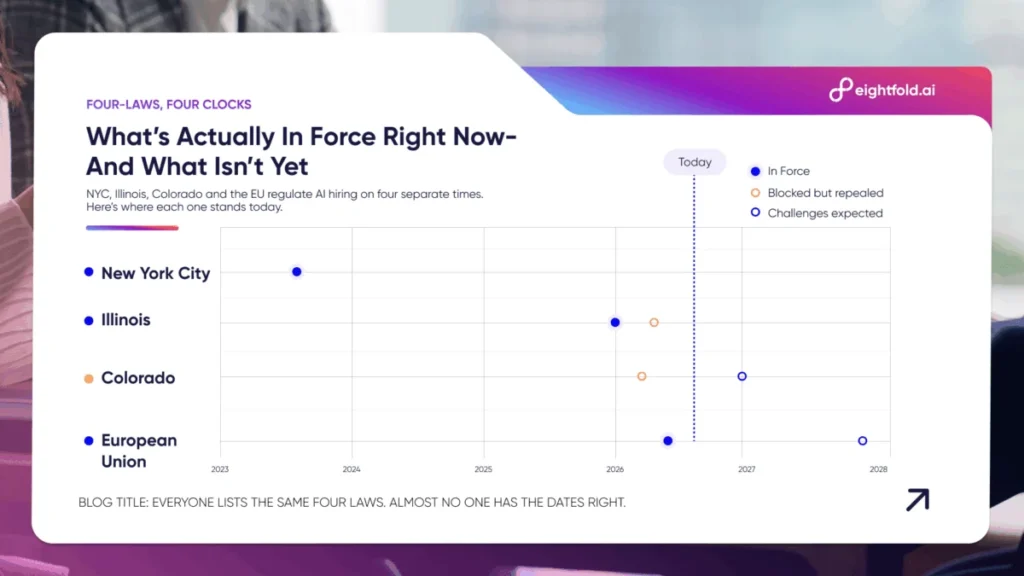
Compliance checklists often present AI hiring laws with equal weight, a practice that fails to acknowledge the nuanced realities of their implementation. The urgency and operational impact of each law vary significantly, with some facing judicial challenges before their effective dates and others experiencing substantial legislative delays that themselves become codified law. For employers operating in multiple jurisdictions, this is not a trivial detail; it represents four distinct compliance timelines, each demanding a tailored approach to achieving "compliant" status. An error in even one date can lead to the unfortunate scenario of assuring a candidate or a regulator that a control is in place when it is not yet operational, or conversely, claiming a regulation does not apply when it already does.
New York City Local Law 144: A Pioneer in AI Hiring Oversight
New York City stands as a trailblazer in regulating AI in employment with Local Law 144, which took effect on July 5, 2023. This legislation mandates that any automated tool used to evaluate candidates for NYC-based roles must undergo an independent bias audit annually. The results of these audits, including selection rates and impact ratios by demographic category, along with the audit date and data sources, must be published in an accessible format for candidates. Furthermore, employers are required to provide candidates with advance notice – at least ten business days before the tool is used – informing them of its deployment and offering instructions on how to request an alternative selection process. Enforcement of Local Law 144 falls under the purview of the NYC Department of Consumer and Worker Protection. The absence of a current, independently verified audit renders an AI tool non-compliant, irrespective of its performance metrics. This early implementation provides a crucial, albeit limited, track record for other jurisdictions to observe.
Illinois HB 3773: Integrating AI into Existing Civil Rights Frameworks
In Illinois, the approach to AI in employment, codified in HB 3773, takes a different path. Effective January 1, 2026, this legislation does not establish a new audit regime. Instead, it seamlessly integrates the use of AI-assisted employment decisions into the state’s existing Human Rights Act. Employers are obligated to notify candidates when AI plays a role in hiring, promotion, discipline, or discharge decisions. Crucially, they must be prepared to explain the functionality of these tools in plain language. The law clarifies that discriminatory outcomes stemming from AI are not treated as novel "AI" violations but are prosecuted under the same established framework as human decision-making, a principle the state has enforced for decades. The notion of "the algorithm decided, not us" is explicitly rendered an invalid defense. A notable development occurred in June 2026 when the Illinois Department of Human Rights withdrew its proposed implementing rules to facilitate further coordination with other state agencies, leaving a revised timeline uncertain. However, the statute’s core notice and non-discrimination duties remain in full effect, meaning employers must comply even without finalized regulatory guidance on specific notice language or timing.
Colorado Senate Bill 26-189: A Revised Approach to AI Governance
Colorado’s journey with AI regulation has been marked by significant shifts. The original Colorado AI Act (SB 24-205), initially slated to be one of the nation’s most stringent frameworks, mandating impact assessments, an explicit duty to prevent algorithmic discrimination, and ongoing risk-management programs, never came into effect as written. In April 2026, a federal court blocked its enforcement following a constitutional challenge. Under pressure from legal challenges and industry opposition, Colorado’s legislature repealed the original act and enacted Senate Bill 26-189 in May 2026. The revised legislation, effective January 1, 2027, presents a considerably less burdensome framework. It requires advance notice to individuals before the use of "covered automated decision-making technology," a plain-language explanation within 30 days of an adverse decision, a right to request data correction, and a right to request human reconsideration "to the extent commercially reasonable." The phrase "to the extent commercially reasonable" acts as a significant qualifier, not an unconditional guarantee. Reports suggest that legal challenges to this revised version are anticipated, underscoring the need to view January 2027 as a target date rather than a settled compliance reality.
The European Union AI Act: A Comprehensive Regulatory Framework
The European Union’s AI Act represents a broad and ambitious regulatory endeavor. High-risk hiring obligations, which explicitly include recruitment and employee-evaluation tools, are set to become effective on December 2, 2027, following a deferral from August 2026 as part of Regulation (EU) 2026/1744, which entered into force in July 2026. This phase will mandate risk management, technical documentation, human oversight, and formal conformity assessments. Notably, Article 50’s transparency duty, requiring that candidates interacting with AI interviewers be informed that they are speaking with AI, was never delayed and is already in effect. Non-compliance with high-risk provisions can result in substantial penalties, with fines reaching up to €15 million or 3% of global annual turnover, placing it within the middle tier of sanctions, below the €35 million/7% ceiling reserved for prohibited AI practices.

Federal Anti-Discrimination Laws: The Enduring Baseline
It is crucial to recognize that none of these AI-specific regulations supersede existing federal anti-discrimination laws. Title VII of the Civil Rights Act of 1964, the Americans with Disabilities Act (ADA), and the Age Discrimination in Employment Act (ADEA) continue to apply to covered employers, regardless of whether decisions are made by humans or AI. The Equal Employment Opportunity Commission (EEOC) provides guidance alongside these statutes, with its 2022 ADA technical assistance and 2023 Title VII guidance addressing algorithmic risks. However, these are not enacted AI-specific laws themselves. The results of a vendor’s audit do not absolve an employer of its own legal responsibilities under these foundational anti-discrimination statutes.
Understanding the Divergent Compliance Levers
A clear delineation of the compliance mechanisms employed by these four jurisdictions reveals their fundamental differences:
- New York City: Employs an "audit-and-publish" model, requiring annual public disclosure of bias audit results to maintain compliance, irrespective of intent.
- Illinois: Integrates AI compliance into its existing civil rights framework, meaning AI-assisted decisions are judged by the same standards as human decisions under the Human Rights Act.
- Colorado: Following its legislative revision, adopts a "notice-and-recourse" approach, mandating advance notification, post-decision explanations, and conditional avenues for human review.
- European Union: Operates under a "product-safety" paradigm, demanding classification, documentation, assessment, and pre-market approval for AI tools deemed high-risk, akin to medical device regulation.
While the underlying concern for fairness and equity in hiring is common across all four, the methods of ensuring employer accountability are distinctly varied. A vendor that can only address one of these compliance models is ill-equipped to serve clients operating in multiple jurisdictions.
Developing a Robust and Dynamic AI Hiring Compliance Strategy
The creation of an effective AI hiring compliance checklist necessitates a departure from the simplistic, one-bullet-per-law approach. It requires a granular understanding of each jurisdiction’s specific requirements, timelines, and enforcement mechanisms. This includes:
- Mapping Jurisdictional Overlap: Identifying which laws apply based on the location of the candidate, the job role, and the employer’s operational footprint.
- Dynamic Timeline Management: Establishing a system to track and manage the distinct effective dates and any potential delays or legislative changes for each applicable law.
- Tailored Audit and Assessment Protocols: Implementing bias audits and risk assessments that meet the specific requirements of each jurisdiction, rather than a generic standard.
- Transparent Communication Frameworks: Developing clear and consistent communication strategies for candidates regarding the use of AI, including required notices and opt-out or alternative process options.
- Vendor Due Diligence: Scrutinizing AI vendors to ensure their tools and services align with the compliance obligations of all relevant jurisdictions. This includes understanding contractual allocations of responsibility, but never abdicating the employer’s ultimate accountability.
- Regular Review and Updates: Given the dynamic nature of AI regulation, establishing a cadence for reviewing and updating compliance strategies, at a minimum quarterly, and whenever new AI tools are introduced or employment locations change.
What Remains Unaddressed: The Nuances Beyond the Law
While these AI hiring laws provide a legal framework, they do not fully address all the complexities involved. Key areas often left undefined include:
- Validity of Bias Audits: The laws typically do not specify the statistical rigor required for a bias audit to be considered valid. Questions regarding appropriate sample sizes and the distinction between genuine bias and statistical anomalies remain largely unaddressed, presenting a significant challenge for auditors and employers alike. This is often a mathematical rather than a legal question, and one that is frequently overlooked in public discourse.
- Legal Counsel is Indispensable: The effective dates of these regulations are subject to change, as demonstrated by the frequent shifts observed in the legislative processes. Relying solely on information from blog posts or general guidance is insufficient. Employers must consult with legal counsel to confirm the current statutory text and applicability of these laws before implementing any compliance measures.
Frequently Asked Questions: Clarifying Key Compliance Concerns
- Do EU deadlines affect US obligations? No, each jurisdiction’s timeline operates independently. Employers must meet all currently enforced deadlines relevant to their operations, regardless of pending regulations elsewhere.
- Is an employer liable for vendor tools? Yes, employers remain ultimately responsible for their use of AI tools. While vendor contracts can delineate tasks, they do not remove the employer’s employment law exposure. Human oversight at material decision points is paramount.
- Is a Local Law 144 alternative process the same as an ADA accommodation? No, these are distinct processes with separate procedures and do not substitute for one another.
- What are the duties of staffing firms? Under the EU AI Act, firms developing or significantly modifying AI tools are considered "providers" with documentation duties. Those merely using them for recruitment are "deployers" following provider instructions. Both roles carry distinct obligations that should be clearly defined in contracts, with legal counsel.
- How does location impact AI law coverage? Coverage is determined by a multi-factor analysis of the candidate’s location, the job role’s location, and the employer’s operational presence. For example, NYC’s law can apply based on the job’s location even if interviews occur remotely. Remote work arrangements require careful, jurisdiction-specific legal review.
- What if an NYC audit is older than 12 months? The AI tool cannot be used for covered NYC hiring activities until a current, independent bias audit is completed and the required summary is published.
- How frequently should this compliance map be reviewed? At a minimum, quarterly reviews are recommended. Additionally, reviews should be conducted before launching any new AI tool or expanding into new job locations, as these regulatory timelines evolve more rapidly than traditional annual policy cycles.
In conclusion, the evolving landscape of AI hiring laws presents a complex challenge for employers. A nuanced understanding of each regulation’s unique requirements, timelines, and enforcement mechanisms is essential for effective compliance. Moving beyond simplistic checklists and embracing a dynamic, jurisdiction-aware approach, supported by expert legal counsel, is the only way to navigate this intricate regulatory environment successfully.