The modern Chief Learning Officer (CLO) faces a paradox that no traditional dashboard can fully capture. In a typical scenario, a corporate team is tasked with deploying an artificial intelligence copilot across multiple business units. The mandate includes building an enablement curriculum, certifying every manager, and tracking completion rates on an interactive development dashboard. On paper, the initiative appears successful: every box is checked, and every milestone is met. However, as eighteen months pass, a stark divide emerges within the workforce. While a handful of teams have integrated the tool into their daily workflows—effectively rewriting how they draft, review, and hand off work—others remain stagnant. For the latter group, the AI tool remains open but unclicked, viewed as just another corporate mandate to be outlasted.
The divergence in AI adoption highlights a critical failure in organizational communication. Research into these "silent rollouts" suggests that the issue is rarely the technology itself, but rather a lack of knowledge circulation. Early adopters often fail to share their breakthroughs, while those struggling avoid revealing their difficulties. Both groups are driven by the same underlying logic: the fear of exposure. Admitting to a lack of proficiency feels like a confession of falling behind, while surfacing an unofficial workaround carries the risk of being labeled as "going rogue." By the time a CLO schedules a refresher course, the technology has inevitably evolved, leaving the organization’s collective knowledge perpetually out of sync with the tools they are expected to master.
The Shift from AI Investment to AI Integration
The scale of this challenge is expanding as organizations significantly increase their financial commitments to generative AI. Current market trends indicate that enterprises are moving to roughly double their AI investment as a share of total revenue. According to a recent report by the Boston Consulting Group (BCG), 72 percent of CEOs are now personally directing AI strategy, signaling that technological capability is no longer just an IT concern but a core pillar of corporate leadership. Despite this high-level attention, a significant gap remains between investment and implementation.
Deloitte’s Global Human Capital Trends report identifies that seven in 10 business leaders view speed and organizational nimbleness as their primary competitive strategy through 2029. Yet, 59 percent of organizations continue to take a purely technology-focused approach to AI deployment. The data suggests this is a strategic error: organizations that prioritize technical rollout over human-centered design are 1.6 times more likely to fall short of their expected returns. To bridge this gap, AI initiatives must be designed with trust, judgment, and psychological safety at their core.
A Chronology of the Modern AI Rollout
To understand why traditional methods are failing, it is necessary to examine the typical chronology of an AI implementation and where the "cascade" model breaks down.
Phase 1: The Top-Down Mandate (Months 1–3)
Leadership identifies a need for AI integration. Strategy is set at the executive level, and a "cascade" of information begins. Training modules are developed, and KPIs are established based on completion rates.
Phase 2: The Silent Divergence (Months 4–9)
As teams begin to use the tools, two distinct cultures emerge. "Power users" find shortcuts and efficiencies but keep them within their immediate circles to maintain a competitive edge or avoid scrutiny. Meanwhile, struggling employees mask their confusion to appear "AI-ready."
Phase 3: The Curriculum Lag (Months 10–14)
The L&D department releases updated training based on data that is now six months old. Because the "circulation" of real-time feedback is blocked by a lack of psychological safety, the training fails to address the actual hurdles employees are facing on the frontline.
Phase 4: The Stagnation Point (Months 15–18)
The organization reaches a plateau. Usage statistics remain flat, and the "gift" of productivity promised by AI remains unquantifiable. The CLO realizes that while the tool has been adopted, the learning has not been socialized.
The Managerial Readiness Gap
The burden of successful AI integration often falls on middle management, yet evidence suggests this group is the least prepared for the transition. Udemy’s 2026 Global Learning and Skills Trends Report reveals a troubling discrepancy: while 88 percent of employees believe effective leadership is critical to the success of AI initiatives, only 48 percent believe their own managers are actually "AI-ready."
This creates a "frozen middle" where managers, who are expected to reinforce AI usage, are themselves too intimidated to admit they do not understand the technology. The reinforcement that L&D departments depend on most is the weakest link in the chain. Consequently, the central question for L&D leaders has shifted. It is no longer about "what" to teach regarding AI, but "how" knowledge moves through the organization.
From Cascade to Circulation: A New Architecture for Learning
The traditional "cascade" model of learning assumes that knowledge is designed at the top and pushed downward in a unidirectional flow. This model is inherently a "single-loop" learning system—it can adjust an output to correct an error, but it rarely questions the underlying assumptions that produced the error.

In contrast, a "circulation" model utilizes "double-loop" learning. This approach encourages the frontline to act as a source of information rather than just a destination. In an adaptive leadership framework, systems are designed to be multidirectional. For this to work, employees must believe two things: that their feedback will lead to actual change and that speaking up will not be used against them.
Industry analysts suggest that "circulation" requires a humanizing mindset. This involves leaders modeling their own "not-knowing" in real time. When a senior executive admits to fumbling a prompt or failing to understand an AI-generated output, it sets a cultural norm that allows others to do the same. This vulnerability is the engine of psychological safety, which in turn fuels the circulation of knowledge.
Agentic AI as a Listening Partner
Ironically, the same technology that is disrupting traditional workflows may provide the solution to the learning gap. The emergence of "agentic AI"—systems capable of independent pattern recognition and trend prediction—offers a new way for organizations to learn from themselves.
Forward-thinking organizations are beginning to use AI as an early-warning system. By analyzing anonymized data across various departments, AI can flag instances where unconnected teams have independently developed unique use cases or workarounds. This allows L&D teams to identify "pockets of innovation" that would otherwise remain hidden in departmental silos.
However, experts warn that this must be implemented with extreme caution. The moment a sensing tool is perceived as surveillance, the candor it requires to function effectively will disappear. To maintain trust, these AI listening mechanisms must be publicly named, opted into, and never used to identify individuals who are "behind" in their adoption.
The New Curriculum: Judgment and Power Skills
As AI increasingly handles the "how" of technical tasks—such as drafting financial models or generating code—the focus of corporate learning is shifting toward judgment. This is what many industry experts now call the "true curriculum."
When a tool can provide a procedural answer on demand, the employee’s value shifts to:
- Knowing when to trust the output.
- Knowing how to interrogate the output for bias or inaccuracy.
- Understanding the ethical implications of the AI’s suggestions.
Reflexivity, the capacity to sit with ambiguity, and interpersonal sensitivity are no longer "soft skills" but "power skills." They are the load-bearing elements of a team that must constantly recombine human and machine capabilities.
Implications for Organizational Structure
The shift toward AI-driven circulation is also forcing a redesign of how potential is measured. Traditionally, potential was defined by what an individual could be trained to do within a fixed job description. In the AI era, potential is defined by how quickly a team can reconfigure itself around the demands of a specific project.
This "team-level" systems mindset treats the organizational chart as fluid. Teams are assembled based on trait-mapping—matching specific strengths like "future focus" or "execution" to a project’s needs—and then embedding AI into that specific context. This fluidity is only possible when the culture frames reconfiguration as an opportunity for growth rather than an exposure of individual inadequacy.
Strategic Recommendations for the Next Two Quarters
For organizations looking to transition from a cascade to a circulation model, the following steps are recommended:
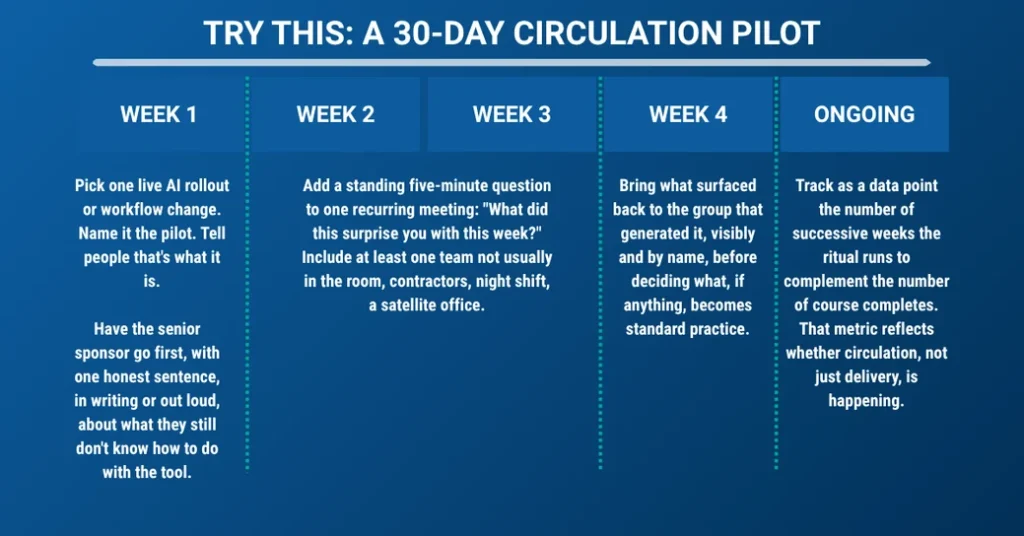
- Implement Rapid-Cycle Inquiry: Instead of long-form surveys, use short, structured bursts of authentic listening. Build a five-minute "inquiry slot" into standing meetings where managers and frontline teams can discuss what they have discovered or where they have struggled with AI tools.
- Model Vulnerability: Require senior leaders to publicly share their own learning curves. A leader admitting, "I still haven’t mastered this specific prompt," can do more for adoption than a dozen mandatory training modules.
- Widen the Sensing Mechanism: Ensure that the "listening" includes those often left out of corporate strategy sessions, such as contract staff, night-shift teams, and frontline workers. Their practical, hands-on experience often produces the most valuable workarounds.
- Shift to Trait-Mapping: Begin evaluating teams based on their collective ability to leverage AI, rather than individual compliance with a curriculum.
Conclusion: The CLO as Learning Architect
The role of the Chief Learning Officer is undergoing a fundamental transformation. In an environment defined by volatility, the CLO can no longer simply be a "curriculum owner." They must become a "learning architect," designing systems that produce connection, resilience, and continuous learning.
AI has opened a portal for organizational transformation, but the technology is only as effective as the human network it supports. The ultimate competitive advantage in the modern economy is not the possession of the most advanced AI tool, but the ability to create a culture where people feel safe to share what they know and admit what they do not. Organizations that successfully circulate knowledge will outpace those that merely attempt to cascade it, turning their collective intelligence into a dynamic, ever-evolving asset.