A recent summit held in the Chicago area, co-hosted by workforce strategist Ian Ziskin and innovation expert Cheryl Perkins, brought together a diverse group of chief human resource officers (CHROs), chief executive officers (CEOs), academics, coaches, and workforce strategists. The objective was to conduct an unvarnished examination of the prevalent challenges within the modern workplace and to explore innovative solutions for the future. The gathering, attended by HR Executive, served as a critical forum for candid dialogue, aiming to pivot leaders from a state of frustration to one of proactive possibility.
"Organizations are navigating unprecedented levels of complexity," stated Cheryl Perkins, setting a somber yet determined tone for the proceedings. "Leaders are balancing significant workforce shifts, the accelerating integration of artificial intelligence, evolving employee expectations, and a constant state of change, all while striving to cultivate healthy, high-performing organizations." She emphasized that the summit was specifically designed to foster the kind of open and honest discourse necessary for addressing these multifaceted issues. "When individuals come together across diverse organizations and disciplines to challenge deeply held assumptions, new pathways inevitably emerge for creating work environments that are more human, more effective, and fundamentally more sustainable," Perkins added.
A central theme that emerged from the discussions was the pervasive misdiagnosis of workplace issues. Many organizations, it was argued, are convinced they are undergoing a purely technological transformation when, in reality, the more profound challenge lies in a human transformation. The symptoms of this fundamental mismatch are widely observable: widespread change fatigue, declining workforce engagement, overwhelming leadership burdens, and fragmented technology adoption often trace back to this core disconnect.
Josh Greenwald, Chief People Officer at Sword Health, articulated this point forcefully, stating, "I believe we are approaching the concept of AI transformation incorrectly. This is fundamentally more about human transformation. We tend to place an overemphasis on the technology itself. Technology, in its essence, is merely the medium that empowers us to become smarter." This perspective underscores a growing sentiment that technological solutions are being implemented without a sufficient understanding of their human implications and the necessary organizational shifts required for their successful integration.
The "Low Tide" Phenomenum: Revealing Deep-Seated Organizational Issues
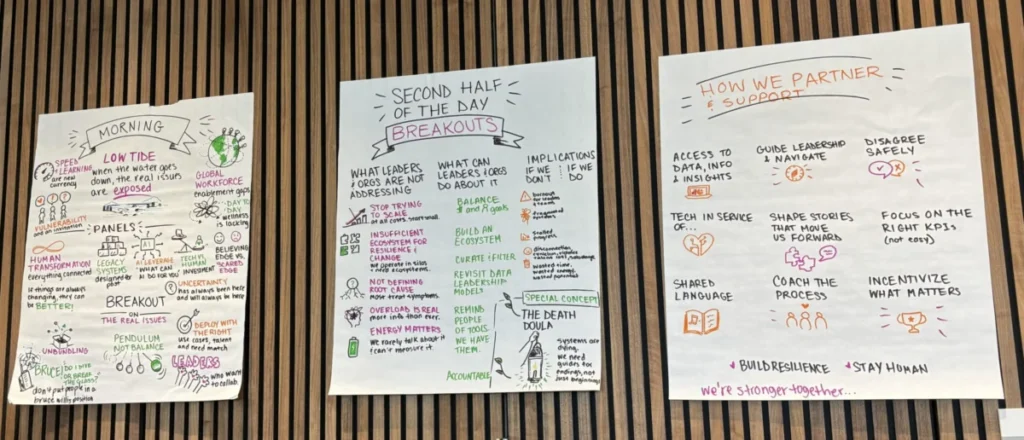
The summit featured several panel discussions that delved into the challenges confronting leaders and the urgent need for organizational reevaluation. Jamie Jacobs, CEO of Gig Talent, introduced the concept of the "low tide" problem. He explained that during periods of economic prosperity, organizations often neglect to address underlying systemic issues. However, as economic conditions tighten, much like a receding tide revealing what lies beneath the surface, these long-standing problems become starkly apparent. "We are now seeing the things that were previously submerged," Jacobs observed. "Legacy organizational systems, leadership models that were designed for a vastly different era – these are the root causes that are now coming to light."
Stela Lupushor, Founder of Reframe.Work Inc. and a faculty member at NYU, highlighted the maturing intersection of human-centered design and technology investment. However, she noted that many organizations still erroneously focus on technology adoption as the primary goal, rather than pursuing more substantial organizational gains. This often leads to the deployment of AI across disparate, siloed systems. The result, according to Srikant Chellappa, CEO of Engagedly, is the generation of only modest efficiencies, leading to a premature conclusion that the investment has failed. "No systems are communicating effectively with each other," Chellappa stated. "Deploying AI with the right use cases, in the right context… frankly, nobody truly knows what that looks like yet." This lack of integration and strategic understanding hinders the realization of AI’s full potential.
Furthermore, the summit addressed the evolving nature of employment. Anthony Nyberg, Director of the Center for Executive Succession at the University of South Carolina’s Darla Moore School of Business, pointed out that shifting patterns in traditional employment, the rise of gig and fractional work arrangements, and the increasing emphasis on skills-based organizations are all responses to mounting pressures. He noted that this dynamic environment redistributes burdens in ways that existing policies and support systems were not designed to handle. "The risks are no longer bundled by organizations," Nyberg explained. "They have been transferred onto the workers." This redistribution of risk has significant implications for employee well-being and organizational responsibility.
Leaders in Isolation: The Unseen Burden
A significant concern raised during the summit was the isolation experienced by leaders. Executives are being asked to navigate these complex times while often struggling with their own challenges, and many organizations are failing to provide adequate support. Harriet Harty, Founder and CEO of Harriet Harty Executive Solutions and a former CHRO at Allstate Insurance, expressed her belief that leaders are increasingly operating in silos. "I think leaders are in a silo right now," she said. "They understand what needs to be done, but they lack the clarity regarding their ultimate direction. The ‘how’ has never been explicitly provided to them."

This sense of isolation, according to Liz Huldin, CHRO at Great Day Improvements, is intrinsically linked to talent strategy. Misalignment at the executive level, she argued, leads to dissatisfaction, even among high-performing employees who have invested significantly in their careers but find themselves unable to adapt at the pace required by the current environment.
Gabriel Machado, Director of Contract Manufacturing Services at Rockline Industries, offered a compelling analogy, suggesting that organizations often approach problems like machines to be repaired, rather than gardens to be nurtured. "It’s more about creating the conditions for things to move in the right direction," he explained. "The human element is a significant component of this process." This perspective emphasizes the need for a more organic and people-centric approach to organizational development.
An audience member further illuminated the situation by positing that a deeper issue of trust lies beneath the surface of change management challenges, technology adoption gaps, and workforce readiness concerns. Organizations are moving rapidly, communicating inconsistently, and expecting employees to absorb constant uncertainty without providing the necessary support or resources to make sense of it all. "Where is the conversation in all of this?" the attendee questioned. "Leaders discuss what we plan to say to employees, but we are not necessarily engaging in genuine dialogue with them." This lack of authentic communication erodes trust and exacerbates employee anxiety.
Simplifying the Path Forward: Essential Capabilities for the Modern Workforce
The discussion then shifted towards actionable strategies. Shannon Wallis, Founder of Cascade Leadership, pointed to a significant trend: major employers, including Microsoft and Amazon, have scaled back hiring new graduates. This is largely because entry-level tasks are increasingly being handled by AI agents. Consequently, managers who are expected to assume greater responsibilities have not had the opportunity to develop their leadership skills organically. "You don’t go from zero to ten masterfully," Wallis remarked, highlighting the gap in leadership development.
Jill Wrobel, Executive Vice President and CHRO at Brunswick Corporation, the summit’s host company, shared her organization’s experience with implementing productivity tools that have been well-received by employees. However, she stressed that moving beyond incremental productivity gains requires a fundamental redesign of workflows and strategic business model choices. "In order for the technology investment to pay off, we actually have to change how this works," Wrobel stated, underscoring the need for operational transformation to complement technological adoption.
Josh Greenwald offered a concise framework for cultivating a future-ready workforce, advocating for a focus on core capabilities. "If we can focus on these four areas and avoid overcomplicating it, we can create a whole new generation of the workforce," he proposed. While the specific capabilities were not detailed in the provided text, Greenwald’s sentiment suggests a need for clarity and strategic prioritization in developing essential employee competencies.
Building Resilience in an Era of Disruption
These insights arrive at a critical juncture. As Anthony Nyberg observed, disruption in the current era has a different character than in the past. Earlier waves of automation primarily impacted frontline and operational roles. However, the AI era is fundamentally reshaping knowledge work and management structures. He noted that those with the most influence and power in the workplace are now being disrupted most directly. Paradoxically, these are also the individuals with the greatest capacity to impede change if they feel threatened. "This is the first time in the history of our industrial society that the change is originating from the supervisor level and moving upward," Nyberg remarked, signifying a profound shift in organizational dynamics.
Ian Ziskin, a co-founder of the summit, provided a comprehensive summary of the event’s overarching message. "Fear, uncertainty, and a constant sense of feeling overwhelmed are currently paralyzing leaders and the workforce," he stated. "We must fundamentally rethink our approach to defining and building leadership capabilities and equip all individuals with the tools to feel more change-ready and resilient. While AI is a powerful instrument to assist us, it is by no means a substitute for common sense and the indispensable human touch." This concluding thought encapsulates the core tension between technological advancement and the enduring need for human judgment and connection in navigating the complexities of the modern workplace.
The "What’s Not Working @ Work?" Summit, presented by Ian Ziskin of EXec EXcel Group and Cheryl Perkins of Innovationedge LLC, was supported by sponsors including the Center for Executive Succession at the University of South Carolina, Engagedly, Gig Talent, the Innovation Resource Center for HR, Talent Connections, Cyberhill Partners, and Brunswick Corporation. The event served as a vital platform for critical reflection and forward-thinking dialogue on the challenges and opportunities facing today’s organizations.