
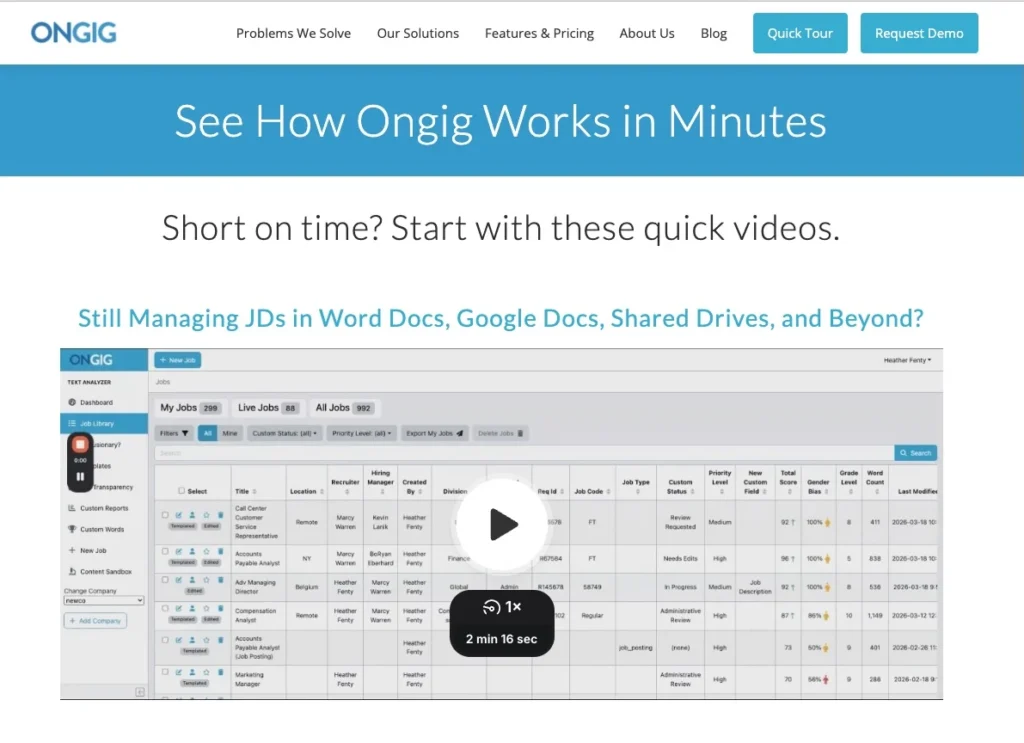
In a strategic move reflecting the contemporary demand for immediate insights and agile information consumption, Ongig, a leading provider of job description management platforms, has unveiled a series of concise, on-demand demo videos. This initiative directly addresses a discernible trend among professionals in the talent acquisition and human resources sectors who, influenced by the speed of AI tools and the ubiquity of quick-form content, seek rapid demonstrations of software capabilities during their initial exploration phase. Authored by Heather Barbour Fenty, a writer with extensive expertise in solving complex HR challenges for recruiters and talent acquisition professionals, this collection of five videos offers a succinct yet comprehensive overview of how Ongig’s platform streamlines the often-cumbersome process of creating, managing, and publishing job descriptions.
The introduction of these quick demos marks a significant pivot from the traditional reliance on lengthy articles or scheduled, full-length custom demonstrations. Fenty noted a pervasive sentiment among prospective clients, stating, "People looking for job description management platforms want quick results during their ‘exploration phase.’ I think it has a lot to do with AI tools being so fast when you ask a question about any topic." This observation underscores a broader shift in B2B software evaluation, where initial engagement increasingly prioritizes instant gratification and self-service learning over time-intensive commitments. The rationale is clear: provide immediate, actionable visual content that addresses core pain points before a deeper dive into a personalized demonstration.
Addressing the Pervasive "Job Description Chaos"
The challenges associated with job description (JD) management are deeply entrenched across organizations of all sizes. Fenty frequently encounters scenarios where companies are still "managing JDs in Google Docs… don’t judge." This candid admission highlights a widespread, albeit often unspoken, operational inefficiency. The landscape of JD management is frequently characterized by disparate systems: shared network drives, outdated Word documents, and a "copy/paste chaos" that inevitably leads to version control nightmares. Such fragmented approaches not only consume valuable time but also introduce significant risks related to inconsistency, compliance, and employer brand integrity.
The traditional manual methods for handling job descriptions – involving multiple stakeholders, email threads, and various document versions – create bottlenecks that hinder efficient recruitment. Recruiters and HR teams often spend an inordinate amount of time simply locating the most current and approved version of a job description, let alone refining its content for optimal candidate engagement and legal compliance. This administrative burden detracts from strategic talent acquisition efforts, leading to recruiter burnout and a slower time-to-hire. Ongig’s quick demo series is specifically designed to illustrate a clear pathway out of this operational quagmire, showcasing what "better" looks like in practical, visual terms.
Chronology of a Modern Problem and a Timely Solution
- Early 2000s – 2010s: The rise of Applicant Tracking Systems (ATS) provides a central hub for candidate data but often treats job descriptions as static text fields, lacking robust content management capabilities. Organizations largely rely on word processors and shared drives for JD creation and storage.
- 2010s – Early 2020s: Increasing regulatory complexity (e.g., OFCCP, GDPR, local pay transparency laws) and a growing emphasis on Diversity, Equity, and Inclusion (DEI) put immense pressure on job descriptions to be accurate, inclusive, and compliant. Employer branding becomes crucial, requiring JDs to be compelling marketing tools. The inefficiency of manual processes becomes more acute.
- Mid-2020s: The proliferation of AI tools sets a new standard for information accessibility and speed. Users expect instant answers and visual demonstrations. The "exploration phase" for B2B software shifts towards rapid, self-guided discovery.
- March 2026: Ongig launches its quick demo video series, directly responding to this evolving user behavior and the long-standing challenges in JD management, offering a modern solution for an enduring problem.
Insights from the Five Quick Demo Videos
Each of Ongig’s newly released videos is strategically under five minutes, engineered to provide targeted solutions to specific, recurring challenges faced by talent acquisition teams.
-
Still Managing JDs in Docs and Shared Drives?
- Enrichment: This video directly confronts the "scavenger hunt" scenario, a common frustration where recruiters spend more time searching for the correct JD than actively improving it. It illustrates how Ongig centralizes all job descriptions into a single, accessible platform, effectively eliminating fragmented storage across various shared drives and personal folders. The visual demonstration highlights features like a unified library, advanced search capabilities, and clear version history, ensuring that teams always access the most current and approved content. This centralization not only saves significant time but also drastically reduces the risk of publishing outdated or incorrect job information, which can have detrimental effects on candidate experience and legal compliance. Industry data suggests that recruiters can spend up to 30% of their time on administrative tasks, a significant portion of which is often related to document management and information retrieval. By centralizing JDs, Ongig aims to reclaim this lost productivity.
-
Stop Rewriting the Same JD 100 Times
- Enrichment: This segment tackles the highly inefficient practice of repeatedly rewriting similar job descriptions for different roles or locations. It showcases Ongig’s intelligent templating system, which moves beyond mere copy-pasting. The video demonstrates how users can create dynamic, reusable templates that incorporate standardized sections, brand guidelines, and compliant language. Crucially, it highlights how these templates can be easily customized with role-specific details, ensuring consistency across all job postings while allowing for necessary adaptations. This approach empowers recruiters to focus on strategic candidate engagement rather than repetitive content creation. Studies indicate that organizations leveraging robust templating systems can reduce the time spent on drafting individual job descriptions by 50% or more, leading to faster job posting and a more consistent employer brand message.
-
How Teams Stay Compliant at Scale
- Enrichment: Compliance is a critical and complex aspect of modern recruitment, encompassing legal, compensation, and diversity requirements. The video addresses the challenge of maintaining compliance when multiple stakeholders (legal, HR, compensation, TA) interact with the same job description, often leading to confusion over the final, approved version. Ongig’s solution, as demonstrated, offers centralized control, audit trails, and automated compliance checks. This includes features that flag non-inclusive language, ensure adherence to specific regulatory mandates (e.g., salary range disclosures where legally required), and track all modifications. The platform acts as a guardian of compliance, ensuring that every published JD meets the necessary standards, thereby mitigating legal risks and fostering an equitable hiring process. The financial implications of non-compliance can be substantial, with fines and legal settlements running into millions for major corporations, underscoring the strategic importance of robust compliance tools.
-
From Draft to Publish (Without Breaking Your Process)
- Enrichment: This video focuses on streamlining the entire job description workflow, from initial draft to final publication. It vividly contrasts the typical fragmented process – characterized by email exchanges, manual edits, and disjointed approvals – with Ongig’s integrated, automated workflow. The demonstration reveals how the platform facilitates seamless collaboration among team members, enabling real-time feedback, tracked changes, and structured approval paths. This integrated approach ensures that JDs move efficiently through review cycles, reducing bottlenecks and preventing errors introduced during manual handoffs. The result is a clean, traceable process that ensures accuracy and speed in getting job opportunities to market. A streamlined workflow can significantly impact time-to-fill metrics, with some estimates suggesting improvements of 15-20% by optimizing the content creation and approval stages.
-
Why JDs Break Your ATS (and What to Do About It)
- Enrichment: This is a particularly insightful video, addressing a common frustration: the degradation of job description formatting and content when pasted into an Applicant Tracking System (ATS). Fenty explains that most ATS platforms are primarily built for candidate tracking and workflow management, not for sophisticated content creation or rich text formatting. Consequently, when well-crafted, branded job descriptions are transferred, they often lose their formatting, images, and even critical structural elements, resulting in a poor candidate experience and weakened employer branding. Ongig is presented as a complementary solution that acts as a "content layer" sitting above the ATS. It ensures that the beautifully formatted, compliant, and engaging job description is published directly to career sites and job boards, preserving its integrity, while still allowing the ATS to perform its core function of applicant management. This symbiotic relationship enhances the overall recruitment tech stack without requiring a costly ATS overhaul. Poor candidate experience due to broken JDs can lead to a significant drop-off in applications and negative perceptions of an employer brand, highlighting the critical need for solutions like Ongig.
Strategic Implications and Broader Impact
The target audience for these videos extends beyond just recruiters and talent acquisition specialists. Recruitment leaders, HR operations professionals, employer branding teams, legal compliance officers, and HR technology decision-makers will find immediate value. Anyone grappling with "job description management software" or contemplating a "career site makeover" will find these resources invaluable for a swift foundational understanding.
Job descriptions, often viewed as mere administrative necessities, are in fact highly strategic assets. They are the initial touchpoint for potential candidates, a critical component of employer branding, a safeguard for legal compliance, and a foundational element for diversity, equity, and inclusion initiatives. The quality and consistency of JDs directly impact:
- Employer Brand: A well-crafted JD reflects professionalism and an attractive work culture.
- Candidate Experience: Clear, engaging, and accessible JDs improve applicant satisfaction and conversion rates.
- Diversity, Equity, and Inclusion (DEI): Inclusive language and unbiased phrasing in JDs are crucial for attracting a diverse talent pool.
- Legal Compliance: Adherence to labor laws, pay transparency mandates, and anti-discrimination regulations is paramount.
- SEO and Visibility: Optimized JDs improve search engine ranking, increasing visibility to passive candidates.
- Quality of Hire: Accurate and detailed JDs attract more qualified candidates, reducing misalignments.
Organizations that effectively streamline and enhance their JD processes with platforms like Ongig frequently observe significant positive ripple effects:
- Faster Hiring Cycles: Reduced time spent on JD creation and approval translates to quicker time-to-fill.
- Higher Quality Hires: More accurate and compelling JDs attract better-suited candidates.
- Reduced Cost-Per-Hire: Efficiencies in the recruitment process lead to lower operational costs.
- Improved DEI Outcomes: Consistent use of inclusive language broadens candidate pools and promotes fairness.
- Stronger Employer Brand: Professional and engaging JDs enhance the company’s reputation as an employer of choice.
These improvements are not merely operational; they have a tangible impact on business performance. Companies with strong employer brands and efficient hiring processes often outperform competitors in terms of talent attraction, retention, and overall productivity.
Official Responses and Next Steps
While there are no direct "statements from related parties" beyond Heather Barbour Fenty’s observations, the very existence of these videos serves as Ongig’s official response to market demand. It represents a proactive measure to demystify job description management technology and provide immediate value to prospective users.
Fenty concludes by encouraging interested parties to explore the quick demo videos as a foundational step. "If you’re even a little curious, start here," she advises, emphasizing the low-pressure, high-information approach. The option for a deeper, customized demo remains available for teams whose specific workflows and requirements warrant a more detailed discussion after gaining an initial understanding from the videos. This tiered approach respects the user’s time and preferences, aligning with modern digital consumption habits. The core message is clear: for messy JD processes, inconsistent content, or clunky career sites, Ongig offers a solution to clean up and scale effectively.
FAQs
- What is job description management software? It is a specialized platform designed to centralize the creation, editing, storage, version control, and publication of job descriptions. Unlike generic document management systems, it often includes features tailored for recruitment, such as templating, compliance checks, and integration with career sites and ATS platforms, streamlining the entire JD lifecycle.
- Why do job descriptions break ATS formatting? Most Applicant Tracking Systems (ATS) are primarily designed for candidate data management and workflow, not as robust content management systems. When rich text, images, or complex formatting from external documents (like those created in Word or a JD management platform) are pasted into an ATS, the system’s limited text editor often strips away or distorts this formatting, resulting in a plain, unbranded, or visually unappealing job description on public-facing career pages.
- How do templates help recruiters? Templates significantly boost recruiter efficiency and ensure consistency. By providing pre-approved structures, standardized language, and compliant sections, templates eliminate the need for recruiters to start from scratch for every new role. This saves substantial time, reduces errors, ensures brand alignment, and allows recruiters to focus on customizing role-specific details rather than repetitive administrative tasks.
- Can this help with compliance? Absolutely. A dedicated job description management platform centralizes all JDs, enables version control, tracks changes, and can incorporate automated compliance checks. This makes it significantly easier to ensure that job descriptions adhere to legal requirements (e.g., non-discriminatory language, pay transparency), internal compensation guidelines, and brand standards, thereby reducing legal risks and fostering fair hiring practices.
- When should I book a demo? The ideal time to book a full custom demo is after you have viewed the quick demo videos and gained a foundational understanding of how the platform addresses common challenges. If the quick videos resonate with your team’s pain points and you see potential for improved workflows, then a deeper, personalized demo is the perfect next step to explore how the solution specifically fits your organization’s unique requirements and existing tech stack.
Dated March 26, 2026, and authored by Heather Barbour Fenty, this development underscores Ongig’s commitment to innovation in Job Description Management, aligning its product demonstration strategy with the evolving preferences of the modern digital consumer in the talent acquisition space.






