
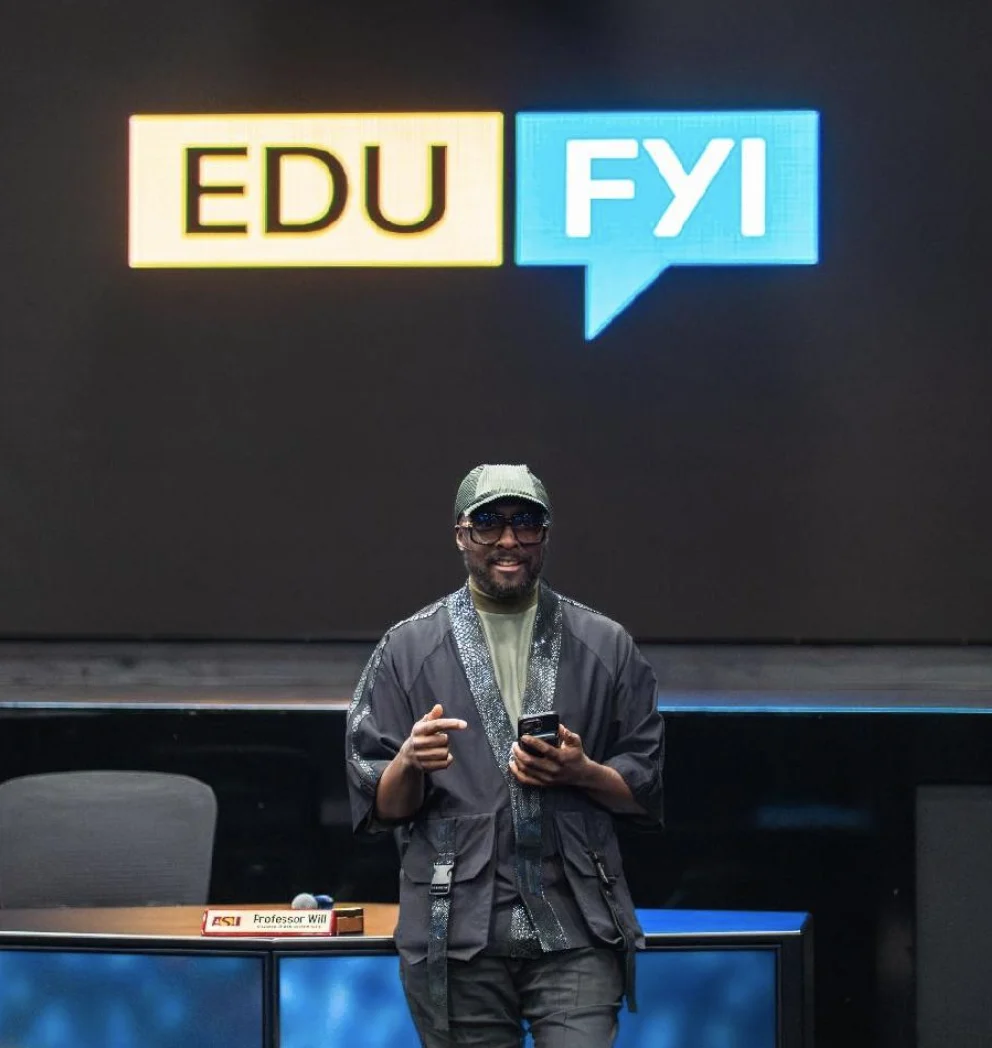
The intersection of celebrity-led innovation and higher education reached a significant milestone in 2025 with the launch of "The Agentic Self," a specialized course at Arizona State University (ASU). Developed in collaboration with William Adams, known professionally as will.i.am, the program represents a shift from viewing Artificial Intelligence (AI) as a mere productivity tool to seeing it as an extension of human identity and agency. This initiative, hosted at the FYI campus in Hollywood—a facility described as a multidisciplinary hub for music, technology, and product development—aims to empower students and professionals to build personalized AI personas that reflect their unique beliefs, interests, and professional goals.
The Concept of the Agentic Self and the FYI Campus
The "Agentic Self" is defined by will.i.am as the process of an individual claiming their personal data and deploying it through an AI agent that acts as a digital reflection of their persona. Unlike generic large language models (LLMs) that provide standardized responses, these agents are designed to be deeply personalized, working on behalf of the user to navigate complex environments.
The learning environment at the FYI campus was specifically engineered to foster this level of deep integration. The classroom was designed in a U-shaped format, modeled after the United Nations, where each participant was equipped with a dedicated station and microphone. This architectural choice was intentional, facilitating seamless collaboration between physical attendees and virtual guests. This setup underscores a broader trend in educational design: the transition from passive lecture halls to collaborative "war rooms" where technology and human interaction are inextricably linked.
A Chronology of AI Exploration: From Prompting to Agency
The development of the "Agentic Self" concept follows a multi-year trajectory of AI evolution. In 2023 and 2024, the primary focus of the global workforce was on efficiency—using tools like ChatGPT to automate writing and coding tasks. However, by 2025, the focus shifted toward "conversational skill building" and "AI-guided mastery."
The journey of the program’s first cohort illustrates how the same core idea—using AI for practice-based learning—can evolve when moved across different technological environments:
- Phase One: Conceptual Validation (ChatGPT): Early experiments focused on whether LLMs could facilitate "hard conversations" by acting as practice partners for high-stakes professional scenarios. This phase proved the concept’s viability but highlighted the limitations of generic platforms in providing structured, long-term growth.
- Phase Two: Enterprise Integration (Microsoft Copilot Studio): At large organizations like Providence St. Joseph Health, the challenge moved from conceptualization to scalability. Implementing AI within a healthcare system required navigating strict governance, data privacy, and strategic alignment, demonstrating that enterprise-scale AI is as much a logistical challenge as a technical one.
- Phase Three: Multimodal Expansion (Acolyte): Collaborations with AI startups like Acolyte allowed for the introduction of avatars and multimodal experiences. This added a layer of realism to the learning process, moving beyond text to include visual and auditory cues.
- Phase Four: Personalized Agency (FYI): The final evolution occurred within the FYI ecosystem, where the "persona" became the central unit of interaction. Here, AI was no longer a tool to be used, but a partner to be configured. This environment allowed for "scaffolded support," a middle ground between the overwhelming blankness of an empty prompt and the rigidity of traditional e-learning modules.
Supporting Data: The Growing Gap Between Access and Readiness
Despite the rapid licensing of AI tools across the Fortune 500, data suggests a widening "readiness gap." According to industry analysis, while over 70% of large enterprises have provided employees with access to AI tools as of 2025, only 15% of the workforce feels "highly proficient" in integrating these tools into their daily workflows.
This discrepancy suggests that access to technology does not equate to the capability to use it effectively. The "Agentic Self" course addresses this by focusing on "workforce readiness," a human-centric challenge rather than a technical one. Research into organizational psychology indicates that "psychological safety"—the ability to experiment, fail, and iterate without fear of repercussion—is the single most significant factor in the successful adoption of AI within corporate cultures.
Perspectives from Industry Leaders and Academic Partners
The collaboration between ASU and will.i.am reflects a broader movement toward "human-led" AI. ASU President Michael Crow has frequently advocated for "tempered innovation," where technology serves the mission of universal access to education.

Brad Bigelow, founder of Acolyte AI and a key contributor to the curriculum, notes that many organizations underinvest in the structures required for confident AI usage. "The gap is rarely technical; it is typically cultural or architectural," Bigelow stated. He argues that the distinction between being "equipped" with a tool and being "ready" to use it defines the divide between market leaders and followers.
The philosophy behind the FYI platform, as led by will.i.am, emphasizes a strong moral and ethical compass. By encouraging users to build agents that reflect their own "point of view," the program aims to prevent the homogenization of thought that can occur when relying on centralized AI models.
Case Study: Scaling Innovation at Providence St. Joseph Health
The practical application of these concepts is already being seen in the healthcare sector. At Providence St. Joseph Health, a version of the AI-guided mastery model has recently moved through the governance process for large-scale deployment.
The implementation at Providence serves as a blueprint for other highly regulated industries. It demonstrates that for AI to be effective in a clinical or administrative setting, it must:
- Align with Strategic Goals: The AI must solve specific, pre-identified friction points in the workflow.
- Maintain Human Oversight: The "human-led" aspect ensures that AI agents assist rather than replace the decision-making of healthcare professionals.
- Adapt to Local Contexts: The "best fit" principle ensures that the AI environment is tailored to the specific needs of different departments, from nursing to billing.
Broader Impact and Future Implications
The success of "The Agentic Self" cohort suggests a new paradigm for professional development. In a world where AI capabilities are advancing at an exponential rate, "curiosity" is being redefined as a core professional capability.
The shift toward AI personas also has significant implications for data ownership. If an AI agent is a reflection of the "agentic self," the question of who owns the data that trains that agent becomes paramount. The FYI platform’s focus on "claiming your data" aligns with emerging "Self-Sovereign Identity" (SSI) movements, which argue that individuals should have total control over their digital footprints.
Furthermore, the "middle ground" of AI-guided mastery—situated between open-ended prompts and static content—is likely to become the standard for corporate training. This adaptive, scaffolded approach allows for personalized learning at scale, providing the structure needed for novices while offering the flexibility required by experts.
Conclusion: The Path Forward for Organizations
The lessons learned from the ASU and FYI collaboration provide a clear directive for leaders, founders, and executives. To remain competitive, organizations must move beyond the "access phase" of AI and into the "readiness phase." This requires:
- Designing for Exploration: Creating environments where employees have the permission and the tools to test how AI fits their specific roles.
- Fostering a Tribe: Recognizing that the community and the "company you keep" in the AI space will dictate the quality of the innovation produced.
- Prioritizing Ethics and Agency: Ensuring that AI deployment expands human agency rather than diminishing it.
As the first cohort of "The Agentic Self" transitions back into the workforce, the impact of their experience will likely be felt through a new wave of human-centric AI applications. The "spark" of an idea, when moved through the right environments—from ChatGPT to enterprise-grade platforms—eventually becomes a robust capability. In the rapidly shifting landscape of 2026 and beyond, the willingness to explore these new digital frontiers is no longer a luxury; it is the essential driver of human and organizational progress.






