The career site job search page stands as a vital, often underestimated, component of the overall candidate experience and a critical gateway for attracting top talent. In an increasingly competitive global talent market, the efficacy of this digital touchpoint directly correlates with a company’s ability to build a robust talent pipeline and maintain a strong employer brand. Yet, a recent analysis highlights that many organizations, even well-established ones, continue to make common, yet easily rectifiable, errors that significantly undermine both candidate satisfaction and crucial search engine visibility.
These prevalent mistakes often stem from an over-reliance on Applicant Tracking Systems (ATS) that, while indispensable for backend HR processes, are not always optimized for frontend user experience or modern search engine algorithms. The consequences are far-reaching, ranging from diminished organic traffic to frustrating candidate journeys, ultimately leading to a reduced quantity and quality of applications. This article delves into five such critical errors, illustrating their impact and outlining actionable solutions that organizations can implement to transform their career sites into powerful talent attraction engines.
The Overlooked Gateway: Why Career Site Job Search Pages Matter
In the digital age, a company’s career site often serves as the first substantive interaction a potential candidate has with an employer. More than just a list of openings, it is an extension of the company’s brand, culture, and values. A seamless, informative, and engaging job search experience can significantly influence a candidate’s perception, driving them to apply and become an advocate for the brand. Conversely, a poorly designed or technically flawed page can deter qualified candidates, erode trust, and create a negative impression, regardless of the company’s actual reputation.
Recent data underscores the importance of a well-optimized career site. Studies indicate that over 70% of job seekers begin their search on general search engines like Google, often using specific keywords combining job titles and locations. If a company’s job postings are not readily discoverable through these organic searches, a substantial portion of the potential talent pool remains untapped. Furthermore, research by Talent Board’s Candidate Experience Awards (CandE) consistently shows that a positive candidate experience, starting with the career site, leads to higher application rates, increased offer acceptance, and even positive word-of-mouth referrals. The financial implications of a suboptimal career site are substantial, often translating into higher recruitment marketing costs, longer time-to-hire, and a compromised ability to fill critical roles.
Deep Dive into Five Critical Flaws Impairing Candidate Experience and SEO
A recent examination of various career sites revealed consistent patterns of errors, with a notable example being Ideal Industries, a reputable company with a 107-year history and a solid Glassdoor rating of 3.8. While singled out for illustrative purposes, these issues are endemic across industries, pointing to systemic challenges in integrating recruitment technology with robust digital marketing strategies. The following sections detail these five critical mistakes and their fixes.
1. The Domain Disconnect: When Your ATS Steals Your SEO Credit
One of the most insidious yet common errors involves the URL structure of job search pages. Instead of displaying the company’s own domain (e.g., jobs.yourcompany.com), many career sites default to showing the Applicant Tracking System’s URL (e.g., adp.careers.com/yourcompany). This seemingly minor technical oversight has profound consequences for Search Engine Optimization (SEO).
Background and Impact: When Google’s crawlers index web pages, they attribute authority and relevance to the domain name present in the URL. If the URL points to the ATS provider’s domain, then the ATS, not the employer, receives the valuable SEO credit. This means that even if a job seeker specifically searches for "Ideal Industries jobs," Google might prioritize the ATS domain in search results or, worse, completely miss the employer’s page in favor of more optimized competitors. Over time, this deprives the company’s primary domain of crucial organic traffic and authority, forcing a greater reliance on paid advertising channels, which significantly increases recruitment costs. The impact on candidate experience is also negative; a candidate might feel disoriented or question the legitimacy of a page that doesn’t clearly bear the employer’s URL. This lack of brand consistency can subtly erode trust.
The Fix: The solution lies in implementing URL masking or a custom domain setup. This technical configuration allows the employer’s branded URL to appear in the browser address bar, even though the content is hosted by the ATS. Most modern ATS platforms support this functionality, and it typically requires a one-time collaboration between the company’s IT department and the ATS provider. Implementing canonical tags can further reinforce to search engines which URL is the preferred, authoritative version of a page, preventing duplicate content issues and consolidating SEO value.
2. Brand Dilution: The ATS Logo Overshadowing Your Identity
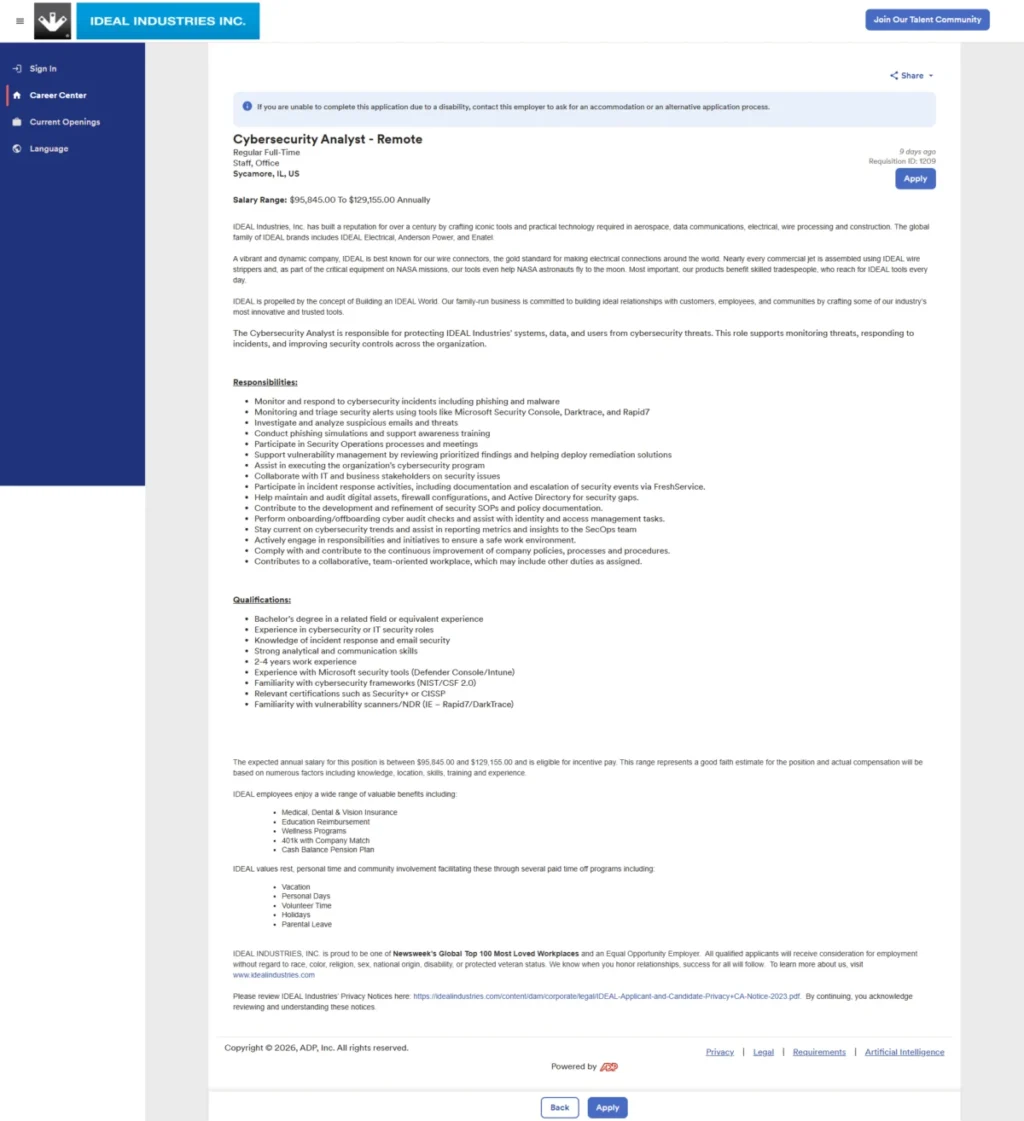
Beyond the URL, visual branding is paramount. Yet, many job search pages feature the ATS provider’s logo as prominently, or sometimes even more prominently, than the employer’s own logo. In the case of Ideal Industries, the ADP logo appeared almost as noticeable as Ideal’s own.
Background and Impact: This visual imbalance creates confusion for candidates. They are seeking employment with Ideal Industries, not ADP. A dominant ATS logo dilutes the employer’s brand identity, making the candidate question whose site they are truly on. This undermines the carefully cultivated employer brand and can lead to a perception of a generic or less professional hiring process. In an environment where employer branding is a key differentiator, ceding visual prominence to a third-party vendor is a missed opportunity to reinforce identity and build connection with potential hires. A strong, consistent brand presence instills confidence and professionalism, crucial elements in attracting top talent.
The Fix: Employers must work with their ATS providers to ensure their own company logo is the dominant visual element on all career pages. The ATS logo, if present at all, should be significantly smaller and less prominent, perhaps relegated to a subtle "Powered by [ATS Name]" footer. This adjustment reinforces the employer’s brand and ensures a cohesive visual experience for candidates.
3. Invisible Pathways: The Pitfalls of Dropdown Filters for Search Visibility
Many career sites rely on interactive dropdown menus for job filtering by location, department, or job type. While convenient for users already on the page, these dynamic elements are often invisible to search engines.
Background and Impact: When a candidate uses a dropdown filter, the content on the page updates, but frequently, the URL in the browser’s address bar does not change. This means there is no unique, static URL for Google to crawl, index, or link to. Consequently, if a job seeker searches for "IDEAL Industries jobs in Illinois" or "full-time manufacturing jobs," Google cannot directly surface a pre-filtered page from the company’s career site. The traffic from these specific, high-intent long-tail keywords is lost. This significantly hinders organic reach and forces candidates to navigate through multiple steps, increasing the likelihood of abandonment. Companies like Culture Amp, by contrast, create dedicated, linked pages for each office hub or job category, allowing Google to index these specific pathways and direct relevant traffic. The advent of Google for Jobs further emphasizes the need for structured, indexable content, as Google actively aggregates and displays job postings from career sites that adhere to specific SEO best practices.
The Fix: The critical step is to generate static, crawlable hyperlinks for each significant job category and location. Instead of just dropdowns, employers should present options as clickable links that lead to unique, indexable URLs (e.g., yourcompany.com/careers/locations/chicago or yourcompany.com/careers/departments/engineering). This allows search engines to discover and rank these specific job groupings, vastly improving organic visibility and directing more targeted traffic to the career site. This often requires a collaborative effort between the HR technology team and the marketing/web development teams to ensure proper implementation and ongoing maintenance.
4. Fading Identity: The Missing Favicon and Brand Consistency
A favicon, the small icon displayed in the browser tab, is a subtle yet powerful branding element. Unfortunately, many ATS-powered job search pages strip out the employer’s favicon, replacing it with the ATS provider’s default icon.
Background and Impact: Ideal Industries’ distinct down-pointing arrow favicon, for instance, disappears on its job search page, replaced by ADP’s icon. This seemingly minor detail contributes to brand inconsistency and a disjointed candidate experience. In a world where digital presence is paramount, every visual cue matters. A consistent favicon reinforces brand identity, aids in user navigation (allowing candidates to quickly identify the company’s tab among many open tabs), and subtly communicates professionalism. Its absence, or replacement with a third-party icon, further alienates the candidate from the employer’s brand and can raise questions about the site’s authenticity, even if subconsciously. It’s a small but cumulative erosion of trust and brand recall.
The Fix: Employers should proactively request their ATS provider or internal technical team to ensure that their branded favicon is consistently displayed across all career site pages, from the main landing page to individual job descriptions. This is usually a straightforward technical adjustment that significantly contributes to a seamless and professional candidate experience.
5. The Conversion Killer: Generic Job Descriptions
Even if candidates successfully navigate to a job posting, a generic, uninspiring job description can be the ultimate conversion killer. Often, these descriptions are vague, laden with jargon, or simply copy-pasted from templates, failing to truly engage or inform potential applicants.
Background and Impact: Take the example of Ideal Industries’ Cybersecurity Analyst posting. While it commendably included a salary range and mentioned specific tools (Darktrace, Rapid7, Microsoft Defender), it still fell short in critical areas. Many job descriptions suffer from:
- Lack of a Compelling Introduction: A generic opening fails to capture attention or articulate the unique value proposition of the role and the company.
- Prioritization Issues: A long, undifferentiated list of responsibilities obscures the most critical aspects of the role, making it difficult for candidates to understand the core focus.
- Vague Remote Work Details: For remote roles, generic statements like "remote" are insufficient. Candidates seek clarity on expectations, collaboration tools, and the company’s remote culture.
- Absence of Company Culture: The job description is an ideal place to subtly weave in elements of company culture, team dynamics, and growth opportunities.
The impact of generic job descriptions is multifaceted. They lead to lower application rates, a higher volume of unqualified applicants (as the role’s true nature isn’t clear), and a missed opportunity to attract diverse talent. Candidates today seek transparency, authenticity, and a clear understanding of the role’s impact and the company’s environment. Research consistently shows that job descriptions that include salary ranges, clear responsibilities, and insights into company culture perform significantly better in attracting high-quality applicants. A generic description suggests a lack of investment in the hiring process, which can deter top talent who expect a thoughtful and professional approach.
The Fix: Crafting effective job descriptions requires a strategic approach:
- Role-Specific Introductions: Begin with a captivating introduction that highlights the unique challenges and opportunities of the role, speaking directly to the ideal candidate.
- Prioritized Responsibilities: Clearly distinguish between core responsibilities and secondary tasks, using bullet points and active verbs.
- Detailed Remote Work Expectations: For remote positions, elaborate on what "remote" truly means for the role, including communication styles, necessary tools, and team interaction.
- Integrate Culture and Impact: Briefly touch upon the team environment, company values, and the impact the role will have within the organization.
- Inclusive Language: Review descriptions for jargon or gender-coded language that might deter diverse candidates.
Small, thoughtful changes in job descriptions can significantly improve conversion rates, attract more qualified candidates, and enhance the overall perception of the employer.
The Broader Implications for Talent Acquisition
These five common mistakes, when viewed collectively, paint a picture of a pervasive challenge in talent acquisition: the disconnect between backend HR efficiency and frontend candidate experience and digital marketing best practices. The implications extend far beyond mere inconvenience:
- Increased Cost-Per-Hire: Reliance on paid job boards and advertising to compensate for poor organic visibility directly inflates recruitment budgets.
- Reduced Quality and Quantity of Applicants: A frustrating or uninformative career site deters top talent, leading to fewer applications and a shallower pool of qualified candidates.
- Damaged Employer Brand: Inconsistent branding, technical glitches, and generic content project an image of disorganization or a lack of investment in talent, harming the company’s reputation as an employer of choice.
- Loss of Competitive Edge: In a tight labor market, companies that fail to optimize their digital recruitment touchpoints fall behind competitors who prioritize a seamless and engaging candidate journey.
- Challenges with Diversity and Inclusion: Generic job descriptions and inaccessible career sites can inadvertently exclude diverse talent pools who might be put off by a lack of clarity or an uninviting digital presence.
Navigating the ATS Partnership: Solutions and Best Practices
The complexity often arises from the inherent nature of Applicant Tracking Systems, which were primarily designed for internal HR workflow management rather than external marketing and candidate engagement. However, the market is evolving, and many ATS providers are increasingly offering more robust frontend customization and SEO capabilities.
Employers must treat their ATS provider as a strategic partner. Regular communication, clearly articulated needs, and a willingness to explore customization options are crucial. It’s also vital to involve internal marketing and IT teams in the career site’s design and optimization process. These teams possess the expertise in SEO, web design, and user experience that HR departments may lack. Some recruitment software solutions, like Ongig, are specifically designed to address these frontend challenges by providing highly customizable and SEO-optimized career site platforms that integrate seamlessly with various ATS systems.
The Future of Career Sites
Looking ahead, the trend is towards even greater personalization and integration. Career sites will likely become more dynamic, leveraging AI to recommend relevant jobs, offer personalized content based on candidate profiles, and provide interactive experiences like virtual tours and employee testimonials. The foundational elements of strong branding, SEO, and a superior candidate experience will remain paramount, serving as the bedrock upon which future innovations are built. Continuous auditing and optimization of the career site are not merely best practices but necessities for any organization serious about attracting and retaining top talent.
Ultimately, a company’s job search page is not just a functional tool; it is a critical marketing asset. By addressing these five common mistakes, organizations can transform their career sites from passive job listings into active, engaging, and highly effective talent magnets, ensuring that their investment in recruitment technology truly pays dividends in a competitive talent landscape.
June 29, 2026 by Rob Kelly in Company Career Site