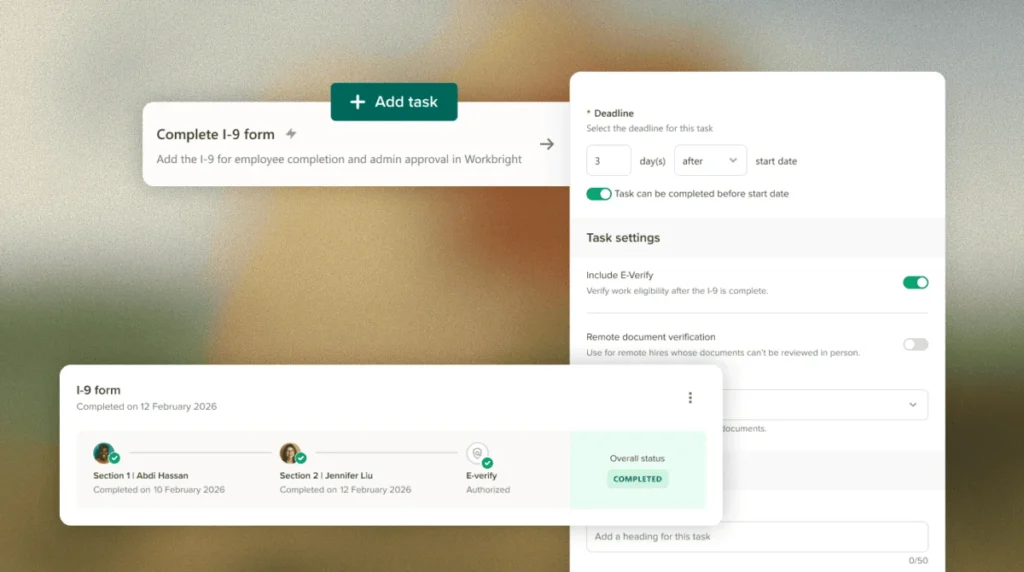
Workable, a leading applicant tracking system and HR software provider, has announced the launch of a new, integrated I-9 and E-Verify workflow designed to simplify and ensure compliance for U.S. employers in verifying employee work eligibility. This significant update aims to eliminate the traditional manual burdens associated with Form I-9 completion and E-Verify submissions, such as downloading PDFs, duplicate data entry, and navigating multiple disparate tools. The new system allows employees to digitally complete Section 1 of the I-9 form, while HR teams can review documents and complete Section 2 directly within the Workable platform. For organizations utilizing E-Verify, the system facilitates automatic submission during the process, ensuring federal requirements are met with enhanced ease and accuracy.
The Intricate Landscape of U.S. Employment Verification
Understanding the significance of Workable’s new offering requires a brief delve into the complexities of U.S. employment verification. Form I-9, Employment Eligibility Verification, is a mandatory U.S. Citizenship and Immigration Services (USCIS) form that all U.S. employers must complete for every new hire, regardless of their citizenship status. Its primary purpose is to verify the identity and employment eligibility of individuals hired for employment in the United States.
The process is structured in several key parts:
- Section 1: Employee Information and Attestation: Completed by the employee by their first day of employment, attesting to their eligibility to work in the U.S.
- Section 2: Employer Review and Attestation: Completed by the employer (or an authorized representative) within three business days of the employee’s first day of employment. This involves physically examining original identity and employment authorization documents presented by the employee from the USCIS-approved List of Acceptable Documents.
- Section 3: Reverification and Rehires: Used for reverifying the employment authorization of employees whose work authorization has expired, or for rehires.
Beyond Form I-9, the E-Verify program adds another layer of verification. E-Verify is an internet-based system operated by the Department of Homeland Security (DHS) in partnership with the Social Security Administration (SSA) that allows enrolled employers to electronically confirm the employment eligibility of their newly hired employees. While E-Verify is voluntary for most employers, it is mandatory for certain federal contractors and employers in a growing number of states. The program checks the information provided on an employee’s I-9 form against DHS and SSA databases to confirm work authorization.
Persistent Challenges in Traditional Compliance
For decades, managing I-9 and E-Verify compliance has presented numerous challenges for U.S. organizations, particularly for Human Resources departments. These include:
- Manual Paperwork Burden: The traditional paper-based process is time-consuming, prone to errors, and requires significant administrative effort for printing, completing, storing, and retrieving forms.
- Risk of Errors and Penalties: Even minor errors or omissions on Form I-9 can lead to substantial fines from Immigration and Customs Enforcement (ICE). Penalties for substantive violations can range from hundreds to thousands of dollars per form, while knowingly hiring or continuing to employ unauthorized workers can result in even more severe civil and criminal penalties. ICE audits are a persistent threat, with thousands conducted annually, often resulting in significant financial liabilities for non-compliant businesses.
- Data Duplication and Disjointed Systems: Many organizations rely on separate systems for applicant tracking, onboarding, and compliance, leading to redundant data entry and increased potential for inaccuracies. This fragmented approach also makes it difficult to maintain a single source of truth for employee data.
- Remote Hiring Complexities: The dramatic shift towards remote and hybrid work models, accelerated by the COVID-19 pandemic, exposed critical limitations in the traditional I-9 process, which historically required physical examination of documents.
- Record-Keeping and Retention: Employers are required to retain completed Forms I-9 for a specified period and make them available for inspection by authorized government officers. Managing physical forms securely and ensuring their accessibility can be an administrative nightmare.
- Ensuring Non-Discrimination: Employers must navigate the I-9 process carefully to avoid discriminatory practices, such as requesting more documents than necessary or rejecting valid documents based on ethnicity or national origin.
A Chronology of Regulatory Shifts and Technological Adaptation
The regulatory framework for employment eligibility verification has evolved significantly since the Immigration Reform and Control Act (IRCA) of 1986 first introduced Form I-9. The E-Verify program, initially a pilot in the late 1990s, expanded significantly in the 2000s, becoming mandatory for federal contractors and seeing increased adoption across states.
A pivotal recent development, directly influencing the need for digital solutions like Workable’s, emerged from the COVID-19 pandemic. From March 2020 to July 31, 2023, DHS provided temporary flexibilities allowing employers to remotely examine I-9 documents for employees working exclusively remotely due to COVID-19-related precautions. This temporary measure became a lifeline for businesses navigating widespread remote hiring.
However, these flexibilities expired on July 31, 2023, creating a compliance imperative for employers to physically re-examine documents for employees hired remotely during the pandemic, or face potential non-compliance. Recognizing the continued prevalence of remote work, DHS subsequently published a final rule on July 21, 2023, establishing an alternative procedure for Form I-9 document examination, effective August 1, 2023. This alternative procedure allows E-Verify enrolled employers in good standing to remotely examine documents via live video interaction, provided they meet specific criteria, including retaining copies of the documents.
Workable’s decision to launch its integrated I-9 and E-Verify workflow aligns perfectly with this critical juncture. The development of such a feature would have been underway for some time, driven by market demand for efficiency and anticipation of evolving compliance needs. Its release now positions Workable as a timely solution for organizations grappling with the expiration of temporary flexibilities and the implementation of the new DHS alternative procedure, particularly for those who are E-Verify users. This move reflects a broader industry trend where HR technology providers are rapidly developing solutions to automate and simplify compliance, transforming what was once a cumbersome manual task into a seamless digital experience.
Workable’s Solution: Seamless Integration for Enhanced Compliance
The core of Workable’s new offering lies in its ability to embed the I-9 and E-Verify experience directly into an employer’s existing onboarding setup. This integration is designed to be seamless and structured, providing a unified platform for managing the entire hiring and onboarding journey.
Here’s a breakdown of how the workflow functions and its key features:
- Digital Section 1 Completion: Upon being hired, new employees receive a secure digital prompt to complete Section 1 of Form I-9. This eliminates the need for paper forms and ensures that all necessary information is captured accurately and efficiently. The digital format guides employees through the process, reducing common errors.
- Streamlined Section 2 for HR Teams: Once Section 1 is complete, HR teams or authorized representatives can review the employee’s identity and employment authorization documents directly within Workable. This can involve physical examination or, for E-Verify users, utilizing the new DHS alternative procedure through a live video interaction. HR then completes Section 2 in the system, ensuring all required fields are accurately populated and dated.
- Automated E-Verify Submission: For Workable customers who have opted to use E-Verify, the system automatically submits the employee’s data to the E-Verify system once Section 2 is completed. This automation significantly reduces the risk of manual errors and delays associated with separate E-Verify portals. The system also tracks the status of the E-Verify case, providing real-time updates and notifications for any Tentative Nonconfirmations (TNCs) that may arise.
- Centralized Document Storage and Audit Trails: All I-9 forms, associated documents, and E-Verify case details are securely stored within Workable. This centralized repository simplifies record-keeping, ensures easy retrieval during audits, and provides a clear audit trail of all actions taken, crucial for demonstrating compliance.
- Reduced Administrative Overhead: By consolidating these critical compliance tasks into a single platform, Workable aims to significantly reduce the administrative burden on HR teams. This allows HR professionals to focus on strategic initiatives rather than repetitive paperwork.
- Improved Employee Experience: A digital, streamlined onboarding process contributes to a positive first impression for new hires, setting a professional tone and minimizing early-stage anxieties related to paperwork.
Supporting Data and Industry Context Reinforce the Need
The financial and operational implications of I-9 non-compliance are substantial, underscoring the value of Workable’s integrated solution. Data from ICE enforcement actions consistently shows that employers face millions of dollars in fines annually for I-9 violations. For instance, in fiscal year 2020, ICE Homeland Security Investigations (HSI) made 1,300 worksite enforcement-related arrests and assessed over $14.4 million in judicial forfeitures, fines, and restitution, alongside $2.3 million in administrative fines. These figures highlight the significant financial risks associated with inadequate I-9 management.
Furthermore, studies on HR administrative tasks indicate that onboarding processes, particularly those involving compliance documentation, consume a considerable amount of HR professionals’ time. Automating these processes can save hours per new hire, translating into significant cost savings and improved productivity for organizations with high hiring volumes. The growth of the HR technology market, projected to reach billions globally, is largely driven by the demand for solutions that enhance efficiency, improve employee experience, and ensure compliance. Companies are increasingly investing in comprehensive HRIS and ATS platforms that offer integrated functionalities, moving away from siloed systems.
The continued dominance of remote and hybrid work models post-pandemic further solidifies the essential nature of digital I-9 and E-Verify solutions. A significant percentage of the U.S. workforce continues to operate outside traditional office settings, making physical document examination impractical and inefficient without the specific allowances provided by the DHS alternative procedure for E-Verify users. Technology that supports this distributed workforce while maintaining regulatory adherence is no longer a luxury but a necessity.
Inferred Statements and Broader Implications
While specific quotes were not provided in the original excerpt, a Workable spokesperson, such as a Head of Product or CEO, would likely emphasize the company’s commitment to empowering HR teams. "This new workflow directly addresses a critical pain point for U.S. employers, providing a modern, efficient, and compliant way to manage employment eligibility verification," a representative might state. "By integrating I-9 and E-Verify seamlessly into our platform, we are not just simplifying a complex process, but also mitigating significant compliance risks for our customers, allowing them to focus on what truly matters: attracting and retaining top talent."
HR professionals and compliance experts would likely welcome such an integrated solution. "The regulatory environment around I-9 and E-Verify is constantly evolving, and the recent changes regarding remote document examination have added another layer of complexity," an inferred statement from an HR compliance expert might read. "Integrated solutions like Workable’s are becoming indispensable for modern HR departments grappling with these challenges. They provide the necessary structure and automation to ensure compliance, reduce audit risk, and free up valuable HR time."
The broader impact of Workable’s new offering extends across several dimensions:
- For U.S. Organizations: It offers a robust tool for mitigating the escalating risks of I-9 non-compliance, which can result in substantial fines and reputational damage. The operational efficiencies gained will allow HR departments to reallocate resources to more strategic initiatives, such as talent development and employee engagement. Moreover, by providing a smooth and digital onboarding experience, companies can enhance their employer brand and improve new hire retention.
- For the HR Technology Landscape: Workable’s move raises the bar for other Applicant Tracking Systems and HRIS providers, pushing for deeper integration of compliance tools within core HR platforms. This trend will likely lead to more comprehensive, all-in-one solutions that simplify the entire employee lifecycle management.
- Regulatory Support: From a regulatory perspective, digital solutions that reduce errors and ensure accurate, timely submissions support the government’s objectives for efficient oversight and enforcement, while simultaneously easing the administrative burden on employers who are striving for compliance.
In conclusion, Workable’s introduction of an integrated I-9 and E-Verify workflow represents a timely and crucial advancement for U.S. employers. By transforming a historically manual and error-prone process into a streamlined digital experience, the platform not only enhances operational efficiency but also significantly strengthens an organization’s compliance posture in an increasingly complex regulatory landscape. This development underscores the continuous evolution of HR technology in response to both market demands and governmental mandates, ultimately aiming to create a more efficient, compliant, and positive experience for both employers and employees. Organizations curious to explore the full capabilities of this new feature are encouraged to contact their Workable account manager or request a demonstration from the team.