In an increasingly candidate-driven market, organizations face the persistent and costly challenge of offer reneges, where prospective employees accept a job offer only to withdraw before their official start date. This phenomenon, often discovered belatedly, leaves companies scrambling to backfill critical roles, incurring significant financial and operational setbacks. Traditional recruitment models frequently fail to address this vulnerability, operating reactively once a candidate has already disengaged. However, a paradigm shift is emerging, with leading organizations recognizing the strategic imperative of proactive candidate engagement, treating early engagement signals as critical leading indicators of potential renege risk. This approach, exemplified by sophisticated tools like the Engagement Health Scorecard, transforms the pre-start period into a structured, data-driven phase designed to nurture commitment and mitigate attrition.
The conventional wisdom, or rather the lack thereof, in many recruitment programs is to assume a signed offer letter signifies a secured hire. Teams often only become aware of a candidate’s decision to renege after the fact, typically through a terse email or, more distressingly, through prolonged silence. By the time a candidate goes quiet, indicating a potential withdrawal, their decision is frequently already firm. This reactive posture, characterized by a frantic scramble for backfills, underscores a fundamental flaw in traditional talent acquisition processes that overlook the critical window between offer acceptance and the first day of employment. Industry data consistently highlights the substantial costs associated with this oversight; studies indicate that the average cost of a reneged offer can range from 1.5 to 3 times the annual salary of the position, factoring in lost productivity, additional recruitment fees, and the strain on existing teams.
The Escalating Challenge of Candidate Renege in a Dynamic Labor Market
The landscape of talent acquisition has undergone profound transformations over the past decade. A combination of factors, including a historically low unemployment rate in many sectors, the rise of remote work opportunities, and increased transparency into compensation and company culture, has empowered candidates like never before. It is not uncommon for highly sought-after professionals, particularly in specialized fields such as technology, engineering, and healthcare, to receive multiple competing offers simultaneously. This competitive environment exacerbates the risk of reneges, as candidates may accept an initial offer as a fallback while continuing to interview for their preferred roles, or simply use it as leverage for a better deal elsewhere. The "Great Resignation" and subsequent "Great Reshuffle" periods further intensified this dynamic, with employees exhibiting a greater willingness to switch jobs in pursuit of better compensation, work-life balance, or career advancement opportunities.
This volatile environment necessitates a more robust and continuous engagement strategy. Merely securing a signature on an offer letter is no longer sufficient; the commitment must be nurtured and reinforced throughout the entire pre-start journey. The absence of a formal process to monitor and address candidate engagement during this critical phase is a significant blind spot for many organizations, leading to preventable losses of top talent.
Proactive Engagement: A Paradigm Shift in Talent Acquisition
The fix for this systemic issue lies in adopting a proactive, data-driven approach to candidate engagement. Rather than waiting for negative signals, organizations must actively monitor and interpret engagement signals as leading indicators of a candidate’s commitment health. This involves creating a structured framework to track interactions, measure responsiveness, and identify patterns that may suggest disengagement. The goal is to intervene strategically and personally before a candidate makes a final decision to withdraw, transforming the pre-start period into an extension of the recruitment and onboarding process rather than a passive waiting game.
"The pre-start period is a golden opportunity to deepen a candidate’s connection with the company," explains Dr. Evelyn Reed, a leading expert in talent management strategy. "It’s not just about logistics; it’s about reinforcing their decision, building anticipation, and making them feel like an integral part of the team before they even step through the door. Ignoring this phase is akin to planting a seed and then neglecting to water it."
The Engagement Health Scorecard: A Detailed Framework for Monitoring Commitment
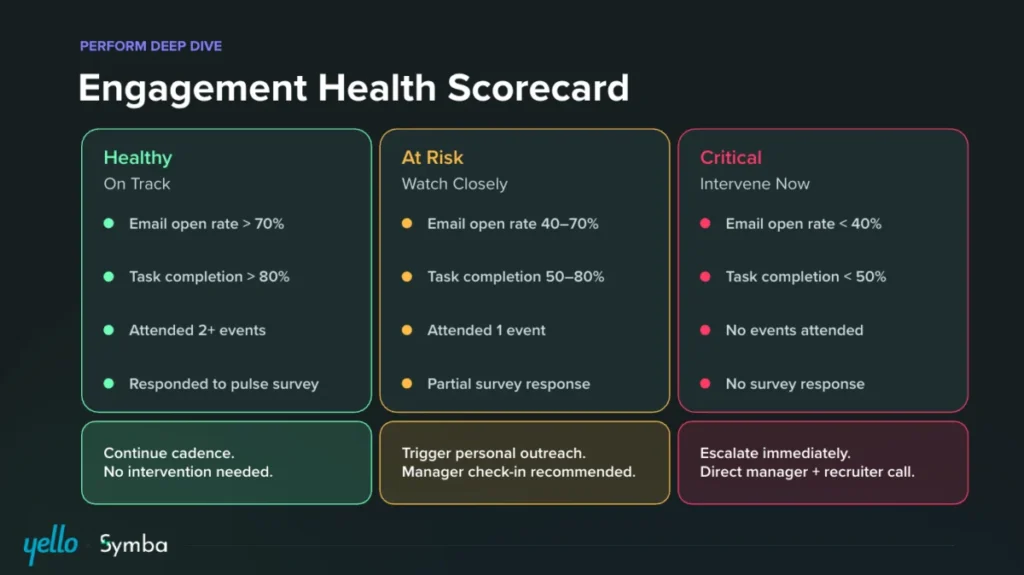
At the heart of this proactive approach is the Engagement Health Scorecard, a systematic methodology designed to categorize candidates into distinct groups based on their behavior during the critical pre-start period. This scorecard provides a clear, actionable framework for recruitment teams, HR professionals, and hiring managers to assess a candidate’s level of engagement and deploy targeted interventions. The scorecard typically leverages various data points derived from digital interactions and personal touchpoints, providing a holistic view of a candidate’s commitment.
The scorecard categorizes candidates into three primary groups, each with specific behavioral thresholds and recommended actions:
1. Healthy Candidates: Sustained Engagement and Positive Indicators
Behavioral Profile: Healthy candidates exhibit consistent and strong engagement across multiple channels. This group is characterized by a high email open rate, typically above 70%, indicating active interest in company communications. They diligently complete pre-onboarding tasks, such as background checks, paperwork, and initial training modules. Furthermore, healthy candidates actively participate in pre-start events, such as virtual meet-and-greets, informational webinars, or team social gatherings, often attending multiple such opportunities. Their responsiveness to surveys and direct inquiries is prompt and thorough.
Underlying Rationale: This level of engagement suggests a candidate who is genuinely excited about the role and the company, feels well-informed, and perceives a clear path forward. Their actions reflect a reinforced commitment and a positive outlook on their impending start.
Recommended Action: For healthy candidates, the primary objective is to maintain momentum and reinforce their positive trajectory. The appropriate action is to continue the established communication cadence, ensuring a steady flow of relevant information without overwhelming them. This includes regular, personalized updates, sharing company news or team achievements, and providing access to resources that deepen their understanding of their role and the organizational culture. Staying the course ensures continued nurturing of their commitment without introducing unnecessary intervention that might disrupt their positive experience.
2. At-Risk Candidates: Declining Engagement Signals and Early Warning Signs
Behavioral Profile: At-risk candidates present early warning signs of declining engagement. Their email open rates fall within a concerning range, typically between 40% and 70%, suggesting a potential decrease in interest or a growing distraction. Participation in optional pre-start events becomes limited, perhaps attending only one or none, despite multiple invitations. Their responses to surveys may be incomplete, delayed, or lack the detailed feedback expected from an engaged candidate. There might also be a subtle reduction in responsiveness to direct communications.
Underlying Rationale: This behavioral shift often indicates a candidate who might be weighing other options, experiencing pre-start jitters, encountering unforeseen personal circumstances, or feeling a lack of connection with the company. The decline, while not yet critical, signifies that their commitment is not as robust as initially perceived.
Recommended Action: Identifying an at-risk candidate necessitates immediate, personalized outreach within 48 hours to prevent further disengagement. A direct, empathetic message from the program manager or future team lead can be highly effective. This outreach should feel individual and genuine, rather than a mass-distributed communication. For instance, instead of a generic event invitation, an at-risk candidate might receive a personal note highlighting specific reasons why a particular upcoming event would be beneficial for them. A check-in from the hiring manager, expressing excitement about their arrival and offering to answer any lingering questions, can also be a powerful reaffirmation. These targeted, personal interventions often turn things around quickly by addressing nascent concerns and rebuilding the personal connection.
3. Critical Candidates: Near-Total Disengagement and Urgent Intervention Required
Behavioral Profile: Critical candidates display almost no engagement whatsoever, signaling a high probability of renege. Their email open rates plummet below 40%, often nearing zero. They attend no pre-start events, show no activity in completing tasks or responding to surveys, and there might be a complete lack of response to communications over three or more weeks. This level of disengagement suggests a significant breakdown in commitment or a firm decision to explore other avenues.
Underlying Rationale: At this stage, the candidate has likely either received a compelling competing offer, is dealing with a significant personal circumstance that impacts their ability to start, or is experiencing profound uncertainty about the role or the company. Their silence is a strong indicator that their commitment has severely eroded.
Recommended Action: Critical candidates require immediate and decisive escalation. The situation demands a direct call from the hiring manager, not an email, to establish a personal, urgent connection. This call should be followed by a personal touchpoint from the recruiter, reiterating the company’s enthusiasm and offering specific support. The objective is to initiate a real conversation about what is happening. Often, the root cause is a competing offer that can potentially be addressed, a personal circumstance that the company might be able to accommodate or help navigate, or simple uncertainty that can be alleviated through direct communication and reassurance. Catching these issues in time, even at this late stage, can sometimes salvage the offer, but it requires swift, high-level intervention.
The Economic Imperative of Proactive Retention
The difference between organizations that successfully retain their accepted candidates and those that are perpetually scrambling to backfill roles is almost always rooted in their approach to data. The first group continuously monitors engagement data, recognizing that the commitment journey extends far beyond the offer acceptance. They do not wait for a renege email; they proactively manage the risk. This continuous monitoring allows for early detection of disengagement signals and enables timely, personalized interventions.
Consider the financial implications: if an organization successfully converts even a small percentage of at-risk or critical candidates who would otherwise renege, the return on investment for an engagement scorecard system can be substantial. For a role with an average salary of $75,000, a renege could cost the company an estimated $112,500 to $225,000. Preventing just one or two such instances per year through proactive engagement can easily justify the resources invested in such a program. Furthermore, the reputational damage of frequent reneges, both internally (employee morale) and externally (employer brand), is immeasurable. A company known for a high renege rate may struggle to attract top talent in the future, creating a vicious cycle.
Broader Impact and Implications for Talent Acquisition Strategy
The adoption of an Engagement Health Scorecard signals a maturation in talent acquisition strategies, moving beyond mere hiring efficiency to focus on retention from the moment an offer is accepted. This approach has several broader implications:
- Enhanced Employer Branding: A proactive engagement strategy improves the candidate experience, transforming the pre-start period into a positive introduction to the company culture. Candidates who feel valued and supported are more likely to become advocates for the brand, regardless of whether they ultimately join.
- Improved Onboarding Success: Candidates who arrive feeling engaged and well-informed are more likely to integrate successfully into their new roles, leading to higher job satisfaction and longer tenure.
- Data-Driven Decision Making: The continuous collection and analysis of engagement data provide invaluable insights into the effectiveness of pre-start programs, allowing for iterative improvements and optimized strategies. This data can inform everything from communication frequency to the types of events offered.
- Strategic Alignment: It necessitates closer collaboration between recruitment teams, HR, and hiring managers, fostering a shared responsibility for candidate success from offer to onboarding. This integrated approach ensures that the candidate experience is seamless and consistent.
- Competitive Advantage: Organizations that master proactive engagement gain a significant competitive edge in the fierce battle for talent, demonstrating a commitment to their future employees that extends beyond the initial hiring transaction.
The comprehensive framework for an Engagement Health Scorecard, including specific thresholds and recommended actions for each tier, along with a step-by-step intervention playbook and a post-cycle review template, provides organizations with the tools to refine their processes continuously. Resources such as "The KEEP Playbook" offer detailed guidance, enabling teams to learn and improve with every recruitment program. By embracing a data-driven, proactive approach to candidate engagement, companies can transform the precarious pre-start period into a powerful phase for building loyalty, mitigating risk, and securing their most valuable asset: top talent.