The familiar lament echoes across many organizations: it often takes longer for a job description (JD) to secure internal approval than it does to successfully fill the actual position. This inefficiency, characterized by mysterious delays, opaque processes, and a pervasive uncertainty about who is responsible for what, points to a fundamental breakdown in a critical talent acquisition function. The resulting chaos not only frustrates recruiting teams but also carries significant implications for an organization’s ability to attract top talent, maintain compliance, and uphold its employer brand in an increasingly competitive landscape. This article delves into the core challenges plaguing JD approval workflows and outlines strategic solutions to transform these bottlenecks into streamlined, efficient systems.
The Hidden Costs of Disjointed Approval Workflows
In today’s dynamic talent market, speed and precision are paramount. Delays in getting a job description approved directly translate to missed opportunities and escalating costs. Industry reports suggest that an average job description approval process can take anywhere from one to four weeks, significantly impacting the time-to-hire, a critical metric that influences everything from operational continuity to recruitment budget efficiency. Research by leading HR tech institutes indicates that companies with optimized recruitment processes can reduce their time-to-hire by up to 30%, gaining a crucial edge in securing top-tier candidates who are rarely on the market for long.
Beyond the immediate impact on recruitment timelines, a dysfunctional JD approval process incurs several other hidden costs:
- Erosion of Candidate Experience: Prolonged delays mean JDs are posted late, causing prospective candidates to move on to more agile organizations. Moreover, poorly vetted JDs, rushed through a chaotic process, can contain confusing requirements, outdated information, or a lack of crucial details like salary ranges, which deter quality applicants and damage the employer brand.
- Increased Compliance Risk: The regulatory landscape surrounding hiring has become increasingly complex, with evolving laws on pay transparency, equal opportunity employment (EEO), and accessibility varying by country, state, and even industry. A disorganized approval process heightens the risk of publishing non-compliant JDs, potentially leading to costly fines, legal challenges, and reputational damage. For instance, non-compliance with pay transparency laws in some US states can result in fines ranging from hundreds to tens of thousands of dollars per violation, alongside significant legal fees.
- Operational Inefficiency and Resource Drain: The constant back-and-forth, manual tracking, and reconciliation of feedback across multiple platforms consume valuable hours from HR, recruiting, hiring managers, and legal teams. This diversion of resources from strategic initiatives to administrative firefighting creates frustration and reduces overall productivity. Sarah Chen, Head of Talent Acquisition at GlobalTech Solutions, notes, "The bottleneck often isn’t finding candidates, but getting the job description approved to even start the search. It’s an enormous drain on our team’s energy and focus."
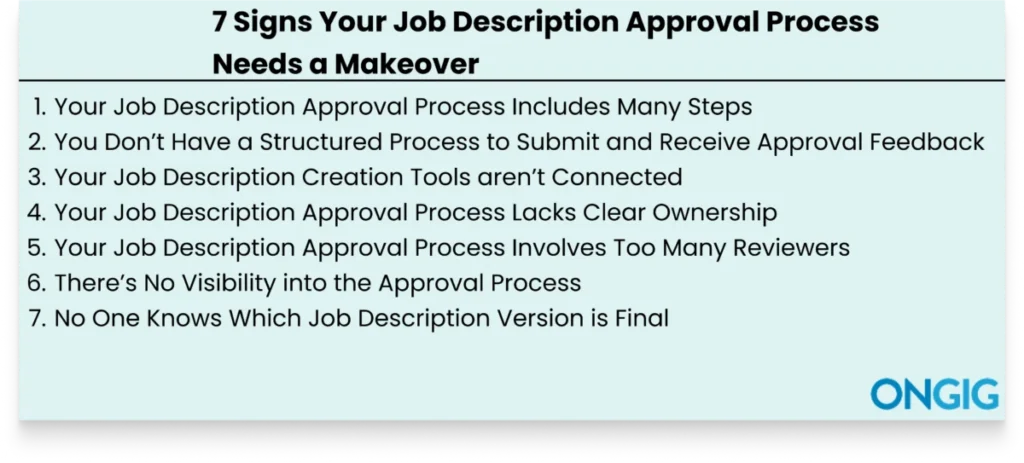
Anatomy of a Broken System: Seven Core Challenges
The root causes of JD approval inefficiencies are often multifaceted, stemming from a combination of outdated practices, a lack of clear protocols, and fragmented technological ecosystems. Understanding these challenges is the first step towards building a robust solution.
1. Overly Complex Approval Chains: Many organizations, in an attempt to be thorough, inadvertently over-engineer their JD approval processes. What starts as a seemingly justified series of checks can quickly balloon into an unwieldy workflow with eight, nine, or even more sequential steps. Each step, particularly those reliant on a single individual’s sign-off, becomes a potential point of failure. If an approver is on vacation, sick leave, or simply overwhelmed, the entire process grinds to a halt. This stretches a task that could ideally take a day into weeks, becoming the norm rather than the exception. A critical audit of each stage is necessary to identify truly essential checkpoints and eliminate redundant or easily consolidated steps.
2. Fragmented Feedback Mechanisms: A common symptom of a messy approval process is the scattering of feedback across disparate communication channels. Imagine the HR team providing edits on Google Docs, the hiring manager sending suggestions via Slack, and the legal department conveying their input verbally or through email. This multi-channel chaos forces recruiters to act as reconcilers, sifting through conflicting edits and potentially missing crucial feedback. The absence of a single, structured platform for submitting, tracking, and consolidating suggestions inevitably leads to inefficiencies, rework, and the risk of publishing an unrefined or unapproved JD.
3. Disconnected Tools and Siloed Systems: The journey of a JD often resembles a digital odyssey: drafted in Google Docs, sent for email review, approved via Slack, and finally manually copied into an Applicant Tracking System (ATS). This disjointed toolchain creates a fertile ground for errors and confusion. Reviewers might edit an outdated version, critical feedback could be overlooked, and tracking who has completed their review becomes a manual, error-prone exercise. Without a centralized hub, there is no single source of truth for the current document under review or its approval status, undermining collaboration and efficiency.
4. Ambiguous Ownership and Accountability: When asked who "owns" the JD approval process, many teams would struggle to provide a clear, consistent answer. This ambiguity — where the recruiting team might assume legal ownership, and talent acquisition might point to HR managers — leads to a critical lack of accountability. Without a designated process owner, delays go unaddressed, follow-ups are neglected, and bottlenecks persist because no one is empowered or responsible for overseeing the entire workflow. David Lee, General Counsel at Innovate Corp., recounts, "Our legal team used to spend countless hours reviewing JDs that had already gone through multiple rounds of edits, often discovering non-compliant language late in the process because there wasn’t a clear owner to shepherd it through correctly."
5. Excessive Reviewer Overload: In an attempt to gather all necessary perspectives, some organizations involve an unwieldy number of reviewers for each job description. While stakeholder input is vital, involving more than six individuals in every approval cycle often creates a "too many cooks" scenario. Managing multiple perspectives, tracking individual review statuses, and mediating conflicting edits from a large group significantly prolongs the process. It also introduces the challenge of determining who has the final say when disagreements arise, transforming a potentially two-day task into a multi-week ordeal.
6. Lack of Process Visibility: Operating without clear visibility into the approval process is akin to navigating blindfolded. When a JD approval stalls, teams are left guessing why: Is the approver busy? Did they receive the notification? Are they facing a specific challenge? This lack of transparency makes it impossible to proactively identify bottlenecks, understand underlying issues, or estimate completion timelines. Without data on where delays occur, optimizing the process becomes an exercise in guesswork, potentially misattributing delays to individual slowness rather than systemic issues like reviewer overload or unclear instructions.
7. Version Control Nightmare: The collaborative nature of JD creation, especially with multiple reviewers, inevitably leads to the generation of multiple document versions. Without a robust version control system, teams are left in a state of confusion, unsure which document represents the latest, approved copy. The original draft, a version with compensation adjustments, another with compliance edits – all might coexist, potentially scattered across different folders or platforms. This confusion can lead to severe consequences, such as a hiring manager inadvertently posting an outdated or unapproved JD, necessitating a costly retraction and restart of the recruitment cycle.
The Modern Imperative: Why Optimized JD Approval is Crucial in 2026 and Beyond
The imperative for an efficient JD approval process extends beyond mere operational convenience; it is a strategic necessity in the contemporary talent landscape.
- Competitive Talent Landscape: With unemployment rates low and skilled talent in high demand, speed in recruitment is a competitive differentiator. Organizations that can quickly move from requisition to job posting are better positioned to engage with top candidates before competitors do.
- Evolving Regulatory Environment: The pace of legislative change impacting hiring practices shows no signs of slowing. From global data privacy laws to local pay equity mandates, JDs must be dynamic and adaptable, requiring an approval process that can swiftly incorporate and verify compliance updates.
- Preserving Employer Brand: A professionally crafted, accurate, and transparent job description is often the first impression a candidate has of an organization. A messy, inconsistent, or non-compliant JD detracts from the employer brand, signaling internal disorganization and a lack of attention to detail.
- Maintaining Alignment Across Stakeholders: A job description is a foundational document, serving not only the HR team but also hiring managers, legal counsel, and future employees. An effective approval process ensures that all critical stakeholders have reviewed and agreed upon the JD’s content, fostering alignment on expectations and reducing the likelihood of mis-hires or disputes later.
Implementing a Strategic Solution: Centralization and Automation
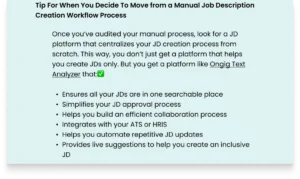
The fundamental solution to most JD approval challenges lies in moving away from manual, fragmented processes towards a centralized, automated system. This paradigm shift leverages technology to create a single source of truth and streamline workflows.
Modern Job Description Management Software, such as Ongig, is designed to address these pain points directly. Such platforms offer:
- Streamlined Workflows: Automated routing ensures JDs move efficiently through predefined stages, minimizing manual hand-offs and delays. Conditional approvals can be set, meaning a JD only proceeds when specific criteria are met or designated individuals have signed off.
- Centralized Feedback & Collaboration: A single platform consolidates all comments, edits, and approvals, eliminating the chaos of scattered feedback. Reviewers can collaborate directly within the document, and changes are tracked transparently.
- Integrated Tool Ecosystem: These systems often integrate seamlessly with Applicant Tracking Systems (ATS) and other HR tools, ensuring data consistency and reducing manual data entry. This means a JD drafted and approved within the platform can be published directly to the ATS without copy-pasting errors or version discrepancies.
- Clear Role-Based Ownership: The software defines clear roles and responsibilities within the approval workflow, ensuring accountability at each stage. This means everyone knows precisely whose turn it is and what actions are required of them.
- Visibility Dashboards & Analytics: Comprehensive dashboards provide real-time visibility into the status of every JD, identifying bottlenecks and average approval times. This data is crucial for continuous process improvement and workload management.
- Robust Version Control & Audit Trails: Every change, comment, and approval is recorded, providing a complete history of the document. This ensures that the latest, approved version is always accessible and that an audit trail exists for compliance purposes. Maria Rodriguez, HR Director at Apex Enterprises, attests, "Implementing a dedicated JD management system was a game-changer. We cut our approval times by half and significantly reduced errors, freeing up our team to focus on strategic talent initiatives."
Transitioning to Efficiency: A Practical Roadmap
Migrating from a chaotic, manual process to an organized, automated workflow requires a structured approach.
- Audit Existing Processes: Begin by mapping out your current JD approval workflow, identifying every step, stakeholder, and tool involved. Pinpoint where delays most frequently occur and where communication breaks down.
- Define Essential Stakeholders and Steps: Based on your audit, strip down the process to its absolute essentials. Determine who must review and approve a JD before it goes live, aiming for a lean, efficient chain (ideally 3-4 core steps). Differentiate between required and optional reviewers.
- Select an Integrated Platform: Invest in job description management software that offers the features necessary for centralization, automation, and visibility. Consider factors like ease of use, integration capabilities, and scalability.
- Phased Rollout and Training: Introduce the new system incrementally, perhaps starting with a pilot team or specific job families. Provide comprehensive training to all stakeholders, emphasizing the benefits of the new workflow and how to use the chosen platform effectively.
- Continuous Optimization: Implement mechanisms to monitor the new process regularly. Use the analytics provided by your software to identify new bottlenecks or areas for further refinement. The goal is not a static solution but an evolving, optimized system.
Tip: Use this Checklist to Get Started with Your Approvals
A clear, shareable checklist can provide immediate clarity and structure, even as you transition to a more automated system.
Step 1: Recruiter Drafts the JD
- Utilize a standardized template.
- Ensure all basic requirements, responsibilities, and qualifications are included.
- Integrate diversity, equity, and inclusion (DEI) best practices in language.
- Include initial salary range research (if applicable and permissible).
Step 2: Hiring Manager Reviews
- Verify alignment with departmental needs and team structure.
- Confirm accuracy of technical requirements and specific duties.
- Provide feedback within the designated centralized platform.
- Approve or request revisions within a set timeframe.
Step 3: Legal/Compliance Review (if required)
- Assess for adherence to all local, state, and federal employment laws (e.g., EEO, pay transparency, accessibility).
- Check for any discriminatory language or misleading statements.
- Approve or request necessary legal amendments via the centralized platform.
Step 4: Final Approval & Publication
- Final approver (e.g., Head of TA, HR Director) gives the ultimate green light.
- The approved JD is published to the ATS and relevant job boards.
- All stakeholders are notified of the JD’s live status.
An efficient JD approval process is no longer a luxury but a fundamental component of a successful talent acquisition strategy. By centralizing operations, automating workflows, and fostering clear communication and accountability, organizations can transform a historically messy process into a powerful engine for attracting and securing the best talent, ensuring compliance, and reinforcing a strong employer brand.