The modern talent acquisition landscape presents an unprecedented challenge: the increasing frequency of candidate reneges after an offer has been accepted but before the start date. This phenomenon, often discovered reactively and after the fact, leaves organizations scrambling to backfill critical roles, incurring significant financial and operational costs. Traditional recruitment processes frequently lack a systematic approach to pre-start candidate engagement, leading to a reactive posture where teams only become aware of a candidate’s wavering commitment once they have already gone silent or formally withdrawn. By this point, the candidate has typically made a definitive decision, rendering most interventions ineffective. The strategic imperative for contemporary organizations is to transition from a reactive stance to a proactive, data-driven methodology that treats engagement signals as leading indicators of potential reneges.
The Escalating Challenge of Candidate Reneges in a Dynamic Talent Market
The competitive nature of today’s job market, amplified by factors such as the "Great Resignation," increased remote work opportunities, and a prevailing candidate-driven environment, has empowered job seekers like never before. Candidates often receive multiple offers, leading to a higher propensity to accept an offer while continuing to explore other options. This fluidity, while beneficial for individual candidates, creates considerable instability for hiring organizations. Industry reports suggest that candidate renege rates can range from 10% to 20% or even higher in certain competitive sectors like technology and healthcare. The financial repercussions of a renege are substantial, encompassing not only the direct costs of restarting the recruitment process—such as advertising, recruiter time, interview panel hours, and administrative overhead—but also the indirect costs associated with delayed project timelines, reduced team productivity, and potential loss of revenue due to vacant positions. Estimates for the cost of a single renege often fall between 30% and 200% of the position’s annual salary, depending on seniority and industry. This economic burden underscores the urgent need for robust pre-start engagement frameworks.
The Shift from Reactive to Proactive: A Strategic Imperative
Historically, the focus of talent acquisition efforts largely concluded once an offer was extended and accepted. The period between offer acceptance and the candidate’s first day was often seen as a passive waiting game. However, this critical window, which can span from a few weeks to several months, is precisely when a candidate’s commitment can waver, influenced by competing offers, personal circumstances, or a simple lack of continued reassurance. A reactive approach, where concerns are only addressed after a candidate has already signaled disengagement, is akin to closing the barn door after the horse has bolted. The solution lies in adopting a proactive, data-centric strategy that continuously monitors candidate engagement and provides structured intervention pathways. This paradigm shift transforms the pre-start period from a passive waiting room into an active, nurturing phase designed to solidify commitment and integrate the candidate into the organizational culture even before their official start.
Introducing the Engagement Health Scorecard: A Data-Driven Solution
At the forefront of this proactive strategy is the implementation of an Engagement Health Scorecard. This systematic framework categorizes candidates into distinct groups based on their observable behaviors and interactions during the crucial pre-start phase, enabling talent acquisition teams to identify and address potential issues before they escalate into full-blown reneges. The scorecard transforms abstract concerns about candidate commitment into quantifiable metrics, providing a clear, actionable roadmap for engagement. By treating specific engagement signals as leading indicators, organizations can move beyond mere intuition and implement targeted, timely interventions.
The core principle of the Engagement Health Scorecard is the continuous monitoring of a candidate’s digital and personal interactions with the organization. This includes tracking email open rates, completion of onboarding tasks, attendance at pre-start events, responses to surveys, and overall responsiveness to communications. These data points, when aggregated and analyzed, provide a comprehensive snapshot of a candidate’s engagement level, allowing for predictive insights into their likelihood of retention.
Categorizing Candidate Engagement: A Tiered Approach
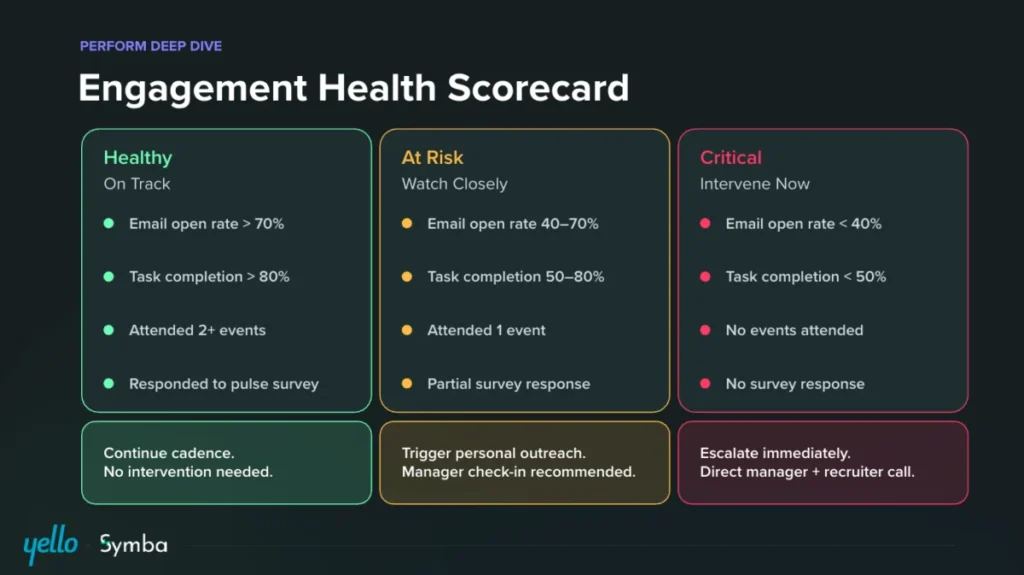
The Engagement Health Scorecard typically segments candidates into three distinct tiers: Healthy, At-Risk, and Critical. Each tier is defined by specific behavioral thresholds and necessitates a corresponding set of prescribed actions, ensuring that interventions are proportionate to the level of disengagement detected.
Healthy Candidates: Sustaining Momentum
Candidates categorized as "Healthy" exhibit robust and consistent engagement. Their behavior during the pre-start period is characterized by high interaction rates: email open rates consistently above 70%, timely completion of any assigned pre-onboarding tasks, active participation in multiple pre-start events (e.g., virtual meet-and-greets, informational webinars), and prompt, comprehensive responses to surveys. These candidates are actively demonstrating enthusiasm and commitment, indicating a strong likelihood of following through with their accepted offer.
For healthy candidates, the recommended action is to "continue the cadence and stay the course." This involves maintaining a consistent, positive communication flow that reinforces their decision and builds excitement for their upcoming role. This could include sending regular, personalized updates about the team or company, sharing relevant articles or news, providing access to pre-onboarding resources, or simply sending periodic check-in messages from the recruiter or hiring manager to maintain rapport. The goal is to sustain their positive momentum, reinforce their sense of belonging, and ensure they feel valued and informed without overwhelming them. Over-communication can be as detrimental as under-communication; therefore, a carefully curated sequence of engagement points is crucial.
At-Risk Candidates: Targeted Intervention
The "At-Risk" category signifies a noticeable decline in a candidate’s engagement, serving as an early warning signal that their commitment may be wavering. Behavioral indicators for this group include email open rates falling within the 40% to 70% range, limited attendance at pre-start events, and incomplete or delayed responses to surveys. While not yet in critical condition, these candidates are showing signs of disengagement that warrant immediate, personalized attention. Ignoring these signals can quickly lead to a further deterioration of commitment.
For at-risk candidates, personal outreach within 48 hours is paramount. This intervention must feel individual and genuine, not like a mass-distributed communication. Effective actions include a direct, personalized message from the program manager, offering a specific invitation to an upcoming event that is tailored to their interests or role, or a brief, informal check-in call from the hiring manager. The purpose of these interventions is multi-faceted: to re-engage the candidate, to subtly probe for any underlying concerns without being intrusive, and to reinforce the value proposition of the role and the organization. Often, a quick, empathetic conversation can address minor uncertainties or logistical questions, turning the situation around swiftly by making the candidate feel heard and valued. It demonstrates that the organization is invested in their success and well-being even before their start date.
Critical Candidates: Immediate Escalation and Resolution
The "Critical" category represents the highest level of disengagement and demands immediate, high-level intervention. These candidates exhibit almost no engagement whatsoever, with email open rates dropping below 40%, complete absence from pre-start events, no responses to surveys, and a general lack of activity or responsiveness over a period of three or more weeks. At this stage, the risk of a renege is extremely high, and the situation requires urgent, direct action from senior stakeholders.
Interventions for critical candidates necessitate immediate escalation. This typically involves a direct phone call from the hiring manager, a personal touchpoint from a senior recruiter or talent acquisition leader, and a frank, empathetic conversation about what might be happening. The objective is to understand the root cause of their disengagement, which often stems from a competing offer, unforeseen personal circumstances, or lingering uncertainties about the role or company culture. By engaging in a real, open dialogue, organizations have a final opportunity to address concerns, re-affirm the value of the opportunity, or even negotiate if a competing offer is the primary issue. Catching these situations in time can often lead to a resolution, preventing the significant costs associated with a renege and a subsequent backfill. It also sends a powerful message about the organization’s commitment to its future employees.
The Economic and Operational Costs of Reneges
The true cost of a candidate renege extends far beyond the immediate financial impact of restarting a search. Operationally, a renege can disrupt project timelines, delay product launches, increase workloads for existing team members, and potentially damage team morale. When a critical role remains unfilled, it can create bottlenecks and hinder strategic initiatives. Moreover, the repeated cycle of recruitment and renege can negatively impact the employer brand, as candidates who have a poor pre-start experience might share their stories, deterring future talent.
A recent study by the Society for Human Resource Management (SHRM) indicated that the average cost-per-hire is approximately $4,129, but this figure can skyrocket for specialized or senior roles. When a renege occurs, these costs are essentially doubled, as the entire process must be repeated. Furthermore, the opportunity cost—the value that the new hire would have brought to the organization—is lost for every day the position remains vacant. Proactive engagement, therefore, is not merely a "nice-to-have" but a critical strategic investment that yields tangible returns in terms of cost savings, operational efficiency, and talent retention.
Beyond the Offer: Nurturing the Pre-Start Relationship
The period between offer acceptance and the first day is a fragile but fertile ground for relationship building. It is an extension of the candidate experience, and how an organization manages this phase significantly influences a candidate’s perception and ultimate decision. Nurturing this relationship involves more than just administrative tasks; it requires a genuine commitment to making the candidate feel welcomed, valued, and integrated. This could include providing access to an internal portal with company culture insights, introducing them to future teammates via virtual coffee chats, or sending welcome kits with company merchandise. These efforts contribute to a positive psychological contract, making it harder for a candidate to renege even if a marginally better offer comes along. The emotional connection forged during this period can often outweigh purely financial considerations.
Expert Perspectives on Talent Retention
Talent acquisition leaders universally acknowledge the growing importance of pre-start engagement. "The difference between teams that retain candidates and teams that scramble to backfill is almost always the same: the first group is looking at data continuously, not just when someone sends a renege email," states a prominent HR technology consultant. "Companies that invest in sophisticated engagement platforms and protocols during the pre-onboarding phase are seeing significantly lower renege rates and higher new-hire retention. It’s about building a continuous relationship, not just closing a deal."
Another industry expert notes, "In a candidate-driven market, the offer letter is no longer the finish line; it’s the starting gun for a new phase of engagement. Candidates are evaluating not just the role and compensation, but also the overall experience and how valued they feel. Organizations that fail to maintain momentum and connection during the pre-start period do so at their own peril." These insights underscore the strategic shift from viewing recruitment as a transactional process to understanding it as a continuous relationship-building endeavor.
Broader Implications for Talent Acquisition and Employer Branding
The successful implementation of an Engagement Health Scorecard and its accompanying intervention playbook has far-reaching implications beyond simply reducing renege rates. It elevates the entire talent acquisition function from a reactive administrative role to a strategic business partner. By leveraging data and proactive engagement, TA teams can:
- Enhance Employer Brand: A thoughtful and engaging pre-start experience reinforces a positive employer brand, making the organization more attractive to future candidates. Word-of-mouth and online reviews from new hires who felt well-supported can be powerful recruitment tools.
- Improve Candidate Experience: A structured engagement process ensures that every candidate feels valued and informed, leading to a superior overall candidate experience, even for those who ultimately don’t join.
- Optimize Resource Allocation: By identifying at-risk candidates early, TA teams can allocate resources more effectively, focusing intense intervention on those who need it most, rather than wasting efforts on already-lost causes or over-communicating with fully committed individuals.
- Boost New Hire Productivity: Candidates who feel engaged and supported before their start date are more likely to hit the ground running, integrate quickly into their teams, and achieve higher levels of productivity sooner. This smooth transition reduces the time-to-productivity, offering further ROI.
- Foster a Culture of Data-Driven Decision Making: Implementing such a scorecard encourages a data-driven approach throughout the HR function, promoting continuous improvement and strategic planning based on tangible metrics.
The Future of Candidate Engagement: Continuous Improvement
The principles underpinning the Engagement Health Scorecard are not static; they represent a commitment to continuous improvement. Post-cycle review templates, as suggested by resources like "The KEEP Playbook," are integral to refining the process. By analyzing renege incidents, identifying patterns, and soliciting feedback from candidates and hiring managers, organizations can iteratively enhance their engagement strategies. This iterative learning process allows thresholds to be adjusted, intervention methods to be refined, and the overall candidate journey to be optimized with every recruitment program. The goal is to create a dynamic, responsive system that adapts to evolving market conditions and candidate expectations.
In conclusion, the era of passive pre-start candidate management is over. In today’s highly competitive talent market, a proactive, data-driven approach to candidate engagement is not merely an advantage but a necessity. By implementing an Engagement Health Scorecard and adopting a systematic intervention playbook, organizations can significantly reduce renege rates, mitigate substantial financial and operational risks, enhance their employer brand, and ultimately secure the talent critical for their success. The focus on continuous data analysis and personalized engagement during the pre-start period marks a fundamental paradigm shift in how leading organizations attract, secure, and retain their most valuable asset: their people.