In the fiercely competitive landscape of modern talent acquisition, the silent but significant challenge of candidate reneges – when an accepted offer is rescinded by the candidate before their start date – represents a critical vulnerability for organizations. Many talent acquisition programs historically operate without a robust, proactive process to address this issue, often discovering a candidate’s withdrawal only after the decision has been irrevocably made. By the time a promising hire goes quiet, their mind is frequently already set, leaving recruiting teams scrambling to backfill roles and facing substantial operational disruptions and financial costs. The contemporary solution lies in a paradigm shift: treating engagement signals as predictive, leading indicators of a candidate’s commitment and satisfaction during the crucial pre-start period.
This proactive methodology, often encapsulated in an Engagement Health Scorecard, categorizes candidates into distinct groups based on their behavior, allowing for timely, tailored interventions. This analytical approach moves beyond mere tracking of offer acceptances to a sophisticated monitoring of a candidate’s journey from offer to onboarding, transforming a reactive scramble into a strategic retention effort. The efficacy of such a system is underscored by the stark contrast between organizations that consistently retain talent and those perpetually caught in backfill crises; the former are characterized by continuous data analysis, not just post-mortem reactions to a renege email.
The Evolving Talent Landscape: A Context of Volatility and Competition
The global talent market has undergone profound transformations in recent years, characterized by unprecedented demand for skilled professionals, evolving candidate expectations, and the persistent challenge of talent shortages across numerous sectors. Phenomena such as the "Great Resignation" or "Great Reassessment" have amplified candidate power, leading to situations where individuals often entertain multiple offers simultaneously, even after accepting one. Industry reports consistently highlight that the average candidate applies to numerous positions and often receives several offers, making the period between offer acceptance and actual start date a high-risk window for employers. Studies from LinkedIn and other talent platforms indicate that a significant percentage of candidates remain open to other opportunities even after accepting a job, with renege rates varying by industry but consistently posing a threat to hiring plans. Some estimates suggest renege rates can be as high as 10-20% in certain highly competitive fields like technology and finance, representing a substantial drain on resources.
This volatile environment necessitates a shift from traditional, linear recruitment models to more dynamic, engagement-centric approaches. Companies can no longer afford to view offer acceptance as the finish line; it is merely a critical milestone in a continued journey of candidate nurturing. The background context for implementing a robust engagement strategy is therefore rooted in economic realities, market competitiveness, and the evolving psychology of the modern job seeker, who values transparency, communication, and a clear sense of belonging even before their first day.
The Silent Threat: Understanding Candidate Renunciation and Its Costs
Candidate reneging, while often perceived as an individual act, has far-reaching implications for an organization. The immediate impact is the creation of a vacant position, necessitating a restart of the recruitment process. This restart incurs direct costs associated with job postings, recruiter time, interview panel time, and potentially agency fees if external recruiters are involved. Beyond these direct financial outlays, there are significant indirect costs. These include lost productivity due to the delayed hiring of a critical team member, potential strain on existing team members who must absorb additional workload, and the opportunity cost of missed projects or delayed initiatives.
Estimates from various HR analytics firms suggest that the cost of replacing an employee can range from 30% to 150% of their annual salary, depending on the role’s seniority and specialization. When an offer is reneged, a substantial portion of this cost is incurred without the benefit of the employee ever contributing to the organization. For a mid-level professional earning $80,000 annually, a renege could effectively cost the company tens of thousands of dollars in wasted recruitment efforts and lost productivity. Furthermore, a high renege rate can damage an organization’s employer brand, signaling potential issues within the recruitment process or the company culture, which can deter future candidates. This negative perception can propagate through professional networks and online review platforms, creating a self-reinforcing cycle of recruitment challenges. The root causes of reneges are multifaceted, ranging from competing offers (often with higher compensation or better benefits), personal circumstances (relocation issues, family needs), to simple uncertainty or a lack of connection with the hiring team or company culture during the pre-start phase. Identifying and addressing these root causes in a timely manner is paramount.
Pioneering a Proactive Approach: The Engagement Health Scorecard
Recognizing the escalating risks and costs associated with candidate reneges, progressive talent acquisition departments are adopting proactive, data-driven methodologies to maintain candidate engagement. At the forefront of this shift is the implementation of an Engagement Health Scorecard, a systematic framework designed to monitor and interpret candidate behavior during the critical period between offer acceptance and the first day of employment. This scorecard transforms nebulous observations into quantifiable metrics, enabling recruitment teams to identify potential issues before they escalate into full-blown reneges.
The core principle behind the Engagement Health Scorecard is the treatment of various candidate interactions as "leading indicators" of their intent and commitment. Instead of waiting for a candidate to go silent or, worse, to formally withdraw, the system provides an early warning mechanism. It leverages readily available data points, such as email open rates, completion of pre-boarding tasks, attendance at company events (virtual or in-person), and responses to surveys, to construct a real-time snapshot of a candidate’s engagement level. This analytical framework allows for the categorization of candidates into distinct health tiers, each correlating with a specific level of risk and mandating a predefined set of intervention strategies. The implementation of such a scorecard is a testament to the increasing sophistication of HR technology and the strategic imperative for talent acquisition to leverage data science to optimize outcomes.
Decoding Engagement Signals: The Three Tiers of Candidate Health
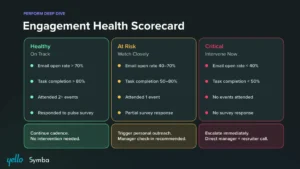
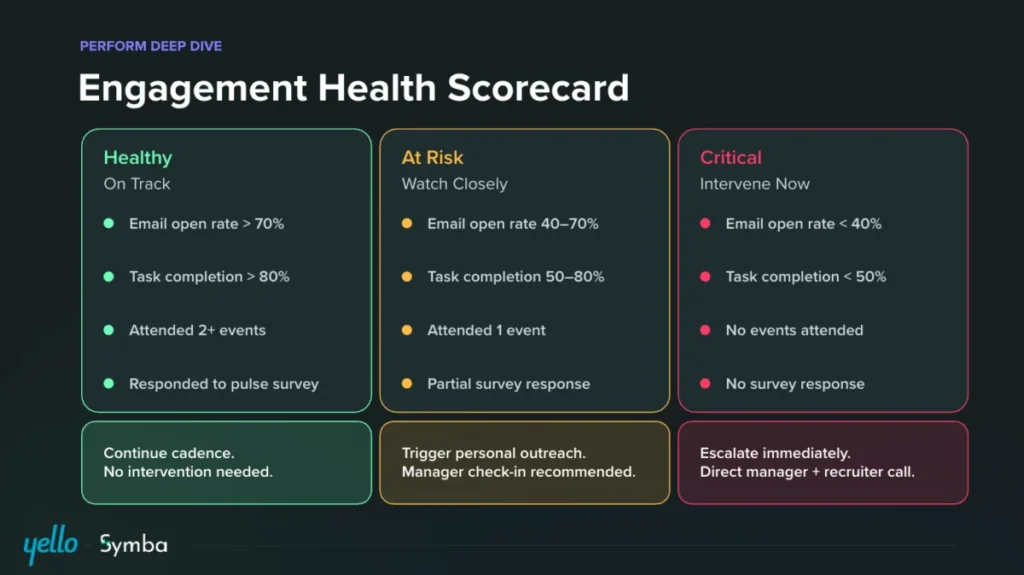
The Engagement Health Scorecard typically categorizes candidates into three primary groups: Healthy, At-Risk, and Critical. Each tier is defined by specific behavioral thresholds and necessitates a distinct course of action, ensuring that resources are allocated efficiently and interventions are timely and appropriate.
Healthy Candidates: Sustaining Momentum
Healthy candidates represent the ideal scenario, exhibiting consistent and enthusiastic engagement throughout the pre-start period. Their behavior is characterized by high levels of interaction with company communications and a proactive approach to pre-boarding activities. Specifically, healthy candidates typically demonstrate email open rates exceeding 70%, promptly complete assigned pre-boarding tasks (such as background checks, paperwork, or IT setup forms), attend multiple introductory events (e.g., virtual coffee chats, team meet-and-greets, company webinars), and provide thoughtful responses to pre-start surveys.
For these candidates, the appropriate strategy is to maintain the established communication cadence and "stay the course." This involves continuing to provide valuable content, sending welcoming communications, sharing company news, and offering opportunities for further engagement without overwhelming them. The goal is to reinforce their positive decision, build excitement for their upcoming start, and ensure they feel continuously valued and connected. Regular, but not excessive, communication from the recruiter, hiring manager, or future teammates helps solidify their commitment. This sustained engagement ensures that their initial enthusiasm translates into a successful transition into the company culture. The psychological rationale here is to prevent any potential "buyer’s remorse" by continuously validating their decision and building anticipation for their start date.
At-Risk Candidates: Targeted Intervention
The "At-Risk" category signals a concerning but often reversible decline in candidate engagement. These candidates exhibit behaviors that suggest a potential wavering in their commitment, indicating they might be exploring other options or encountering unforeseen issues. Behavioral indicators for at-risk candidates typically include email open rates falling between 40% and 70%, limited attendance at optional events, and incomplete or delayed responses to surveys or pre-boarding tasks. They might also show a general decrease in responsiveness or a lack of proactive communication.
Upon identifying an at-risk candidate, immediate and personalized outreach is critical, ideally within 48 hours of detecting the declining engagement. This intervention should be distinctly different from mass-distributed communications. A direct, personal message from the program manager, expressing genuine interest and offering support, can be highly effective. This might be followed by a tailored invitation to an upcoming event, specifically chosen to resonate with their interests or role, making them feel individually recognized rather than part of a generic mailing list. Crucially, a proactive check-in from the hiring manager can often be the most impactful intervention. This direct conversation allows the hiring manager to reiterate their excitement, address any latent concerns, and reinforce the value the candidate will bring to the team. Often, a brief, sincere conversation can quickly turn things around, addressing minor hesitations or clarifying misunderstandings before they escalate. The aim is to re-establish a personal connection and uncover any emerging concerns that might not be openly articulated.
Critical Candidates: Immediate Escalation and Root Cause Analysis
Critical candidates represent the highest level of risk, exhibiting almost no discernible engagement. This tier demands immediate and high-level intervention, as the likelihood of a renege is significantly elevated. Characteristic behaviors include email open rates consistently below 40%, complete non-attendance at any pre-start events, no responses to surveys, and a prolonged period of inactivity—typically three or more weeks—across all communication channels. At this stage, passive monitoring is no longer sufficient; direct and decisive action is required.
The intervention for critical candidates must involve immediate escalation to senior stakeholders. A direct phone call from the hiring manager is often the most effective first step. This personal touchpoint, coming from the future direct leader, carries significant weight and demonstrates the company’s commitment. Following this, a personal outreach from the recruiter is essential, not just to reiterate previous messages but to engage in a genuine conversation aimed at uncovering the root cause of the disengagement. This conversation should be empathetic, open-ended, and focused on understanding "what’s going on" rather than simply pushing for compliance. Common root causes at this stage include the candidate receiving a compelling competing offer (often with a better salary, benefits, or role scope), encountering significant personal circumstances (e.g., family illness, relocation challenges, visa issues), or experiencing deep-seated uncertainty about the role or company. Catching these issues in time allows the organization to potentially address them—whether through a counter-offer, flexibility with start dates, connecting them with support resources, or simply providing reassurance and clarity. The goal is to move beyond superficial interactions to a real dialogue that can either salvage the hire or provide critical insights for future recruitment strategies.
The Operational Blueprint: Implementing the Scorecard
Implementing an Engagement Health Scorecard requires more than just defining tiers; it demands a robust operational blueprint. This includes integrating data from various HR systems (Applicant Tracking Systems, HRIS, CRM), establishing clear protocols for data collection and analysis, and defining the roles and responsibilities of different stakeholders. Recruitment teams need access to user-friendly dashboards that visualize candidate engagement data in real-time. Automation tools can flag candidates moving into "At-Risk" or "Critical" categories, triggering alerts for recruiters and hiring managers.
Collaboration across departments is key. Recruiters, hiring managers, and HR business partners must work in concert, understanding their specific roles in the intervention process. Training is essential to ensure that all parties understand how to interpret the scorecard, what actions to take, and how to communicate effectively and empathetically with candidates at different engagement levels. Furthermore, the scorecard should not be static; it requires continuous review and refinement based on post-cycle analysis. A template for post-cycle review, as suggested by resources like "The KEEP Playbook," allows organizations to learn from each recruitment program, adjusting thresholds, refining intervention strategies, and improving overall candidate retention over time. This iterative process ensures the scorecard remains a dynamic and effective tool in an ever-changing talent market.
Beyond the Scorecard: Broader Implications for Talent Strategy
The adoption of an Engagement Health Scorecard extends beyond merely preventing reneges; it signifies a broader strategic evolution in talent acquisition and management. Firstly, it reinforces the critical importance of candidate experience. A well-executed engagement strategy ensures candidates feel valued, informed, and connected, fostering a positive perception of the employer brand. This positive experience can lead to future referrals and a stronger talent pipeline, even for candidates who ultimately do not join the organization.
Secondly, it underscores the strategic value of data-driven HR. By leveraging analytics to predict and mitigate risks, talent acquisition moves from an administrative function to a strategic business partner, directly impacting organizational productivity and financial health. The insights gained from engagement data can inform improvements across the entire recruitment funnel, from job description optimization to interview processes and compensation strategies.
Finally, a proactive engagement model fosters a culture of continuous communication and support, which is vital for long-term employee retention. The habits of engagement built during the pre-start phase can seamlessly transition into effective onboarding programs and ongoing employee development initiatives. Organizations that prioritize early engagement are more likely to create a workforce that feels connected, supported, and committed, ultimately enhancing overall organizational resilience and competitive advantage in the global talent marketplace. The future of talent acquisition is undeniably rooted in predictive analytics, personalized experiences, and continuous engagement, with tools like the Engagement Health Scorecard serving as foundational elements for this strategic imperative.